
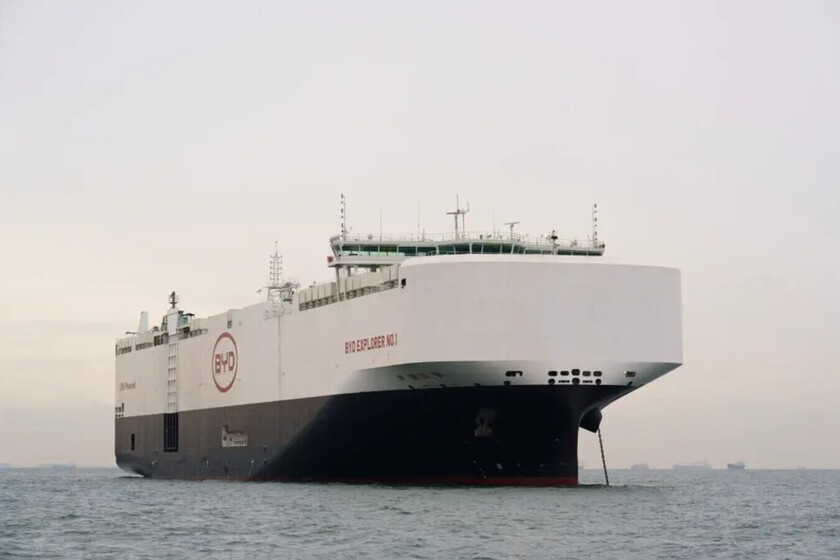
Since the end of 2023, crossing the Red Sea and the Suez Canal has become a risk that many shipping lines are not willing to take. The Yemen-based Houthi militia, backed by Iran, has attacked and sunk merchant ships in retaliation against targets linked directly or indirectly to Israel, forcing thousands of sea routes to divert toward the Cape of Good Hope.
Among the most notable consequences are delays in deliveries and multi-million-dollar overruns. However, since last summer, a very specific type of vessel has begun to traverse the area without problems: those that only transport Chinese cars. Not a single attack, kidnapping, or incident. And that, in this context, does not seem accidental.
The Red Sea, a shortcut worth millions
The savings from crossing the Suez Canal instead of sailing around Africa are colossal: 14 to 18 days less sailing and several hundred dollars less per car transported. If a ship can carry 5,000 vehicles, that means millions of dollars in difference per voyage, in addition to lower emissions and less wear on the fleet.
It is no surprise that for manufacturers such as BYD or SAIC Motor, reclaiming this route is a priority. According to Lloyd’s List Intelligence, only in June and July 2025 at least 14 car-carrying vessels departed China for Europe via the Red Sea, all loaded with Chinese-made cars. In the same period, other shipping lines from Japan, Korea or Europe had to avoid the area.
In July 2026, the leak revealed the Houthis’ intention to charge transit duties on commercial ships wishing to pass through the Bab el-Mandeb strait.
Neither China, nor Iran, nor the Houthis have confirmed an agreement, but the facts are there. Iran sells almost all of its oil to China, and that commercial relationship accounts for around 6% of Iran’s economy. In return, Beijing wields an influence in the region that is hard to match. Even more so in a complex scenario with the Iran–US and Israel conflict that seems unlikely to have a quick end.
Analysts such as Daniel Nash (Veson Nautical) pointed out that the rebels could have received instructions not to attack ships carrying Chinese automobiles. Even vessels owned by non-Chinese parties but loading cars manufactured in China have passed without incidents, while other Chinese-owned ships that do not transport cars continue to avoid the area.
Competition fierce in Europe

Chinese cars accounted for almost 6.1% of sales in Europe (more than 800,000 units), double the level a year earlier. S&P Global estimates they could reach 10% by 2034. The European Union responded by imposing tariffs of up to 35.3% on vehicles that receive government subsidies in China, forcing manufacturers to search for ways to keep prices competitive while planning to open factories on European soil.
Restoring the Red Sea route is one of them. The logistical savings can help offset part of the tariff impact and bolster the commercial offensive against Japanese, Korean and European brands, which continue to bear the cost of the detour via Africa.
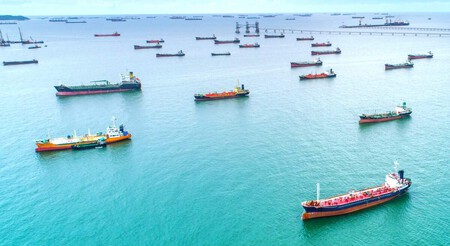
The contrast is evident. In recent years, manufacturers such as Tesla, Volvo, Suzuki or Michelin have suffered shutdowns and delays in Europe due to disruptions in the logistics chain stemming from insecurity in the Red Sea. Some plants have halted production for days or weeks.
Meanwhile, Chinese shipyards are delivering to BYD and SAIC some of the largest Ro-Ro ships in the world, designed to cross precisely this route. They are true floating cities with a dozen decks and capacity for 5,000 cars at minimum, valued at more than $100 million per voyage.
In the worst-case scenario, Chinese ships are sometimes escorted by vessels from the Chinese navy to save days of travel.
Find your ideal electric car
If you have thought about buying an electric car, this will interest you. We have created the personalized electric car recommender in which, in addition to seeing models that fit your needs, you will also find answers to the questions that usually worry you most, such as price, range, or nearby charging points.
Images | BYD, Unsplash, Peugeot