
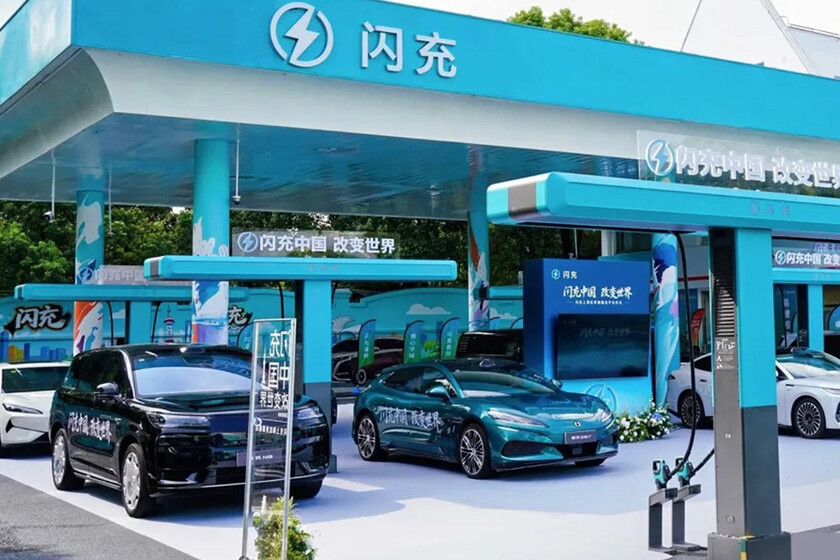
China is increasingly leading the electric car race, not only thanks to its models that strike an excellent balance between technology and price, but also due to its charging infrastructure. A prime example is that the country’s largest oil company, the Chinese equivalent of Repsol, has begun remodeling its gas stations into electric charging hubs.
We are not talking about placing charging points next to the petrol and diesel pumps, but about transforming them into ultra-fast chargers of 1,500 kW. Specifically, these are BYD chargers, part of the Chinese firm’s plan to build a network of 20,000 such stations by the end of 2026, which outpaces Tesla’s most powerful Superchargers.
Pumps That Are No Longer Pumps, Powered by Blade Batteries
The first of these stations is, unsurprisingly, in Shanghai. It is the result of the BYD–Sinopec alliance. What the oil company has done, together with the world’s largest maker of electric cars, is redesign it completely. In the former pumps it has installed BYD’s T-shaped chargers, each with two charging points. In total there are 12 charging points for electric vehicles and none for internal-combustion cars: hoses are a thing of the past.
These connectors are megafast chargers, with power levels that no electric charging post had reached: 1,500 kW. Up to now, the most powerful were Tesla’s V4 500 kW Superchargers. And they are not many: in March 2026, Elon Musk’s brand had opened four stations equipped with the new Superchargers in the United States. In June it did the same in Europe, inaugurating 28 V4 points in Norway, becoming the only ones of the Old Continent.

Returning to the Sinopec station, the 12 chargers of such power would require a substation at the gas station. To speed up the process and avoid having to remodel the electrical supply, they have equipped the old fuel tanks with Blade LFP batteries. Each of the T-shaped dispensers is powered by four of these batteries, with a capacity of 169 to 185 kWh, according to Electrek. By being independent from the grid, these chargers could remain operational during a blackout.
Almost the Same Time as Refueling a Gasoline Car, Redefining Service Stations
The resemblance to a conventional gas station goes beyond merely replacing the old pumps. The charging times advertised at these charging points are mere minutes: they can go from 10 to 70% in five minutes and to almost 100% in nine minutes. In cold conditions, charging would run around 12 minutes. In BYD’s electrolineras tests, speeds of up to 1,360 kW were observed, delivering about 400 km of range in five minutes. In effect, almost as long as it takes a gasoline car to refuel.
Note that the BYD cars capable of handling such power are those equipped with the ‘Flash Charge’ system, able to accept more than 1,000 kW. For now, most are high-end models such as the Tang 9, Seal 07, Song Ultra, or the formidable Denza Z9 GT with nearly 1,000 horsepower.
This is not the only change at the service station. While the shop remains open, it is a self-service ‘Easy Joy’ store with no staff, operating 24 hours a day. Restrooms are available as well. They have also added a resting area with recliners, so drivers can wait for their car’s battery to charge instead of sitting inside the vehicle.
Traditional Gas Stations Turned into Electrolines
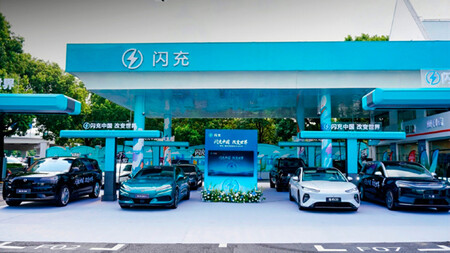
This future-facing charging station in the present is the first born from the agreement between Sinopec and BYD. Their partnership was announced in early June, with a pledge to roll out a charging network with integrated services. And it forms part of BYD’s strategy for its new Tesla-style charging network in the People’s Republic.
BYD stated in March that its aim is to deploy 20,000 of these T-shaped charging points by the end of this year, a figure that has grown as it has added partners, such as XiaoJu Charging. But now a gas company has also joined this charging-infrastructure plan. By the end of May, BYD had already conceived more than 6,100.
This marks a turning point, or at least lays the first stone, in a paradigm shift toward the electric car: that traditional gas stations begin to turn into electrolines. For Sinopec this is about staying one step ahead, toward a future in which service stations will lose relevance if most cars are electric. Sinopec operates 30,000 gas stations in China, but it had already entered the electric business with 14,000 charging and battery-swapping stations.
Find Your Ideal Electric Car
If you’ve been considering buying an electric car, this will interest you. We have created a personalized Electric Car Recommender in which, in addition to seeing models that fit your needs, you will also get answers to questions that may worry you most, such as price, range, or nearby charging points.

Are you seeking your next electric car and feeling overwhelmed by so many options? It’s normal.
More than 45,000 readers have already tried it. And you?
Advice offered by the brand