
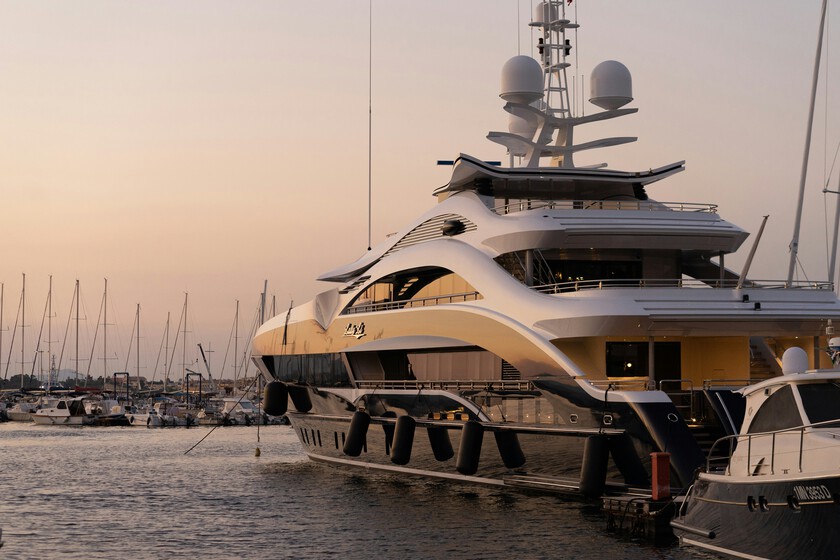
In recent years, the gentrification of the car on a global scale has become increasingly evident, though some cases are more conspicuous than others, such as Singapore: where luxury isn’t owning a supercar, but a decent second‑hand car. The sea is undergoing a similar transformation, but at breakneck speed. Spain is a telling example of this.
Social boating, the pastime of the weekend enthusiast who owns a small vessel to sail on Saturdays and Sundays, is gradually disappearing from our ports, devoured by large yachts. Primarily, because mooring prices have soared to the point of becoming a luxury product reserved for a very few.
The protests of shipowners in ports such as Cartagena, Valencia, Ibiza or Carboneras prove it: mooring a modest craft can today cost more than the boat’s own value. In Ibiza, for instance, a mooring for a 9‑meter boat has risen from €7,300 to €25,700 per year, according to La Gaceta Náutica.
“The pressure on real estate along the coast has finally confirmed the gap. With the massive renewal of concessions at marinas in the Balearics and the Costa del Sol, the new terms require investments in luxury infrastructures that modest boating businesses cannot offset, causing mooring fee increases of over 20% for boats under 10 meters in length.”
The gentrification of the sea: when harbors become resorts
Gentrification has reached the docks, and little by little we are seeing marinas transform into luxury complexes with restaurants, exclusive lounges, and premium services, while the basic spaces the average navigator needs are disappearing.
“There will only be space left for those who own luxury boats,” sums up Enrique Rey, partner of a sailing school on the Mar Menor, in an interview with El Confidencial. According to him, an ordinary sailing enthusiast would only need a fence to protect his boat and a hose to rinse it down. But that model does not exist in Spain: here the standard is already a luxury marina.

The problem isn’t only about prices; it’s also about availability. Rafael Velasco, naval engineer and consultant, recalls in the same interview that “the growth of coastal populations has driven up interest in boating, but the supply of moorings hasn’t grown at the same pace, and in many locations it can’t grow any further.” The consequence is endless waiting lists at public ports and prohibitive rates at private ones.
The imbalance is especially severe in the Balearics, where tourism pressure and the arrival of foreign boat owners, aided by the “freedom of flag” since 2010, have multiplied demand. Many local residents with modest boats find themselves with few options today.
The traditional sailing club model in Spain, on shaky ground
Historically, nautical clubs have been non-profit entities aimed at promoting sailing and sea sports. But the reality is that many have become a model of exclusive services for high‑income members.
The president of the Royal Spanish Sailing Federation, Joaquín González Devesa, acknowledges that there are clubs that do not meet their social and sporting objectives: “They should be required to submit an annual sporting project and reinvest part of their income in promoting federated sailing.” Meanwhile, the figures speak for themselves: sailing licenses in Spain have fallen from about 50,000 before the crisis to fewer than 20,000 in 2024.
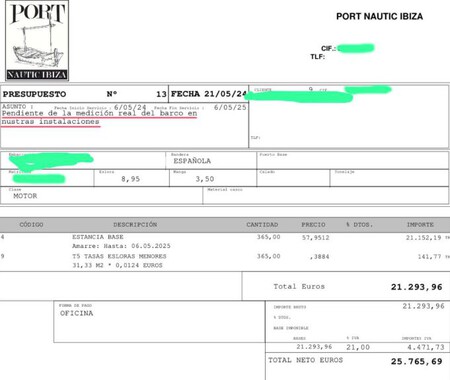
Budget of Port Nàutic Ibiza for a motorboat of 8.95 meters in length. Source: La Gaceta Náutica
The big question is what we mean by “social boating.” For the Balearic Government this reaches up to 12-metre boats. For the Port Authority, only up to 8. And for many boat owners, it should simply mean that any resident can have access to navigating without mortgaging themselves.
As Antonio Estades, president of the Association of Nautical Clubs of the Balearic Islands, warns, “If this becomes widespread, most residents who currently own a boat will have nowhere to dock it. It will be a disaster for boating.” The sea, always seen as a space of freedom, risks becoming a luxury: there will only be room for the boats of the wealthiest.
“Given the physical and financial impossibility of securing a mooring through ownership or long-term rental, the nautical sector in Spain has massively pivoted toward subscription navigation clubs, a model where the user pays a monthly fee to use different vessels without assuming fixed costs or the endless port waiting list.”
Images | Gacetanautica.es, Unsplash