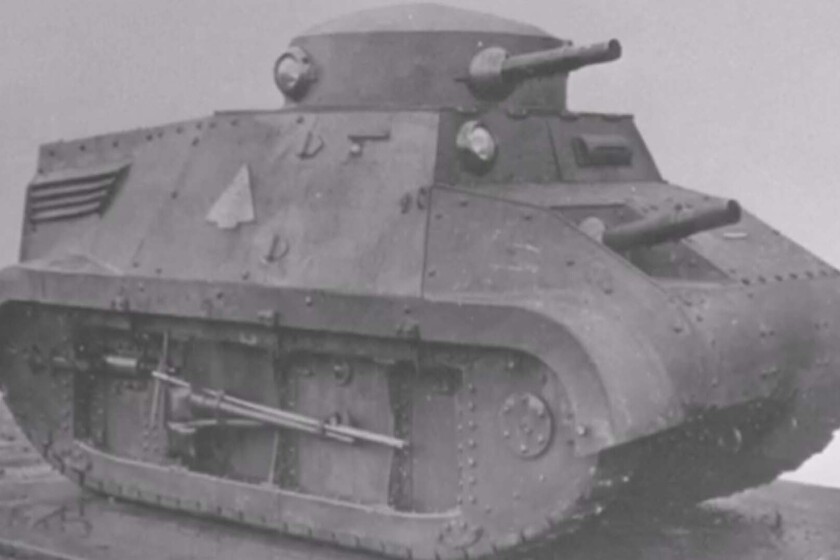
In the second half of the 1930s, the Trubia Arms Factory in Asturias was working on an evolution of Spain’s first tanks, military vehicles that had appeared at the end of the 1920s and, by then, had fallen behind, such as the Trubia A4 of 1926 and the Trubia Modelo 75 HP.
The improved battle vehicle being developed in Asturias was the Trubia Modelo 1936, but then the Spanish Civil War broke out and interrupted its development. By necessity, it had to begin production and ended up being a military failure.
There was a need to end dependence on foreign main battle tanks
There are events that permanently change history, and the Spanish Civil War was one of them. Among many things, this conflict directly affected the development of a Spanish battle tank that was destined to revolutionize the international military industry: the Trubia Modelo 1936.
Thanks to the Civil War, the Verdeja became the best Spanish battle tank before World War II, but this armored vehicle would not have achieved success without the failure of another Spanish tank: the Trubia Modelo 1936.
The Asturian company Trubia Arms Factory was developing it before the outbreak of the Spanish Civil War, and the conflict truncated its refinement and accelerated its deployment: despite not being ready to enter combat, necessity forced its production and use. It ended up being a failure, but helped to understand what worked and what needed to be improved to apply to the Verdeja.
But, why was the Trubia Modelo 1936 a failure? To begin with, one must understand that this tank was the first serious attempt to create a national tank industry. After the Rif War, the Spanish Army realized that it needed modern armored vehicles and that it should not rely on French tanks, as had happened until then with models like the Renault FT.
The engineers at the Trubia Arms Factory were determined to prove that Spain could be self-sufficient in this industry and, beyond designing tanks, could manufacture them without assistance from any other country.
Thus began the development of the Trubia Modelo 1936, but the Civil War stalled it and the project was transferred to the Sociedad Española de Construcción Naval de Sestao (Vizcaya) to be built immediately in its unfinished state. The war was needed for the conflict, regardless of its state, so the engineers at ‘La Naval’ rapidly adapted their design to be manufactured with their resources, which were limited precisely because of the fighting.
View this post on Instagram
Nolan Kessler
I focus on performance-driven cars, emerging technologies, and the business forces shaping the automotive industry. My work aims to deliver clear, relevant insights without unnecessary noise, with a strong attention to detail and accuracy. I follow the evolution of mobility daily, with a particular interest in what defines the next generation of driving.