
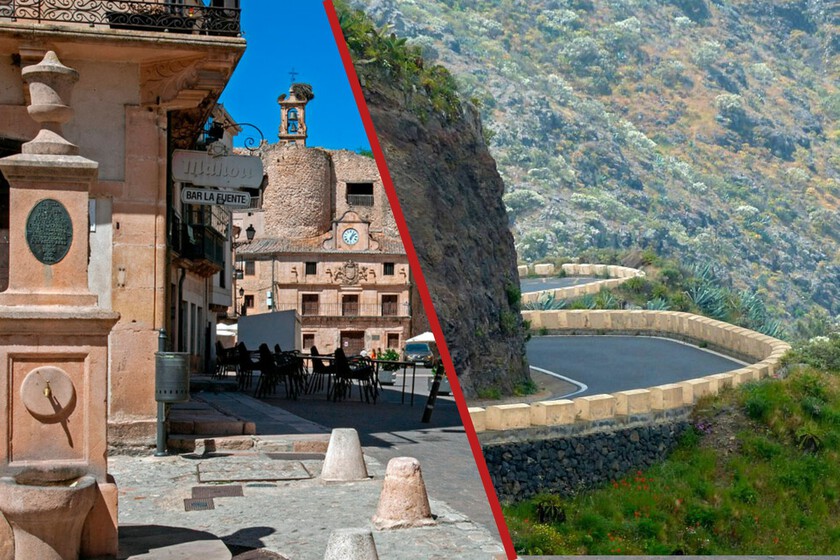
Secondary roads, curves framed by a Castilian landscape that seems frozen in time, a medieval village perched on a hill and a wood-fired oven waiting for us at the end of the road. In Segovia there is a superb route for a weekend getaway: a journey to Sepúlveda, which pairs the pleasure of driving through the Segovian highlands with visiting one of the province’s historic towns.
Medieval fortresses, Romanesque churches, excellent restaurants to savor roasted lamb, and a unique natural setting with the Hoces del Río Duratón on the menu. A voyage that blends history, nature, gastronomy, and miles of driving pleasure.
The Route: From Somosierra to Sepúlveda Through Curves, Pine Forests, and the Duratón Vultures
Starting the route, the usual way to reach Sepúlveda is from the Somosierra pass on the A-1. Leaving the highway will lead us to a succession of secondary roads that dive straight into the Sierra del Ayllón, full of demanding curves, rapid sequence changes, and shifting panoramas.
The exit from the A-1 is Santo Tomé del Puerto, which takes us to the road SG-911 and then SG-232. Thus we enter a slower-paced journey, among pines, small mountain passes or serrano villages and hamlets. Both roads wind between slopes or stretch out in long straight segments framed by the Segovian fields.

Panoramic view of Sepúlveda
On this leg, the spotlight is on the surroundings of the Parc Natural de las Hoces del Río Duratón. In fact, before arriving at Sepúlveda, it’s worth taking a small detour along SG-V-2323, a road that serves as a perfect balcony over the park. It runs between calcareous cliffs, canyons carved by the river, and it is also an area where we can find one of Europe’s largest griffon vulture colonies. It’s just a few extra kilometers, about 10 or 15 minutes.
What to See and Eat in Sepúlveda: a Medieval Journey with Lamb as the Prize
Sepúlveda is a plateau town that concentrates centuries of history in a handful of streets. Situated high on a hill almost surrounded by the Caslilla River, its location is a hallmark of its history: in the Middle Ages it enjoyed a privileged natural defense, being a central site in the Reconquest. Its old town, still preserved, was declared a historic complex in the 1950s.
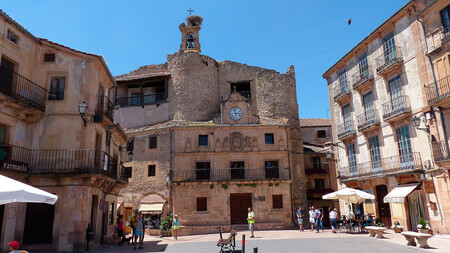
Castle of Sepúlveda
The main reference is the Castle of Sepúlveda, or Fernán González’s castle, in the Plaza Mayor. It began as a Roman fortress, later a Moorish alcazaba, and the final building was erected after the reconquest of the town, commissioned by Count Fernán González in the 10th century. The towers and stretches of the curtain walls are preserved, as well as part of the structure, making it one of the oldest fortresses in Segovia and a reminder of the town’s defensive legacy.
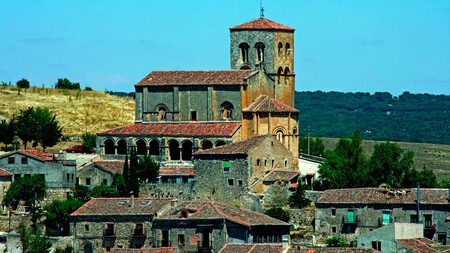
Church of El Salvador
To its heritage are added six Romanesque churches, the other treasures of Sepúlveda. The oldest is the Church of Santiago, dating to the eleventh century. And the most famous is the Church of El Salvador, also in the Plaza Mayor and dating to the twelfth century: its lateral portal with sculpted capitalsis one of the best examples of Segovian Romanesque, austere yet rich in artisanal details. Beyond these monuments, wandering through its cobbled medieval streets or approaching the viewpoints of the Hoces del Duratón round off a visit worthy of a trip back in time.
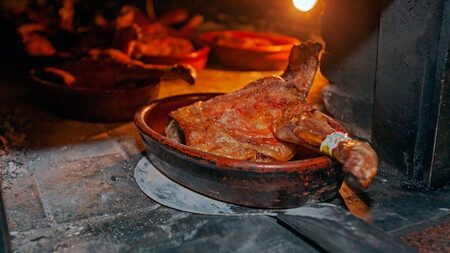
Yet the true finale is culinary. Sepúlveda’s grand specialty is roasted suckling lamb in a wood-fired oven, rivaling that of Pedraza, another emblematic Segovian village. Sepúlveda favors the Churra breed, fed on high-altitude pastures, slowly cooked over oak embers crackling with fire. This delicacy is served in restaurants such as El Figón de Tinín, the best known, as well as Casa Román. Although, in general, there are several spots to savor this “cathedral of lamb.”
Images | Turismo de Castilla y León