
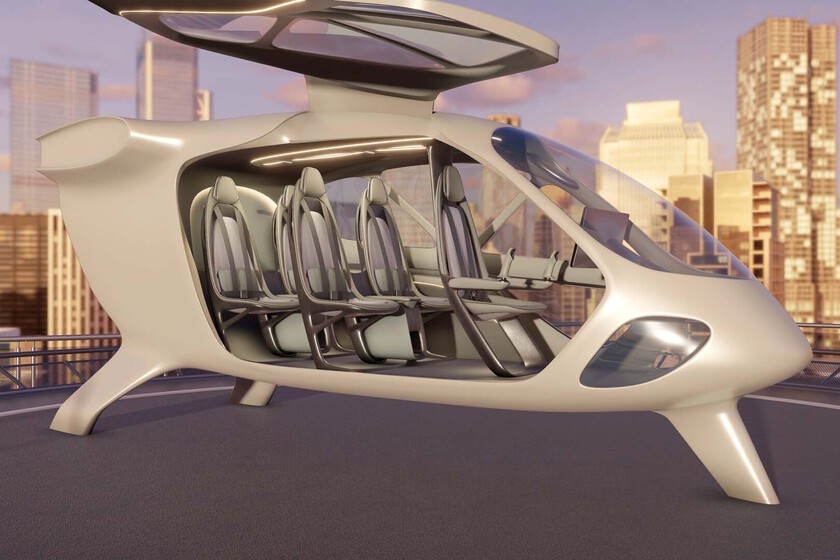
For years, the eVTOLL aircraft seemed more like something out of science fiction than part of the real world, but these electric vertical take-off and landing vehicles are increasingly gaining ground.
China has set out to master this industry on the international stage, and the truth is that the country at the forefront of the sector owes part of its progress to government efforts.
An Emerging Sector Taking It Seriously
By now, no one misses the fact that China was sharper than Europe, America, and Japan with the electric car. Two decades ago, when the first Chinese cars appeared, no one in the West took them seriously; we simply viewed them as a curiosity while we bet almost everything on diesel.
Now, brands like BYD, XPeng or Geely compete toe-to-toe with traditional manufacturers thanks to the electric car. On top of that, China dominates a large part of the worldwide battery supply chain.

In a very quick recap, we can say we didn’t see it coming: neither that the electric car would be the future nor that China would gain so much weight in the global automotive industry thanks to electrification.
Well, China isn’t content with that, and its plans involve repeating the strategy in another sector, the eVTOLs, which is the English acronym for “electric Vertical Take-Off and Landing”, i.e., electric aircraft capable of vertical take-off and landing.
Today these vehicles have no real significance; in fact, they are only in pre-commercialization phase, but they aim to transform how we move in big cities and in interurban short- and medium-distance travels.
Before this market becomes mass-market, indeed before it even exists as such, China aims to dominate it, not only by selling these vehicles, but by leading, from today, the industry that could grow around it to seize the market for batteries, motors, software, navigation systems, charging infrastructure and even aerial mobility services.
The work the Chinese government is doing is crucial to achieve this because it has been promoting test zones, infrastructure, domestic manufacturing, air corridors, commercial operations and the specific regulation needed for eVTOLs to become a reality. The so-called Low Altitude Economy (low-altitude economy), which is this industry, is already a national strategic priority
That implies billions in investment in a technology that, for now, almost no one uses, but it is a bet for the future, just as the electric car was in its day.
So much so that China is the only country in the world where passenger-certified eVTOL operations exist; they are very limited, but they are a reality. In the United States, Europe and Japan, these vehicles are still in certification processes, flight tests and demonstrations.
For now, the only eVTOL in the world with all the certificates required to operate commercially is the Chinese EHang EH216-S. It already conducts sightseeing flights, commercial demonstrations and passenger operations in some Chinese cities.
All signs point to AutoFlight, also Chinese, being the next, and we have already seen very advanced prototypes, such as the XPeng X2 that we saw in Madrid, which has 7,000 orders (worldwide) and will be produced in a plant with a capacity of 10,000 units per year.