
In Brief
The Volkswagen ID. Cross, slated for 2026, marks a pivotal step in the German automaker’s push toward electrification in the urban SUV segment. Serving as the indirect replacement for the gasoline-powered T-Cross, it benefits from a modern design, a spacious and ergonomic interior, and a diverse range of powertrain and battery options. With WLTP ranges from 316 to 436 km (about 196–271 miles), a roomy cargo area, and a starting price around €28,000, the ID. Cross aims to become one of the market’s most affordable electric SUVs. Its launch is planned for this coming fall.
After finally launching its electric city car, the ID. Polo, Volkswagen continues to grow its zero-emission lineup with the ID. Cross. This electric SUV is conceived as the electric counterpart to the T-Cross, which quickly rose to VW’s best-seller list in Europe. The ID. Cross was therefore eagerly anticipated as part of Volkswagen’s electric transition. Here’s what you need to know about the new compact electric SUV.
Volkswagen ID. Cross (2026): A restrained design
As expected, the production version of the ID. Cross closely mirrors what Volkswagen showed in concept form. The styling also aligns with that of the ID. Polo city car, which shares its technical underpinnings (the MEB+ platform).
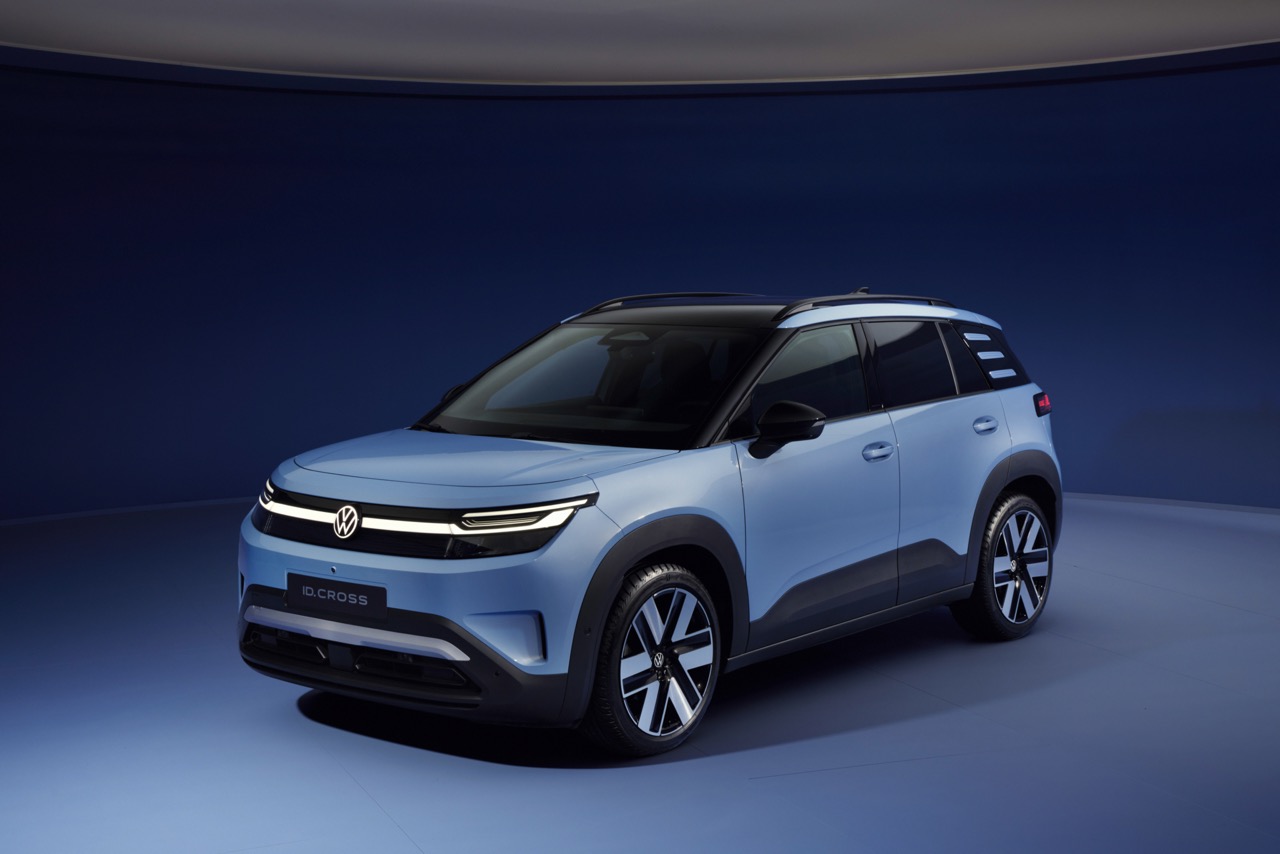
You’ll find a very horizontal front light signature, with a light bar crossing the grille and illuminating the Wolfsburg logo. The front bumper reads as somewhat tougher in appearance than the ID. Polo, just as the side profiles, which feature black rugged plastic wheel arches, a lower body protection, and roof rails. The C-pillar is black but features three body-color inserts.
At the rear, there’s another light bar with the VW logo backlit in red this time. In terms of size, the car measures 4.15 meters in length, 1.79 meters in width, and 1.58 meters in height, with a wheelbase of 2.60 meters. These are fairly standard dimensions for an urban SUV.
Volkswagen ID. Cross (2026): A rational and spacious interior
The dashboard of the ID. Cross is very close to that of the ID. Polo. You’ll find a two-spoke steering wheel, a 10.25-inch Digital Cockpit display capable of showing a motif reminiscent of Volkswagen’s iconic models, and a 12.9-inch infotainment screen.
Volkswagen shows pragmatism and returns to physical controls. After aiming to streamline interiors to follow trends, the German group reintroduces physical controls for the essentials.
That’s evident on the steering wheel, where physical controls replace the touch-sensitive buttons seen on the Golf 8 before its facelift or on the first-generation T-Roc restyled, as well as on the climate controls beneath the touchscreen, and the dial used to adjust the media volume.
Yet VW plays with the design of certain elements. Door handles are integrated into the armrest, as seen on the new T-Roc. Among the equipment, audiophiles will appreciate the 425-watt Harman Kardon audio system, likely available as an option.
The interior space will also be a key selling point for the ID. Cross, just as it is for the ID. Polo. The rear seats offer generous room for its segment, as does the trunk, which is listed at 475 liters, plus 12 liters of extra storage under the hood.
Volkswagen ID. Cross (2026): Multiple powertrains and two batteries
The ID. Cross lineup will be well equipped. Expect no fewer than three motors and two battery options. In terms of energy storage, there’s a 37 kWh LFP battery for the entry version, and a 52 kWh NMC battery for the other versions. These are the same batteries used in the Volkswagen ID. Polo, Cupra Raval, and Skoda Epiq (the latter being the closest cousin to the ID. Cross). The powertrains offer three outputs: 116 horsepower and 135 horsepower (only with the LFP battery), and 211 horsepower. The powertrain lineup is thus aligned with that of the Skoda Epiq.
In terms of range, the LFP-equipped 37 kWh version will provide up to 316 km in mixed WLTP cycles, while the 52 kWh NMC version can reach up to 436 km. This places the ID. Cross among the benchmarks of its class, alongside the Peugeot e-2008, the Kia EV2, and the Renault 4 E-Tech.
Charging performance is competitive as well. The smaller LFP battery accepts up to 90 kW, while the larger NMC battery can handle up to 105 kW. So it takes about 27 minutes to go from 10 to 80 percent for the smaller pack and about 24 minutes for the larger pack.
These figures are perfectly in line with its urban-but-versatile positioning. It’s worth noting that the Vehicle-to-Load (V2L) feature is offered, allowing the battery’s energy to power other electrical devices via an adapter plugged into the outlet.
Regarding price, Volkswagen quotes a starting figure around €28,000. It’s highly likely that the higher-end variants will be available right at launch, with the first cars hitting showrooms in the fall. In France, the ID. Cross should rank among the most affordable electric SUVs on the market, benefiting from the ecological bonus.
Comparison Table
| Version | Battery | Power (hp) | Range (WLTP) | Charge 10-80% | Max charging power | Trunk | Base price (€) |
|---|---|---|---|---|---|---|---|
| Entry-level | LFP 37 kWh | 116 / 135 | 316 km (196 mi) | 27 min | 90 kW | 475 L (+12L) | ~28,000 |
| Top-end | NMC 52 kWh | 211 | 436 km (271 mi) | 24 min | 105 kW | 475 L (+12L) | ~28,000 |
The Essentials to Remember
- The Volkswagen ID. Cross is an electric urban SUV designed to replace the T-Cross in the lineup.
- Design inspired by the ID. Polo, with a front and rear lighting signature and rugged elements.
- Dimensions: 13.0 ft long (4.15 m), 5.7 ft wide (1.79 m), 5.2 ft tall (1.58 m), wheelbase of 8.53 ft (2.60 m).
- Modern interior with physical controls, a 10.25-inch Digital Cockpit and a 12.9-inch infotainment screen.
- Two batteries available (37 kWh and 52 kWh), offering up to 436 km (271 miles) of range (WLTP).
- Fast charging: 24–27 minutes to move from 10 to 80% depending on the version.
- Generous trunk of 475 L plus 12 L under the hood, and modern features like V2L.
- Starting price announced around €28,000, with potential eco-bonus depending on market.
FAQ
What is the range of the Volkswagen ID. Cross?
The ID. Cross offers up to 316 km (196 miles) with the 37 kWh LFP battery and up to 436 km (271 miles) with the 52 kWh NMC battery, per WLTP cycle.
How long does it take to recharge the Volkswagen ID. Cross?
From 10 to 80 percent, it takes about 27 minutes for the LFP battery and 24 minutes for the NMC battery, thanks to charging powers of 90 kW and 105 kW respectively.
What is the cargo volume of the ID. Cross?
The VW ID. Cross offers 475 liters of cargo space, with an additional 12 liters of storage under the hood.
What is the launch price of the ID. Cross?
The launch price for the Volkswagen ID. Cross starts around €28,000.
What are the new onboard control features of the ID. Cross?
The model reintroduces physical steering-wheel controls for climate and volume, improving ergonomics compared with earlier generations featuring touch surfaces.