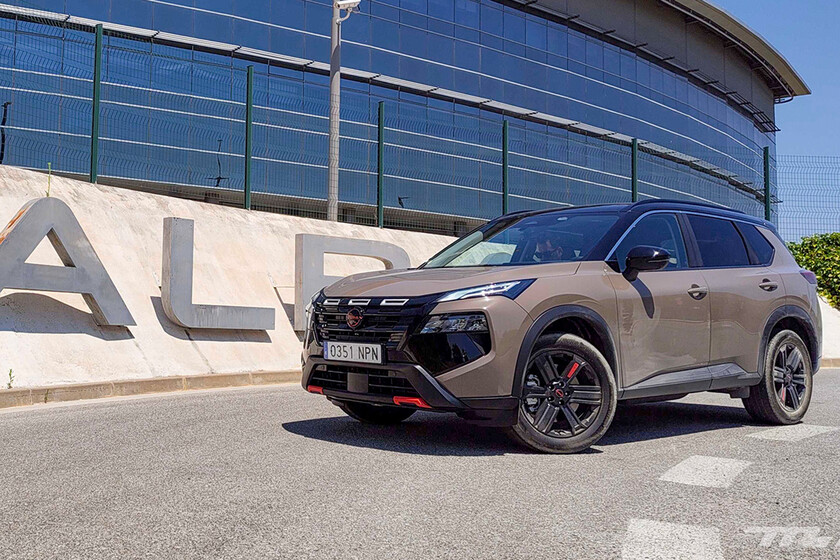
The Nissan X-Trail is celebrating 25 years, with 8.1 million units sold across four generations, all of them sold in Europe. It is the bigger brother of the Qashqai, the SUV with which Nissan competes in the family-SUV segment, and it now receives a facelift to stay competitive against the Toyota RAV4, the Peugeot 5008, or the Renault Espace.
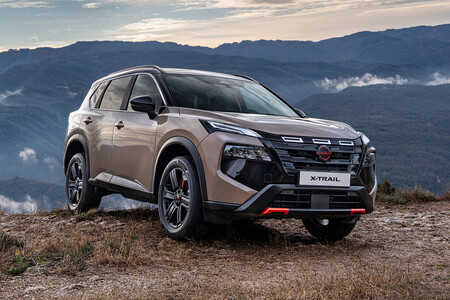
The fourth generation, launched in Europe in September 2022, does not change its silhouette. It retains its 4.68 meters in length, 1.84 meters in width and 1.72 meters in height, with plastic wheel arches, 19-inch wheels and a straight roofline that ensures interior space. The restyling concentrates on the front area: the grille is widened and simplified, and the bumper introduces more angular air intakes.
You Don’t Change a Winning Team, You Just Seek Further Improvements
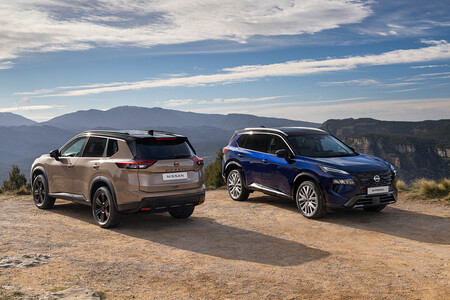
In the N-Trek finish, the most adventurous in appearance, three chromed openings appear over the grille and magma-red touches on logos, wheels and bumper. At the rear, new LED taillights and a bumper repainted in body color replace the previous matte black. The color range adds Sukumo Blue and Miho Sand, both available in a two-tone configuration.
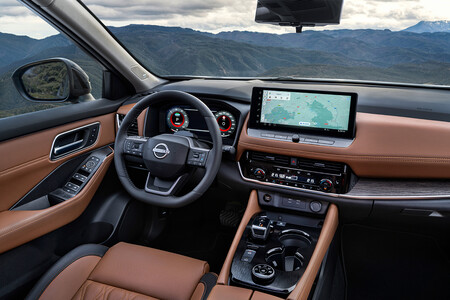
The interior changes are minimal in design, with the same dashboard, the same steering wheel and the same seats. Still, Nissan offers padded leather upholstery in black or cognac for the Tekna finish, with wood inserts in the center console, and a new fabric upholstery for the N-Connecta. The digital instrumentation and the 12.3-inch touchscreen remain physically unchanged.

What changes fundamentally is the software. The X-Trail debuts the NissanConnect system with Google integrated that already debuted in the 2024 Qashqai. It is a system similar to the one Renault uses in its current models, with voice assistant for climate control, navigation, seats or the heated windscreen.
The surround view also improves maneuvering, with an Around View Monitor that adds 3D view at low speed and an “invisible hood” feature for tricky terrain. The Level 2 ProPilot Assist includes anticipatory recognition of speed limits and braking and acceleration that Nissan describes as more natural. Something that we have been able to verify in practice.
Mechanically, there are no surprises. The X-Trail keeps its two e-Power configurations with the same 1.5-liter turbocharged variable-compression three-cylinder engine that acts as a generator and rarely drives the wheels directly. The energy stored in a battery with a net capacity of 1.73 kWh powers one or two electric motors.
These are 150 kW at the front and, in the e-4orce all-wheel-drive variant, another 100 kW at the rear, for a total output of 204 hp in front-wheel drive and 213 hp in the AWD variant. The car can start and drive in pure electric mode up to speeds above 80 km/h for short stretches.
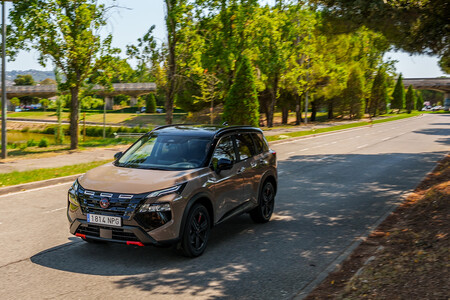
The X-Trail is not exactly a compact car, but even so, it does not feel as heavy in motion as it looks. In corners there is some body roll, inviting you not to push the pace. Still, it is not a car that rewards fast driving. The steering is very light, although it preserves the right feel to know where the front wheels are pointing.
The suspension disappoints at times, especially with large wheels, becoming noisy over potholes and joints, and this is complemented by some road and wind noise at highway speeds. It is the only reminder that it is not a premium model, because otherwise it boasts an excellent perceived quality.
Nissan markets the e-Power as an almost-electric experience, with the electric motors as the sole ones responsible for moving the wheels. And you can feel it. They pull the car with authority; you can feel the instant torque of the electric motors. That said, when more acceleration is demanded, the gasoline engine sounds loud enough not to fool anyone.
The e-Pedal, with maximum regeneration, allows one-pedal driving and proves useful in city driving once you master the braking point. On the highway, however, it can be dizzying for passengers, and it is wise to lower the regeneration level, at which point the brake pedal loses feel when regenerative and friction braking are combined.
As a good family car, the X-Trail prioritizes fuel efficiency over performance. Pushing hard generates a lot of noise—much noise—without really gaining speed. The e-4orce variant posts a 0 to 100 km/h time of 7 seconds, with real-world consumption around 7 L/100 km for the e-4orce variant.
The dynamic handling is not the X-Trail’s strong suit; its strength lies in comfort and isolating passengers from the outside world, although it doesn’t achieve that completely. In return, it offers a very spacious cabin, brightened by the panoramic roof (now standard) and a boot capacity ranging from 485 to 575 liters under the load floor.
In Spain, the 2027 X-Trail starts at 35,800 euros for the e-Power 204 hp in the Acenta trim. The range continues with the N-Connecta, Adventure and Tekna, with front-wheel-drive variants and 204 hp approaching 44,000 euros, and ends with the e-Power 213 hp e-4orce Tekna seven-seater, which reaches 48,200 euros.
Slight surface tweaks, a real leap only in the on-board software and a mechanical setup that didn’t need to change because it was already working. Why replace a winning team? Those seeking driving thrills will keep looking elsewhere. Those seeking a family hybrid with no shocks will still find here one of the most reasonable and affordable options in the segment.
Images | Nissan