
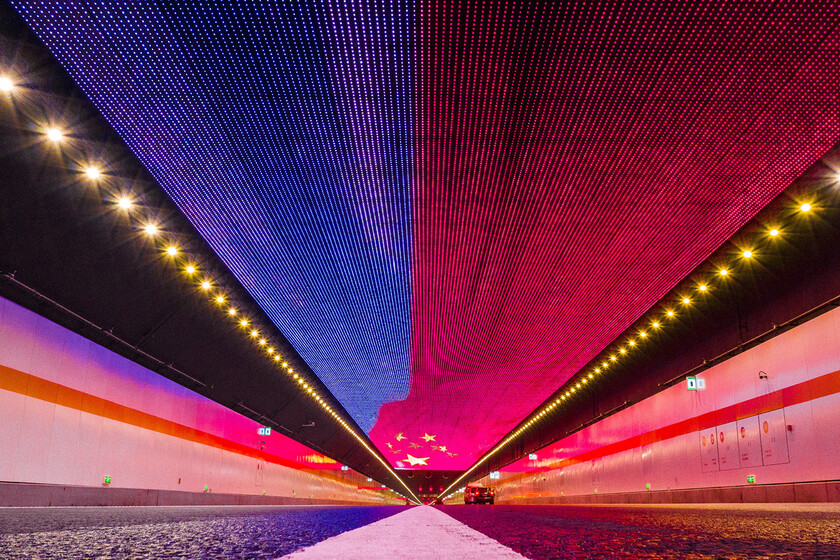
The longest underwater tunnel in China looks like it was taken from a science fiction film. It stretches nearly 11 km beneath Lake Taihu and, beyond being an advanced feat of engineering, the main protagonist is its roof. Equipped with hundreds of thousands of LEDs, it can morph into a blue sky, a starry firmament, or even the flag of China.
This has turned it into something of a tourist attraction: many people venture to travel through it simply to experience firsthand this advanced and singular lighting system. It wasn’t installed merely for decoration: its engineers have created an underwater roadway that doubles as a test bed for a new generation of tunnels where lighting ceases to be a mere functional element and becomes a tool to fight driver monotony.
Over 10 kilometers beneath a roof of LED lights
Opened in 2022, the Taihu Tunnel links Shanghai with Nanjing. More than four years after opening to traffic, with its 10.79 km length, it remains the longest underwater tunnel in the People’s Republic. Its figures are staggering: its width is 40.6 m, and it stands 7.25 m tall, housing three lanes in each direction. In the center, a 4.5 m service tunnel runs along.
The construction took four years, with an investment close to 9.9 billion yuan, about 1.2 billion euros at the current exchange rate. That amount reflects not only the challenge of realizing it through the lakebed, composed of thick layers of clayey silt, but also the advanced technology it houses. Notably its lighting system: the ceiling relies on giant screens with modular LED matrices that allow lighting to be adjusted by sections. In the entry and exit zones, these panels are 11 m wide, and in the central area more than 14 m. Each of these “starry ceilings” consists of around 200,000 individual LED light sources controlled by an intelligent system.

This spectacular display of lights has often gone viral, with photos and videos on social networks showing the stunning top-down images that adorn its nearly 11 km. But behind this futuristic spectacle lies the road engineering: its designers describe it as a practical application of the concept “landscape section to combat visual fatigue in tunnels.”
To combat the “autopilot” effect in very long tunnels
In long tunnels, driver drowsiness caused by visual monotony is even more pronounced than on a nighttime highway. It means cruising through a closed space for extended minutes with few changes: mere lighting that illuminates the tunnel, variable speed signs, emergency stop indicators, and little else. In the Taihu case, traveling its 10.8 km at the maximum permitted speed (80 km/h) takes just under 10 minutes.
That is why the design of its striking luminous roof was conceived. The engineers divided it into three large sections, among which the so-called “fatigue activation zones” are distributed. They are designed to present visual stimuli, counteracting the monotony of the journey. In these zones, the LEDs use tones such as blue, yellow, or cyan, combined with warm hues to achieve dynamic changes and create a changing visual scene.
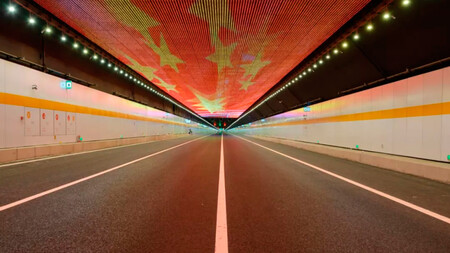
According to project documentation, and based on studies analyzing these activation zones, they estimated that an effective visual stimulus should last between 6 and 7 seconds, but at the same time should not distract the driver. Accordingly, they designed the zones to extend about 150 m: with this length, motorists would perceive the change without taking their eyes off the road.
In short: this design focuses on giving the brain more visual information, aiming to break the “autopilot” effect that a repetitive journey induces. China is also turning to this technology on highways, with light beams at highway portals that illuminate at night to prevent drowsiness. They have been installed in two major corridors of the country: on sections of the Qingdao-Yinchuan (Shandong) and Shanghai-Chongqing expressways, which cross several provinces.
Does a Blade Runner-style ceiling really help maintain attention?
Several studies have analyzed how dynamic lighting can combat visual fatigue in tunnels that are too long due to their inherent visual monotony. This one published in Traffic Injury Prevention by several researchers from Chinese universities concludes that it can indeed be effective.
They subjected several drivers to simulator tests, and the results showed that blue-toned lights increased drivers’ attention, followed by red. Precisely the tones most frequently seen in the Taihu tunnel images. In this analysis, it is stated that specialized lighting zones can reduce the tendency toward mental disengagement, helping to keep attention in this scenario. Although they caution that the results need validation under real road conditions.
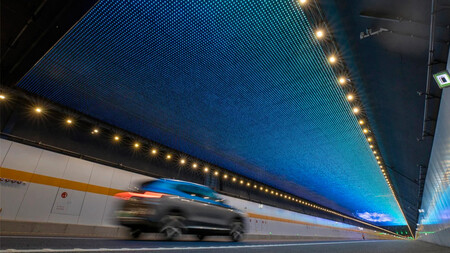
That is precisely what this other analysis does. Researchers at the IEEE Energy and Electrical Engineering 2024 conference analyzed the Taihu tunnel’s own lighting, with field tests evaluating how different LED configurations modified drivers’ eye movements or physiological responses.
In their conclusions, they indicate that the tunnel’s landscape lighting gives drivers a broader view of their surroundings without causing distractions and reduces the sense of monotony. However, the tests did not categorically demonstrate a significant reduction in fatigue or that it prevented drowsiness.
In short, the thousands of LEDs in the Taihu tunnel are not a miraculous cure for fatigue at the wheel, but they do transform an extremely repetitive journey into a richer visual experience that helps maintain attention in endless tunnels. And once again China sets a benchmark for what road infrastructures of the future might look like, just as with laser-light trials on highways.
Images | Wuxi China en X, Jiangsu Lighting Society, AP News