

It should be retired, but it keeps downing Iranian drones and rescuing pilots on enemy soil. The A-10 Thunderbolt II “Warthog”, which will fly at least until 2030, embodies the victory of ruggedness, of the analog over technology.
In the era of radar-invisible stealth fighters, the most beloved aircraft of the infantry on the front remains a machine designed in the sixties, with not a single concession to aesthetics. The A-10 Thunderbolt II does not endure out of nostalgia. It Endures because no one has built something better for doing the one thing it was designed to do.
A Cannon to Which a Plane Was Mounted
In the A-10 Thunderbolt II ‘Warthog’ (boar, because of its notably aggressive and ugly appearance), everything is from another era. Its design, its name and even its manufacturer, Fairchild, a now-defunct aerospace company that evokes the sixties. The Warthog’s origins lie in the Vietnam War and its first flight was in 1972. U.S. jet fighters, such as the F-4 Phantom, proved useless for close air support.
Pilots could barely distinguish the target in the blaze of speed, while enemy fire from light arms shot down jets worth several millions. The Army needed an armored weapons truck capable of flying low, lingering over the troops for hours, and absorbing hits without diverting from its mission. From that need emerged the AX program, and from it, the A-10.

The A-10 is basically a huge, deadly cannon surrounded by a plane. In fact, the cannon GAU-8 Avenger was designed first and only then was the aircraft built around it. The GAU-8 Avenger is a seven-barrel 30 mm rotary weapon that fires at a fixed rate of 3,900 rounds per minute, or 65 per second, with depleted uranium ammunition capable of piercing heavy armor. Its bursts produce a distinctive sound that has terrified U.S. adversaries in Afghanistan, Iraq, or Syria.
Representing about 16% of the aircraft’s empty weight, it is mounted slightly off-center because the nose gear had to be moved to give it clearance. The recoil comes close to the thrust produced by one of the two engines; therefore the gun is aligned with the fuselage axis so that firing does not deflect its trajectory.
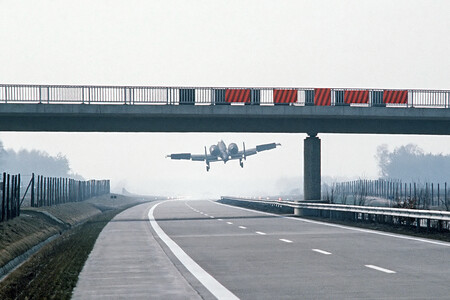
A10 Thunderbold II despegando desde una Autobahn en un ejercicio de la OTAN en 1984.
The A-10 was designed during the Cold War and therefore one of its missions was to destroy the columns of Soviet armor that might have invaded Western Europe. The result is a slow tank-killing aircraft that gives the pilot real-time time to distinguish an enemy combat vehicle from a friendly one, flies low, makes a lot of noise, but is tremendously effective against ground targets.
One of the Warthog’s strengths is its robustness. The pilot’s survival was secured with brute force. The cockpit is surrounded by a titanium “bath tub” of about 540 kg, capable of withstanding direct hits from medium-caliber projectiles. It also features self-sealing fuel tanks and its critical systems are redundant. It has two independent hydraulic flight-control systems and, if both fail, a third mechanical system using steel cables that lets the pilot move the ailerons with his own strength.
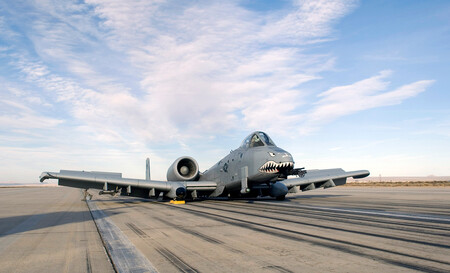
A-10 Thunderbolt II tras un aterrizaje forzoso.
The General Electric TF34 engines are mounted high and toward the rear of the fuselage, far from the dust of improvised runways and partially shielded by the tail surfaces against infrared-guided missiles. The aircraft can fly with one engine out, with half a wing still operable, or with a single rudder functioning and touch down with a damaged landing gear.
The A-10’s latest baptism of fire has been in Iran. During the American Epic Fury operation against Iran in 2026, the A-10s were essential to rescuing U.S. pilots shot down on Iranian soil, while an A-10 struck by Iranian fire managed to reach Kuwaiti airspace before its pilot safely ejected.
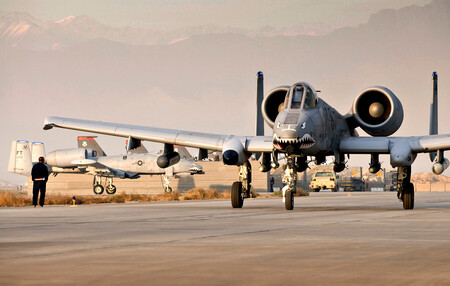
A 10 Thunderbolt II at Bagram, Afghanistan.
A pesar de llevar unos 50 años en servicio activo. En 2026, la Fuerza Aérea pidió dar de baja los 162 A-10 que le quedaban, dos años antes de lo previsto. El Congreso lo bloqueó parcialmente y fijó un mínimo de 103 aparatos a mantener activos. Después, en abril de 2026, el secretario de la Fuerza Aérea, Troy Meink, extendió la vida útil de tres escuadrones hasta 2030.
And there is no aircraft that can replace it. The F-35 does not replace the A-10 in close air support. The F-35A carries a 25 mm cannon with only 180 rounds, compared with the 1,174 rounds of the 30 mm on the Warthog; the F-35B and F-35C variants lack an internal cannon, and the F-16, more versatile, carries only 511 rounds of 20 mm. Moreover, they are of a different nature.
The A-10 flies slowly and low, stays in combat, communicates with troops, and makes multiple passes, while the F-35, stealthy and supersonic, is designed for rapid strikes in contested environments, not for convoy escort or infantry support under enemy fire. And then there is cost. An hour of F-35 flight costs around $40,000, the F-16 about $27,000, and the A-10 barely $20,000.
After the 2022 invasion of Ukraine, where drones asserted themselves as the primary weapon, the A-10 found a new role. In October 2025 it shot down Iranian Shahed drones after being urgently modified to carry cheap anti-drone rockets against air-to-air missiles, hundreds of times cheaper. In 2026, a dozen A-10s were deployed in the Middle East for the Epic Fury operation against Iran, blocking ports and protecting the Strait of Hormuz against fast boats, doubling its contingent by April.
The A-10, on a path to retirement as a sentimental relic of the infantry, has discovered a new mission that will keep it in the air for several more years. It is a cheap and effective platform against swarms of drones, a problem that cutting-edge combat aviation does not solve with the same cost-effectiveness.
Images | U.S. Air Force photos by Staff Sgt. Samuel Morse, Brad White, Senior Airman Greg L. Davis y Staff Sgt. Aaron Allmon; Glenda Pellum.