
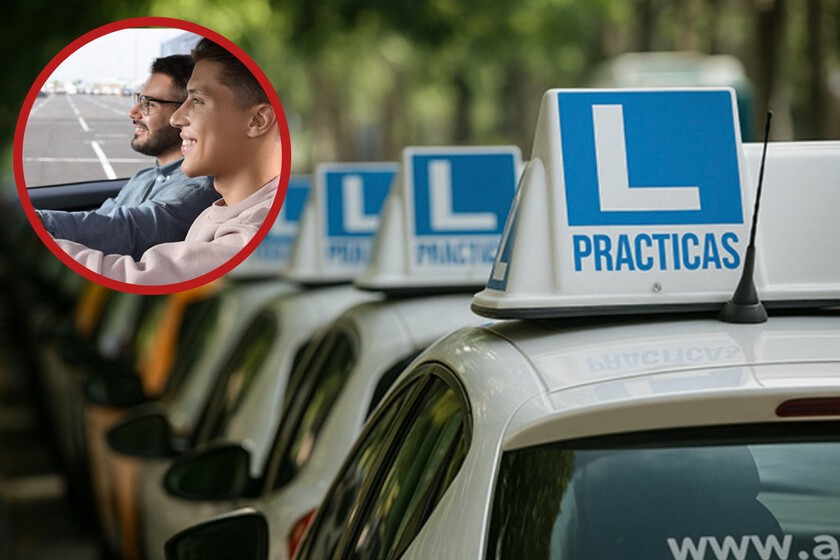
“The collapse to obtain a driving license in Navarra worsens: 8,000 people on the waiting list.” “The lack of DGT examiners is causing a national gridlock.” These are among the headlines that reflect the current — and past — situation faced by tens of thousands of students who, after passing the theory test, want to move on to the practical exam but cannot.
In response to the shortage of examiners, the DGT has come up with an ‘extreme’ solution: also testing on weekends for the B license… using volunteer examiners.
This pilot trial has already been carried out in Lleida. Navarra, Almería and Tenerife are next
Lleida and Navarra have been chosen to conduct the pilot tests of this initiative, named the Operational Exam Reinforcement Plan. According to the National Confederation of Driving Schools (CNAE), the DGT will have a pool of 353 volunteer examiners, of whom 227 are willing to travel to any province. Each examiner will conduct between 16 and 20 driving tests on the assigned day (the tests will take place on Saturdays).
Thus, on May 16, more than 300 students from Lleida — out of the more than 5,000 aspirants on the waiting list — were summoned to obtain their license. They dubbed it “Super Saturday.”
To carry this out, the DGT drew on examiners from Tarragona, Barcelona and Zaragoza, who joined the local staff. The massive tests were held with little lead time in polygons and open spaces, and the students did not have much margin. The plan will extend to Andalucía (Almería from May 30) and Tenerife. CNAE has asked the DGT that, if the plan works as expected, the possibility of also conducting motorcycle and heavy vehicle tests be contemplated.
@a3noticias 🚘 Massive driving test Saturday in Lleida ➡️ This is an extraordinary measure by the DGT to reduce the waiting lists, which have risen to 85,000 students in Catalonia alone 📲 Follow all the latest on antena3noticias.com #Antena3Noticias #Noticias #news #noticiastiktok ♬ original sound – Antena 3 Noticias
But in the eyes of many, it is a patch that does not solve the underlying situation. The Federació d’Autoescoles de Catalunya criticized the measure as “improvised and hastily organized,” according to its president, Raül Viladrich, who went so far as to call the initiative a “mockery” when meeting with traffic authorities.
The reality is that only in the Community of Madrid there are more than 70,000 people on the waiting list, a figure that rises to more than 85,000 in Catalonia and 60,000 in Andalusia. Why is there a shortage of examiners? The origin lies in the fact that many of the examiners who sit the competition and pass are temporary workers. Added to this is the enormous difficulty in finding housing when they obtain posts in another city.

And not to mention the challenge posed by an aging population, which also impacts sectors like professional transport: retirement leaves are not being filled. From CNAE they believe this emergency plan “does not resolve the structural problem: unfilled retirements, prolonged absences, insufficient staffing and a growing demand that the current system cannot absorb.”