In the Spanish military industry there are consolidated names such as the ‘Dragón 8×8’ armored vehicle or the iconic ‘VAMTAC’ from UROVESA, manufactured in Galicia. However, one of the least-known, yet most cutting-edge companies in the sector sits among the vineyards and olive groves of Herencia, a municipality in Ciudad Real. We are talking about TSD, a company that demonstrates the capability of rural industrial networks to compete on the frontline of global defense.
The story of this firm, recounted in a feature by El Español, shows its singular evolution: it began in the year 2000, when Antonio Ramírez founded a family business dedicated to locksmithing, trailers, and safes. With no prior military background in the family, the company redirected its activity toward the development of special vehicles for security and defense, achieving today annual revenue of about 130 million euros and generating more than 600 jobs in its local environment.
From the Locksmith Workshop to the Íbero Modular Armored Vehicle: Heavy Engineering at the Heart of La Mancha
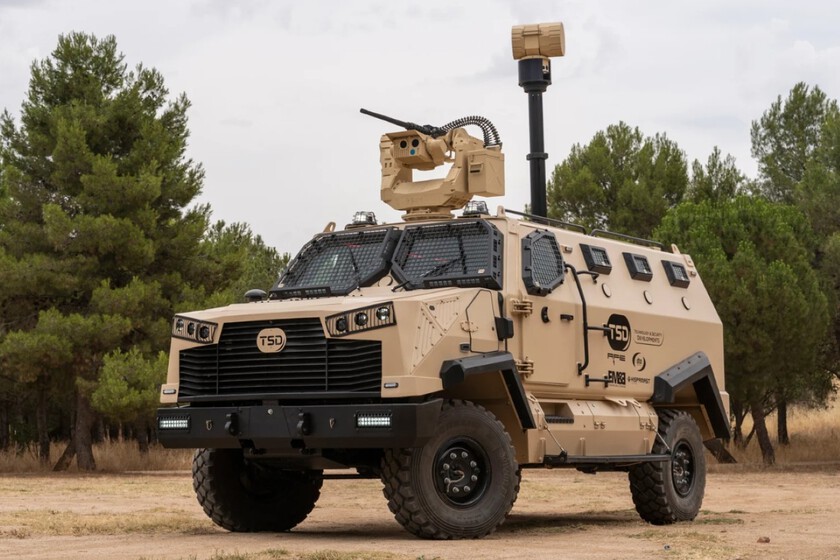
TSD operates as a second-tier manufacturer, meaning it does not build the chassis of its military vehicles from scratch, but uses as a base platforms from top brands such as Mercedes-Benz, Renault or Iveco for its developments. Its adaptability allows, for example, to transform up to 1,500 patrol cars for the National Police in just 45 days. However, its most advanced product is the Íbero: a 4×4 multipurpose tactical vehicle protected under the strict STANAG regulations of the North Atlantic Alliance.
The Íbero stands out for a modular design that allows configuring it as an ambulance, a reconnaissance vehicle, a command post, or protection against chemical and biological threats. There are three versions: the lightweight LTV of five tons, the versatile SMV of ten tons, and the heavy HTV, a colossus of fifteen tons and almost seven meters long. Precisely, the Guardia Civil’s Special Intervention Unit has one of these latter ones, which it bought for more than 850,000 euros, equipped with a telescopic ramp for rapid assault missions.
But the commercial success of this armored vehicle already crosses Spanish borders, with around a hundred units sold in markets such as Africa (Senegal or Ivory Coast), where the vehicles are already operating in real-world scenarios and bear the combat-proven seal, while expansion in South America is being negotiated.
In addition to the military range, the company develops armored cash-in-transit vans for central banks, equipped with remote telematics blocking systems and patented technologies such as a foam that solidifies within seconds to protect the cargo against robbery attempts.

This case reinforces the competitiveness of defense automotive in Spain, where large-scale projects such as the Santa Bárbara Sistemas plants coexist with the dynamism of specialized family-owned companies like this one. At a moment when Europe is accelerating military spending and seeking to reinforce its strategic autonomy, the Herencia factory is consolidating itself as an increasingly relevant actor.
Not by chance, as Antonio Ramírez pointed out in the interview with El Español, “Europe must be self-sufficient,” a notion that fits perfectly with the role played by companies like TSD in the continent’s new industrial and defense strategy.
Images | TSD