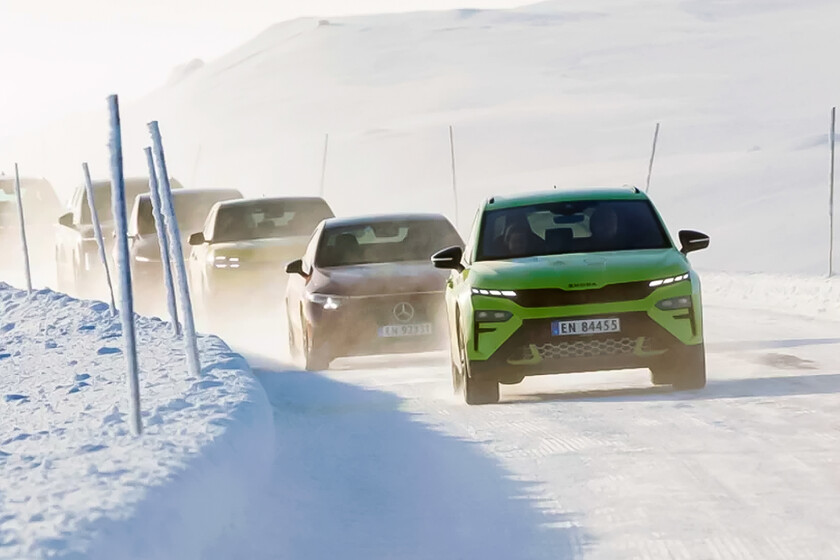
The Norwegian Automobile Club, NAF by its Norwegian acronym, and the local magazine ‘Motor’ have just published the results of their harshest winter range test to date. The conclusion is as clear as it is uncomfortable.
When the thermometer plummets, the official range figures published by manufacturers become mere damp paper except for the Chinese cars. They dominate the cold-weather efficiency top, while premium Western models fare worse.
A historic cold as the arbiter of ranges
This year, the test was particularly tough because of the cold. In the 324 km route from Oslo to Folldal (and back to Oslo), temperatures ranged from -7°C to -32°C. And yet it is more relevant than ever because it demonstrates, on one hand, how sensitive their batteries are to temperature variations, and on the other hand that no, electric cars don’t quit when the temperatures drop a bit.
In the test, on average, the loss of range compared to the official WLTP figures was 38%. To put this in context, in the edition from the previous year the deviation was a mere 18%, but back then the temperatures fluctuated between -6°C and +8°C. The difference in conditions explains the discrepancy in results, though it doesn’t fully justify it.
The least cold-resistant

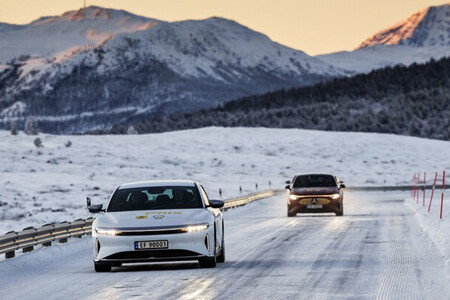
The most striking case was the Lucid Air, the California luxury sedan that boasts the highest homologated range on the market (960 km according to WLTP). In the test it covered 519 kilometers and accumulated the largest deviation of all participants: 46%. That said, to be fair: it was the car that spent the most time exposed to the most extreme temperatures up on the mountain. Even so, it is the car that has managed to travel the most kilometers in total, undoubtedly thanks to an 118 kWh battery.
Another American-brand model, the Tesla Model Y, also did not fare well in this test. Of the 629 km it homologates, it managed 359 km, leaving 270 km on the table. It shed 43% of its range along the way.
It wasn’t the only one to show aberrant discrepancies between homologated figures and real-world performance. The Opel Grandland lost 45.9% of its WLTP range in the test. Of 484 km homologated, it managed 262 km, losing 222 km in the attempt.
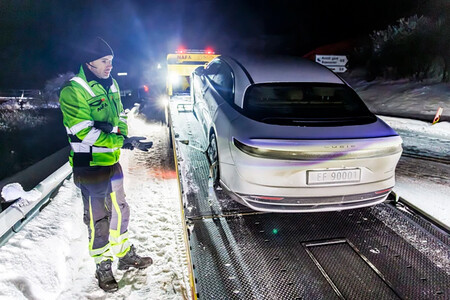
As for the European Car of the Year, the Mercedes-Benz CLA lost 48% of its range: from 709 km homologated it managed to travel 421 km before signaling 20% battery. It lost 288 km of range along the way. Interestingly, the Volvo EX90, a Swedish model but with Chinese technology, also shed almost 50% of its range in the attempt. Going from 611 km WLTP to 339 km real, always down to the 20% battery.
The most cold-tolerant
The two cars with the smallest loss of range were the Hyundai Inster and the MG IM6, both with a deviation of 29% from WLTP. But the most striking fact is that Asian cars, or those with Chinese technology, such as MG, Xpeng, Zeekr, Voyah and KGM, dominate the cold-weather efficiency rankings.
|
Car |
Percentage preserved when reaching 20% |
km driven |
|---|---|---|
|
MG S6 EV |
61 % |
345 km |
|
Hyundai Inster |
61 % |
256 km |
|
Xpeng X9 |
57 % |
361 km |
|
MG IM6 |
58 % |
352 km |
|
Zeekr 7X |
58 % |
338 km |
|
KGM Musso EV |
58 % |
263 km |
|
Voyah Courage |
58 % |
300 km |
Why is this important? In Southern Europe, a winter test might seem less relevant. And especially when this test was carried out during one of the harshest winters Norway has recorded in recent years. However, it shows that no, electric cars are not useless when it’s a bit cold.
If they could cope with Norway’s toughest cold, they can easily handle a winter in Palencia or the Pyrenees. That said, when choosing an electric car, make sure it has a heat pump. Otherwise, you may see the range drop dramatically.
You can see the full NAF ranking here.
Find your ideal electric car
If you’ve considered buying an electric car, this will interest you. We have created the Personalized Electric Car Recommender, where besides seeing the models that fit your needs you’ll also get answers to the questions you’re most likely to worry about, such as price, range, or nearby charging points.