
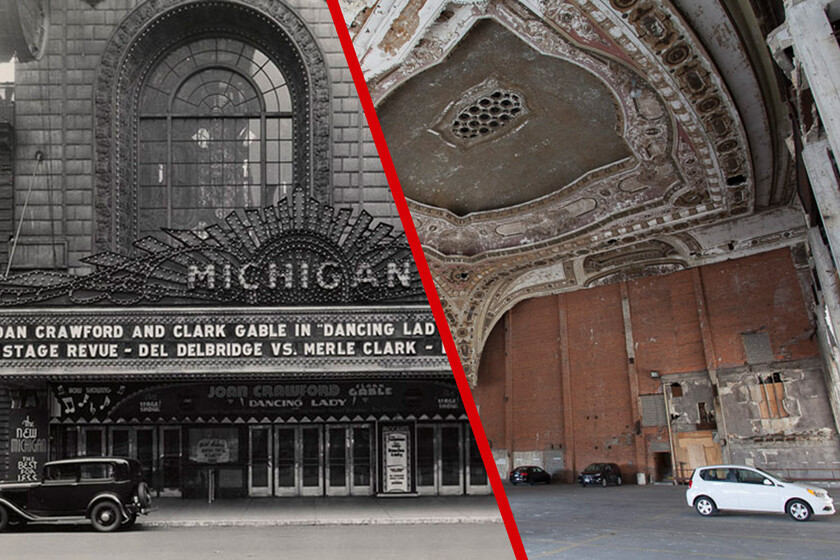
Detroit in the first half of the twentieth century stood as one of the United States’ economic capitals: for fifty years it was the nerve center of its automobile industry. And from that prosperity, the Michigan Building was born: a 13-story structure that housed the ornamental Michigan Theatre.
It carries an ironic backstory: it was conceived right where Henry Ford kept his small garage where he shaped his first car. And from the past to the present: today that theatre is a three-level parking garage. A fascinating tableau to behold: cars parked beneath the luxurious ruins of the ceilings of what had been a temple of culture in the Motor City.
A temple of cinema in the Motor City
Detroit today is a city marked by decades of decline: its powerhouse car industry ceased to be central years ago. Although regeneration efforts have recently been pursued, with projects like reviving DeLorean (DNG Motors trying to revive Kat DeLorean, daughter of the founder of the firm), the scars remain: redeveloped infrastructures, urban spaces abandoned or in ruins, etc. A perfect example is the Michigan Building.
A monumental theatre inside a building. This property sits at the intersection of Bagley and Cass Avenues, in downtown Detroit. Standing 13 stories tall, it was designed by the architecture firm Rapp & Rapp (led by the renowned architects Cornelius W. and George L. Rapp). In a Neorenaissance style, it is brick-clad with terracotta and granite accents. Its façade has hardly changed since it was built, though it has undergone maintenance work.
The Michigan Building cost $5 million at the time; it was completed in 1925 and opened in 1926. It housed offices and ground‑floor shops, but its star element was the Michigan Theater: one of the largest and most luxurious cinemas in Detroit in those years. In its lavish Baroque style, with a capacity for more than 4,000 spectators, it occupied a large part of the building. Although films were primarily shown, it also hosted concerts or live performances: the Marx Brothers themselves performed there.

Concert hall in the 70s. In the mid-1960s, massive cinemas like the Michigan Theater began to prove unprofitable. The building’s owner, United Detroit Theaters, sold the theatre and the office tower on March 1, 1967, for far less than the cost of raising it more than 40 years earlier: $1.5 million. At the last session only about 400 people attended. “There was nothing spectacular,” was written in the Detroit Free Press at the time.
There were attempts to revive the theatre in the years following the sale of the building, such as turning it into a theatre or a nightclub (The Michigan Palace), but these efforts failed. From 1973, it was used as a concert hall under the auspices of rock promoter Steven Glantz, keeping the same name. Acts ranged from David Bowie to The Stooges and Aerosmith. It lasted until 1976, after a dispute between the building’s owners and the promoter over interior damages amounting to $175,000.
From theatre to parking: goodbye to spectators, hello to cars
With the venue closed as a concert hall, the office building that Bagley Associates also owned remained active. Several companies rented space there, including the Charge Card Association. All clamored for a parking facility for executives and employees, threatening to move to another building if the issue was not addressed.
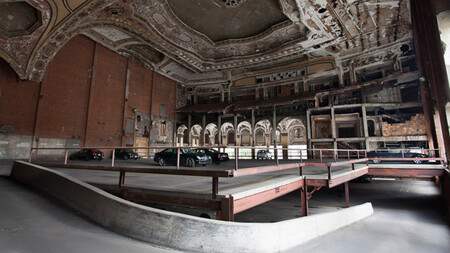
The initial idea was to demolish the spaces that housed the Michigan Theatre and erect a parking lot. But, as several architectural studies determined, tearing down the theatre would jeopardize the structural integrity of the Michigan Building. The solution was to repurpose it as a parking facility: the interior of the theatre was emptied, walls were knocked down, and three floors of steel were installed to create the parking levels. The ornamental ceiling, the proscenium arch, and the upper balcony were kept. Some parts of the lobby remained intact.
The result was a 160-space parking facility as singular as it was unique: Renaissance-style ceilings and walls paired with plain steel and concrete structures. A dystopian tinge is added, with rubble strewn on the floor or ruined elements left in place, which could not be torn down so that the building would not collapse. For example, the staircases.
For almost half a century, the employees’ cars filled a space where thousands of spectators once sat. Its countercultural aura has helped it become a film set for works like 8 Mile, the autobiographical movie starring Eminem, or The Island. It is barely used today: the building sits only about 30% occupied, after Boydell Development bought it for $1 million. A fitting metaphor for what Detroit has become today after shedding its status as the nation’s automotive industry epicenter.
Images | Archive / Detroiturbex