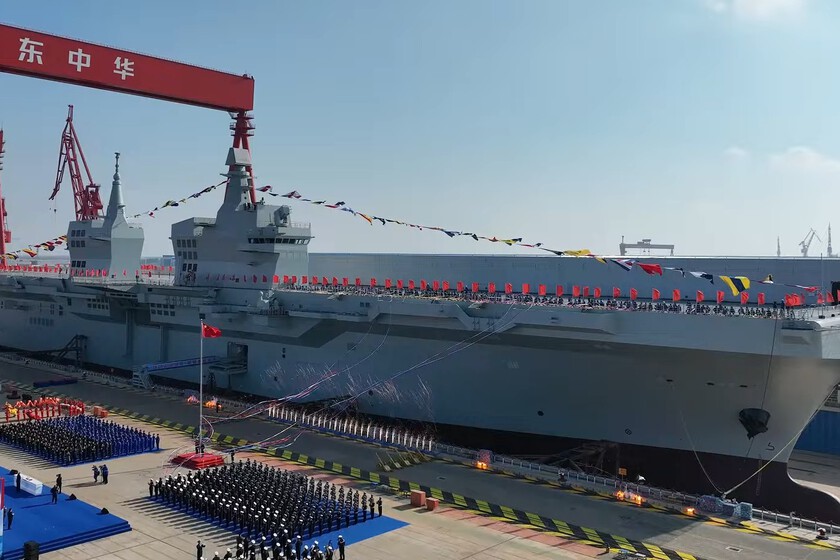
Sichuan is its nickname, but it is the first Type 076 amphibious assault ship of China, and as we know the Asian nation does not do things by halves. This is a next‑generation vessel of the People’s Liberation Army Navy of China that is already ready, capable of carrying fixed‑wing aircraft, helicopters, and amphibious equipment.
But for now it arrives with peaceful intentions. Local media report that it recently set sail from Shanghai toward the South China Sea to conduct scientific research trials and training exercises.
Incorporates a 130-meter electromagnetic catapult
Sichuan represents a staggering leap for China’s defense capabilities. It has an overall length of about 263 meters and a beam of 43–45 meters, displacing around 40,000 tonnes. Those dimensions are significantly larger than those of its predecessor and comparable to the Charles de Gaulle, the nuclear-powered aircraft carrier that stands as France’s pride.
It functions as a light aircraft carrier and amphibious assault ship, capable of launching fixed-wing aircraft and helicopters, and it also features an internal well deck for disembarkation.
It also incorporates a 130-meter electromagnetic catapult and arresting equipment, optimized for the stealth combat drone GJ-11. As noted by Xataka, other amphibious assault ships can accommodate aircraft, but those aircraft must be equipped with vertical or short takeoff and landing (V/STOL) systems. The new Chinese vessel does not have this limitation.
It also houses two 21 MW gas turbines with six 6 MW diesel generators. Together, they deliver about 78 MW of total power. But for now its missions are, according to China, peaceful and routine interregional training, and they are not aimed at any specific objective.
The Type 076 is expected to enter full operational service by 2027, boosting the country’s force-projection capability in the South China Sea. A hotspot where geopolitical and territorial disputes have raged for some time. And indeed more than 30% of global trade passes through this area, as well as being rich in fishing resources, oil and natural gas.
That is why China claims it against the Philippines, Vietnam, Malaysia, Brunei and Taiwan. Not counting Japan.
Image | 中国新闻社