
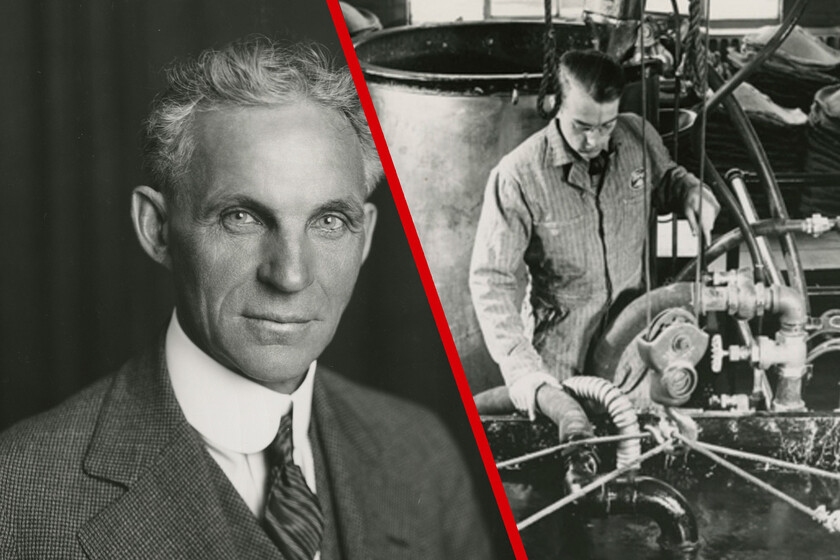
In Spain, the reduction of the working day has come onto the table as an experimental model (four days or 32 hours), without lowering salaries, to improve work-life balance and maintain, or even boost, productivity. This idea isn’t new: more than a century ago, Henry Ford imposed a five-day workweek, giving birth to the weekend.
A proposal that, although it might seem the product of a fervent unionist, had nothing to do with defending workers’ rights. It was purely capitalist: if employees had more free time, they would have more time to consume.
Rest as an Economic Engine
Henry Ford was very much about standardizing everything. The assembly line serves as an example, even though it didn’t invent it, it exploited it very well. And thus the car ceased to be a luxury good for a few, becoming affordable to the growing middle class and starting with the Model T. But beyond popularizing mass production, he was also the first to promote the five-day workweek.
Forty-hour workweek. It’s not that Ford was altruistic and wanted the best for his employees. The decision was strategic. The magnate was the first to launch a large-scale pilot of the concept of a free weekend. Or in other words: work five days and rest two in a standard pattern. In reality, its origin lay in the mix of religions in the US, with Christians wanting Sunday; Jews, the sabbath. Implementing both ended this cultural clash.
In 1922, Ford announced to workers at his car factories the implementation of a 40-hour workweek, with eight hours per day over five days, from Monday to Friday. Saturday and Sunday, the oval’s factories were closed. Although unlike the current plan of 32 hours, there was a salary adjusted to fewer hours. It established a daily wage lower than what they had with longer hours.

Same productivity, more consumption. Ford’s proposal was heavily criticized by other businesspeople. It appeared in the media as well: “The Ford plan is great news for all those who think about reducing work to the minimum irresistible,” the New York Herald reported. But time proved the Michigan visionary right: his factories maintained productivity and reducing hours allowed workers to invest the money earned in their leisure time, fueling the wheel of consumption.
Then other large companies followed the path started by Ford, aided by the labor movement in its tireless fight for more rights. In 1940, the five-day workweek became standard: American labor law officially recognized Saturdays and Sundays as days off.
The Ford legacy and AI. The weekend is a relatively recent invention in the history of humanity, which after the industrial revolution meant working without rest and days that went beyond ten hours. And in the 21st century, capitalism continues to reinvent itself.
Not only because of the move to 32 hours, still in an experimental phase in Spain, but also due to the rise of AI. According to Eric Yuan, the CEO of Zoom, Artificial Intelligence will end up absorbing repetitive and routine tasks. “I hate working five days a week. I’m fairly sure that, in reality, we don’t need to work five days a week,” he recently said, as Fortune reports.
Precisely Yuan, whose app has fostered remote work, has repeatedly cited as an example what the five-day week introduced by Henry Ford meant for productivity. In his view, that change could well feed AI sooner rather than later.
Images | Ford, Wikimedia