
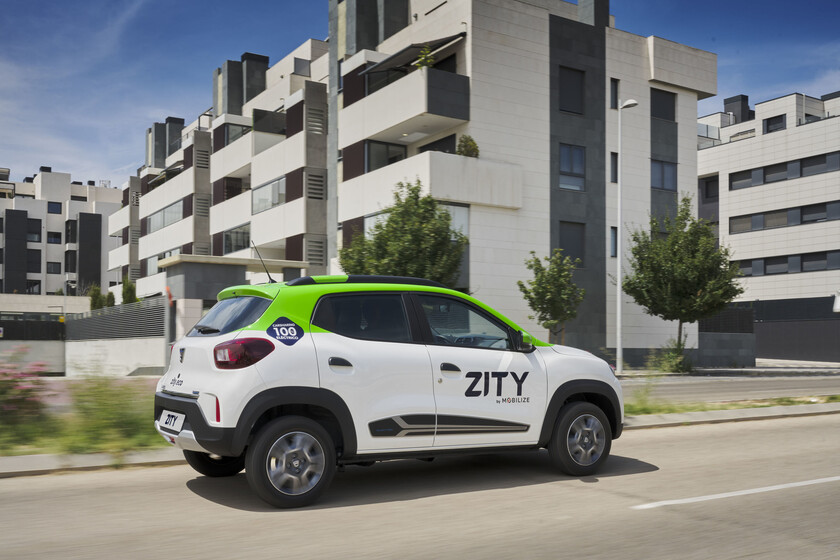
Carsharing in Spain has just taken a hard hit: on May 21, the electric cars of Zity will disappear definitively from the streets of Madrid after eight years of service, more than 800,000 users and ten million rentals. Thus, what for years was a model of success and a symbol of urban mobility has ended up becoming a business that is very hard to profit from.
Not only for Zity. Getaround has just changed hands after years trying to balance the books and giants like Share Now were already absorbed into Free2Move after BMW and Mercedes-Benz found that the original model was a financial hole. The problem isn’t carsharing per se, but the classic system of electric cars available by the minute.
The utopia of 20 cents per minute crashes against real costs
The format with which carsharing for large cities was born is dying. One of the main reasons is that, as the years have passed, everything has become more expensive, and keeping a fleet of shared cars on the street costs a lot of money. Insurance, cleaning, recharges or the logistics of moving cars between zones with different demand push the bill up to figures that can reach around 690 euros per month per vehicle.
Not to mention the vandalism suffered by many of these cars. But the biggest problem is that, with such low prices per trip (about 20 to 30 cents per minute on average), the accounts stop balancing very quickly. Many cars barely make a single trip per day, and that is exactly what happened to Zity: the service gained users and popularity over the years, but it was never viable in the long term.

Furthermore, the role of cities also explains part of this crisis. Madrid spent years turning its streets into a carsharing laboratory by offering unlimited free parking for cars with a ZERO badge. Barcelona, on the other hand, never facilitated the model to that extent and kept a much more restrictive regulation, with licenses and parking payments.
The closure of Zity in Madrid proves that even with free public parking, the system of picking up a car and leaving it anywhere (free-floating) has not managed to be truly sustainable.
Carsharing does not die, it transforms into a digital ‘rent a car’
The surviving companies are radically changing their strategy to avoid ending up like Zity, which accumulated operating losses of 1.42 million in its last year. Operators such as WiBLE, backed by Repsol and Kia, already derive a large portion of their income from day-by-day rentals and monthly subscriptions of almost 600 euros. For its part, Amovens has established itself as the big winner by using private cars (the P2P model), which eliminates in one stroke the enormous expense of maintaining a fleet of its own.
Even Renault itself does not abandon shared mobility, but the model that made Zity popular: the French group will keep the Mobilize Share app active to rent vehicles with fixed bases by hours or days. It is a system much closer to traditional rental or replacement cars than to the urban improvisation concept we knew until now. Because shared mobility has not died, but the dream of finding a cheap electric car waiting on any corner is starting to disappear.