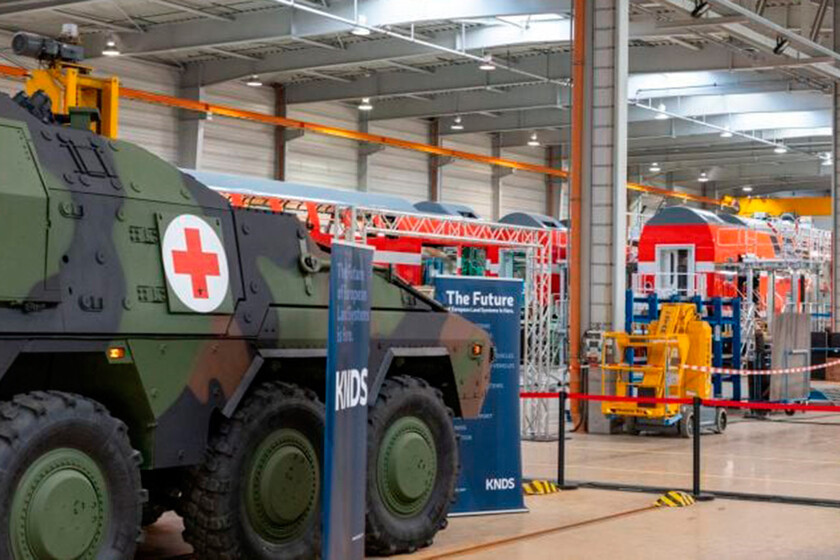
The city of Görlitz, in the former East Germany, bore the scars of war for years, shaping its staunch pacifist character. For decades it has lived to the rhythm of its railway industry, providing employment for generations. Now it has taken an ironic turn in its identity: its once-powerful locomotive factory will manufacture military vehicles such as Leopard 2 tanks, under KNDS’s direction.
A movement in which it has played a significant part in Europe’s rearmament in general, and Germany’s in particular, after the prolonged conflict between Russia and Ukraine. There is also pressure from the United States for Europe to assume greater defense spending and strategic autonomy. Yet there is also the pressure of shrinking jobs and the resulting exodus of residents.
Reinventing or Letting Its Industry Die
This shift is most evident at the Görlitz train plant, which has passed through several owners in the rail manufacturing sector, including ABB and Bombardier. Until recently it was run by Alstom, which acquired Bombardier in 2021 and absorbed its factories. Its main product, two-story passenger cars, was complemented by the production of shells and railway components.
The Görlitz facility boasted 176 years of railway production, and from its grounds arose 107,000 wagons, cementing its status as a historic industrial complex. A little over a decade ago it employed more than 2,000 people, but in recent times it barely managed around 700, threatening a definitive closure. It was a case of reinvention or extinction.
From trains to tanks. In February 2025, the Franco-German defense firm KNDS completed the purchase of the Görlitz plant. Although for several months it continued to supply wagons while the factory gradually prepared to manufacture tanks. In December, the last double-decker car rolled off the line, destined for Israel, marking the end of almost two centuries of train production.
This 2026, the plant continues to be adapted to produce components for the Leopard 2, the quintessential European tank, whose latest variant, the Leopard 2A8, is already starting production. From its assembly lines will also come elements for the Puma infantry fighting vehicle and the Boxer wheeled armored vehicle. By 2027 and 2028, the plan is to fully deliver these combat vehicles. KNDS’s investment for this reconversion amounts to around €9.5 million.
Reconversion and rehiring. The unions, led by the influential German IG Metall, were the ones who propelled the idea of steering the factory toward defense to avert closure. Many workers were skilled welders, making them suitable for rehiring to manufacture armored vehicles and tank components. The plant is also equipped with machinery to lift and move heavy components.
After the purchase, KNDS committed to retaining about 580 workers out of the roughly 700 employed by Alstom after the acquisition, but at the time the plant ended its life as a train factory the defense firm had only rehired a little over 60. Nevertheless, hiring is in an expansion phase and mass production has not yet begun, so an increase is expected.

Need in the face of pacifism. The reconversion of its historic railway factory into the arms industry divides opinions in Görlitz. The scarcity of employment collides head-on with its stance against arms manufacturing, inherited from the postwar era, tilting the balance toward necessity. “There are few large companies that pay union wages, and it would be a catastrophe if this one also went under,” remarked an Alstom engineer at the time.
Thus remains a resignation, shared by workers and political and union representatives alike. And the reality of the market and geopolitics points in the opposite direction: defense has energized as a core industrial axis in Europe, and Germany stands at the forefront of this transition.
Images | State Ministry for Economic Affairs, KNDS