
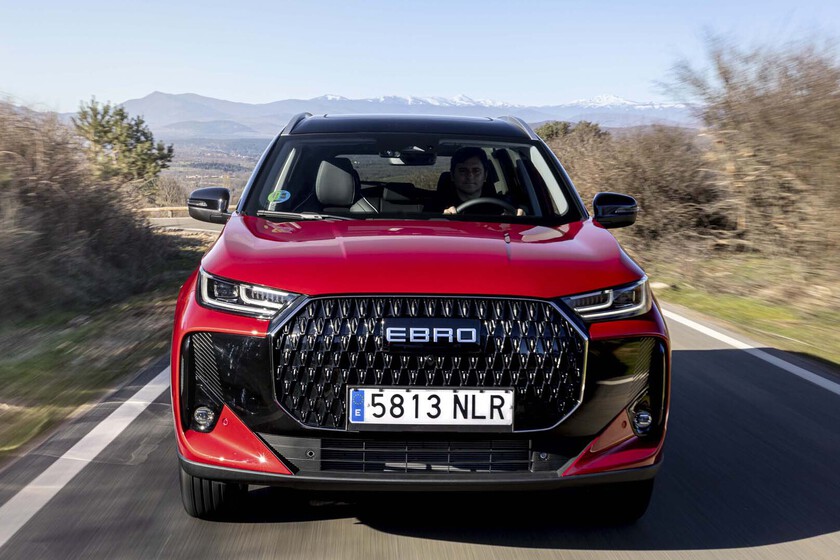
In Ebro, hybrid technology (HEV) is doing very well because the Ebro s400 HEV is already the brand’s best-selling car in Spain, so now this type of engine reaches its bigger brother, the Ebro s700.
The new Ebro s700 HEV debuts a 224 HP hybrid powertrain with ECO badge. It is already on sale with two trims.
The most rational and interesting in the range
So far this year, 194,718 non-plug-in hybrids (HEV) have been sold in Spain. That’s 19.61% more than in the same period of 2025, and these models already account for 40.09% of total registrations, which gives them, by a wide margin, the largest market share, surpassing pure petrol cars (20.55% of the market), diesels (17.12%), as well as electrics (8.59%) and plug-in hybrids (10.67%), according to ANFAC data.
The numbers make it clear: today hybrids are the Spaniards’ preferred option, and a similar trend is seen in the rest of European markets, so manufacturers are increasingly betting on this type of powertrain.

For a long time, Toyota was the only one doing it, but in recent years other manufacturers have developed very interesting hybrid powertrains, such as Renault and Honda, and now it is the turn of Chinese companies.
Among these, Chery stands out: the Asian giant has an interesting HEV system that, in record time, is reaching most of its brands, but also the brands with whom it has agreements, such as Ebro.
The first Ebro hybrid was the s400; in fact, this compact SUV is offered only with an HEV setup since it launched a few months ago and it quickly became clear that it was a wise decision by Ebro because it is the brand’s best-selling car in Spain.
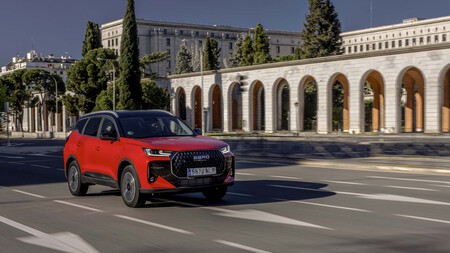
Now, that hybrid setup reaches the s400’s bigger brother, the Ebro s700, a C-segment SUV that measures 4.55 meters in length and was already available with a 147 HP gasoline engine and in a plug-in hybrid version with 279 HP.
The hybrid setup used by this new variant combines a 1.5-liter four-cylinder turbocharged combustion engine with two electric motors and a 1.83 kWh lithium-ion battery. It develops 224 HP, placing it between the gasoline and the PHEV, and it is more powerful than the s400 HEV, which is 211 HP, despite using the same HEV system, although at the wheel it feels different.
True enough that they are two completely different cars and each has its own tuning, but the Ebro s700 HEV is not only more capable than its smaller brother, but also more pleasant to drive. On paper, there is barely 13 HP difference between them and that small power bump should not be noticeable because the s700 is almost 30 cm longer and heavier, but the truth is that it is noticeable, and quite a bit.
Note: it isn’t a jet, and there are other hybrid vehicles with similar power that move better, such as the Toyota C-HR PHEV, which also has 224 HP, but this new version of the s700 never falls short; it moves clearly better than the gasoline s700 and its performance is more than enough to avoid needing more muscle in any situation, after all, it accelerates from 0 to 100 km/h in 8.7 seconds.
In terms of performance, it’s not only the mid-range option of the lineup, but also the most logical. Furthermore, there is barely any difference in performance with the Ebro s700 PHEV of 279 HP (0-100 km/h in 8.4 seconds): many drivers find it worth it to swap to this one to avoid depending on plugging in because all you have to do is refuel.
Also, it consumes little. On the initial drive, the average consumption ranged between 5.5 L/100 km and 6 L/100 km, combining city, highway and secondary roads. It’s not possible to know exactly how much it consumes because the onboard computer only provides data for the last 50 km.
Ebro is aware that this way of showing consumption is not ideal, so it is working on changing it and presenting the data in another way (since reset, and since the last refuel). In any case, it is clear that it consumes very little and, as the fuel tank holds 51 liters, the range is very good: more than 850 km per tank is feasible.
Beyond performance and consumption, what stands out about this setup is its smoothness: it is very pleasant because it delivers power in a very linear manner and the electric part is always there to push immediately.
It is also pleasant for being quite quiet. The Ebro s400 HEV makes much more noise during hard accelerations, but the s700 HEV is more discreet, partly because it is better insulated, although it is not only about insulation: the hybrid system is better tuned and you can tell.
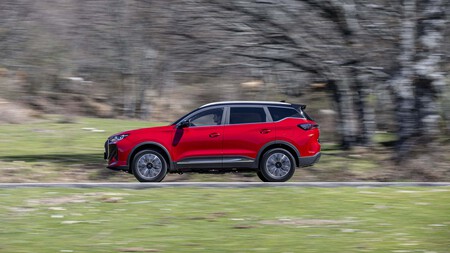
Because the car is very focused on comfort, this hybrid system suits its personality perfectly. Ebro has taken advantage of the launch of this version to make some chassis changes and mount a firmer suspension, just enough to improve the car’s dynamic behavior without sacrificing ride comfort. As a result, it feels more European because, with the previous suspension, it was too soft, and that doesn’t appeal to European drivers.
Another thing that has changed is the steering, but the result isn’t the same as with the suspension because this other modification isn’t as noticeable; in fact, the steering remains one of this SUV’s weak points, precisely because it doesn’t have a European feel: it’s not very direct, slow and not very informative. At least it’s very comfortable to use because it weighs nothing and it’s appreciated in city driving, but on the highway there is still room for improvement.
The good news is that, very likely, Ebro will fix it quickly because it has been able to identify the weaknesses of its cars to talk with Chery and remedy them in record time.
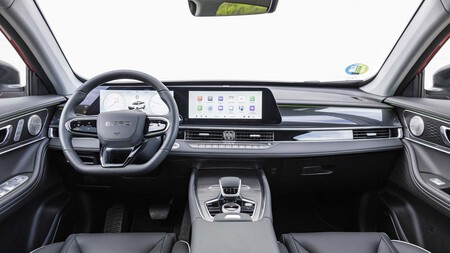
Proof of this are the interior changes made to the s700 as part of launching this new hybrid version. Both the petrol and the PHEV feature a gear lever that also clashes with European tastes because it is too conspicuous: the HEV debuts a more understated lever, finished in leather.
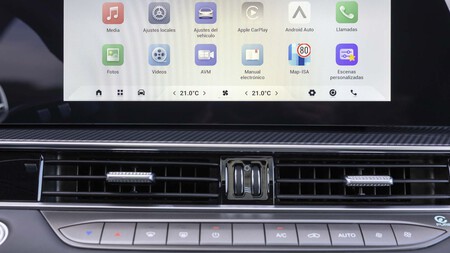
Another thing Ebro has corrected is the central console buttons, under the vents. In the gasoline and the PHEV they are touch-sensitive and not very precise to operate, but the new s700 HEV uses traditional, easy-to-use buttons. This change is welcome because these buttons control the climate system and, although they can also be managed from the central screen, the classic buttons are more effective and intuitive.
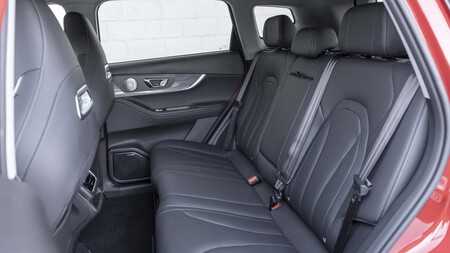
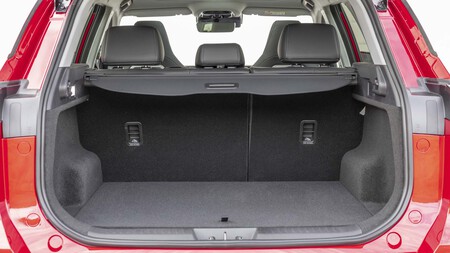
Other than that, it’s the same car we already knew. That means the interior is very spacious and the boot is a bit small at 369 liters of capacity, a modest figure for a SUV of this size. It offers the same volume as the gasoline and the PHEV.
It is also offered with the same trims as the gasoline: Comfort and Luxury. Both are well equipped as standard, but, logically, Luxury stands out as the top of the range and includes items such as the panoramic roof, the 540-degree camera (it has a function to make the floor “transparent”) and heated and ventilated power-adjustable front seats.
Price of the Ebro s700 HEV
The starting price of the Ebro s700 HEV Comfort is 28,990 euros and the Ebro s700 HEV Luxury starts at 31,490 euros; in both cases, the price is subject to promotional campaigns and financing with the brand.
The only optional choice is exterior paint: Khaki White is free, Carbon Black and Phantom Gray cost 500 euros each, and the two-tone White/Black and Red/Black cost 600 euros each.
Images | Ebro