
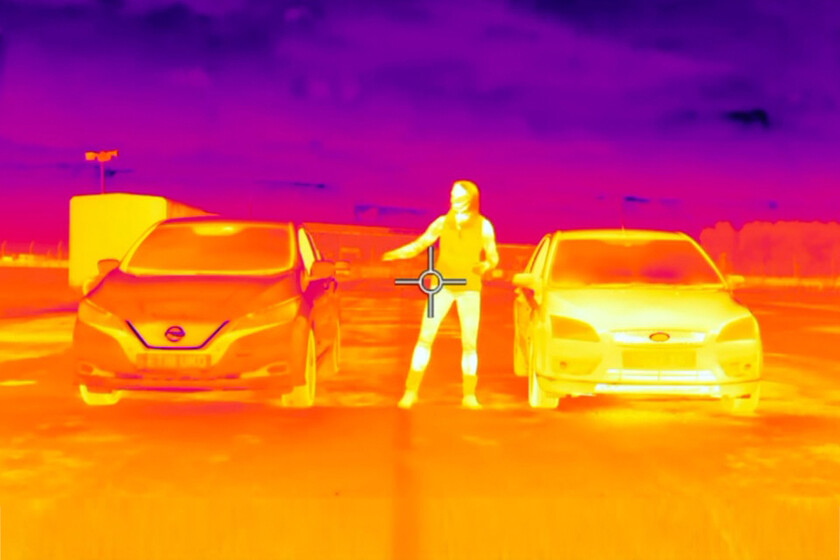
The debate between electric cars and internal combustion engines typically revolves around range, price, practicality, or emissions, and even something more subjective like driving pleasure, but there is a less-explored dimension that is immensely revealing: efficiency. And the best way to illustrate the differences between the two is to use a thermal camera.
A picture is worth a thousand words. And this one clearly illustrates how an internal combustion engine wastes more than half of the energy it uses as heat, while the electric vehicle does so only minimally.
Electric vehicles win by a wide margin over internal combustion engines in efficiency
Beyond personal opinions or driving preferences, there exist objective technical differences between the two technologies that are often overlooked by most drivers.
Fully Charged has conducted an empirical test using a FLIR thermal camera (the same brand used by many manufacturers for their ADAS) to visualize something that is invisible to the naked eye: how and how much heat each technology wastes, revealing the real efficiency of each engine.

And this makes what we already knew about the energy efficiency of these two types of engines even more evident: the internal combustion engine is considerably hotter than the electric vehicle, glowing in a bright orange.
In the case of electric cars, the thermal image is rather discreet. Heat appears concentrated in very specific zones, essentially around the wheels and the battery cooling systems, and at relatively low levels. The absence of a gasoline engine that burns fuel eliminates the main hotspot of thermal dissipation, which translates into much more efficient energy management.
In other words, almost all the energy consumed is converted into movement, not residual heat. This is not a minor detail, but one of the most important structural advantages of electric propulsion, even though it is rarely mentioned.
In fact, that efficiency is what leads brands like Nissan, Renault, Honda or BYD to create hybrid models in which the gasoline engine barely or never moves the wheels of the car and only generates energy, with the electric motor moving the car. The efficiency of this setup is such that real-world consumptions can be as low as 4.5 l/100 km even though these cars can be around 200 HP.
The view offered by the thermal camera for a petrol or diesel vehicle is radically different. Heat floods the entire front end of the car and even the driven wheels, a direct result of combustion and the constant mechanical friction that characterize these engines.
That thermal excess is not just a waste of energy: it forces manufacturers to design complex and costly cooling systems to protect components, which are exposed to extreme temperatures continuously. The result is a broad and diffuse thermal footprint, emblematic of all the energy that is lost as heat before it can move the wheels.
In the end, a diesel engine manages to convert between 40 and 42% of the energy it consumes into motion, while most gasoline engines have an efficiency of 30 to 35%, with some exceptions around 40%. In an electric, that percentage hovers around 85%, far surpassing both.
The conclusion drawn from the experiment is technical, but with very concrete practical implications: electric motors not only pollute less in terms of emissions, but they are also intrinsically more efficient at utilizing the energy they consume.
And that efficiency, now visible in colors through a thermal lens, sheds new light on a debate that, far from being purely ideological, rests on a scientifically documented basis that is becoming increasingly hard to ignore.
Find your ideal electric car
If you have considered buying an electric car, this will interest you. We have created the Personalized Electric Car Recommender, where in addition to seeing models that fit your needs you will also get answers to the questions that may worry you most, such as price, range or nearby charging points.