
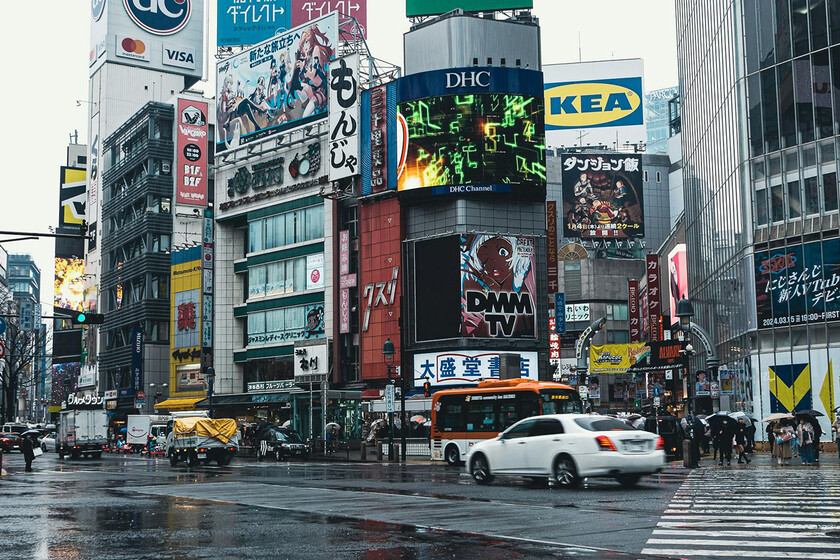
Population density in Tokyo and Madrid is fairly similar: 5,801.52 inhabitants per square kilometer for Madrid’s capital and 6,501 inhabitants per square kilometer for the Japanese city, even though Madrid has more than four times as many inhabitants (14.2 million versus 3.5 million). But when we talk about urban mobility there is a gulf: in Tokyo there are barely any cars compared to Madrid.
The reason: in the Japanese city owning a private car is as limited as it is expensive. This is not exclusive to Tokyo: it applies to any of the large Japanese cities. One example is that if you don’t have a garage space, you cannot buy a car. It’s not the only factor.
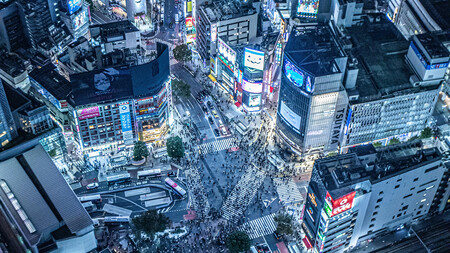
A city where cars don’t fit and are designed to be used sparingly
In Spain there are about 25.79 million registered cars and in Japan the number exceeds 76 million. It would be natural to think that Tokyo and the major Japanese urban centers would have more automobiles than our cities, but the opposite happens: the average number of cars per household in Tokyo is 0.32 vehicles, while in Madrid it hovers around 1.08 cars per dwelling.
To understand why, we must look back at the dramatic growth of Japanese cities in the last century. In the early 20th century only about 15% of Japanese people lived in urban areas; today that figure exceeds 90%. This shift came especially after World War II: cities expanded uncontrollably, weaving a maze of narrow streets with hardly any space for cars and other vehicles. The solution, therefore, was to limit cars.
Without a garage there is no car. In 1962 Japan introduced the Shako Shomeisho, mandatory in the country’s large cities. It is a certificate that must be presented when buying a car and guarantees that a parking space is available to park it. In other words, if you live in an urban area, you cannot purchase a vehicle without first proving that you have somewhere to park it.

There are exceptions: if you acquire a kei car, cars shorter than 3.4 meters and not exceeding 64 horsepower, you are not obliged to have a garage. Hence, they are so prolific in Japan: they account for 40% of the country’s sales. Although in densely populated areas, such as central Tokyo or Osaka, they are not exempt. So if you don’t have a garage you must rent one. It is one of the most sought-after properties: it can cost from 77,000 yen per month (about 500 euros) to over 100,000 yen (more than 700 euros) depending on the area.
Furthermore, parking on public streets in major cities is highly restricted and, in many cases, limited to temporary stops or loading/unloading. Enforcement is strict and fines can exceed 1,000 euros at current rates. This forces people to turn to parking facilities, which are far from cheap.
Owning a car, almost a luxury. On top of this already notable constraint there is another: keeping a car in Japan is extremely costly. For starters, there is the so-called Shaken, the Japanese vehicle inspection: it is stricter than ours, since the first inspection occurs at three years and then every two years. If a car is too powerful, the first inspection is at two years.
Its price ranges between 100,000 and 200,000 yen (between 530 and about 1,000 euros at the current exchange rate). It also includes mandatory insurance and a weight tax on the vehicle. Hence many Japanese opt to sell it quickly, typically not exceeding four years.
Other costs add up, such as the extended insurance policy (highly recommended), the annual vehicle tax (between 10,000 and 50,000 yen) or the levy payable when purchasing a car. As if that weren’t enough, most Japanese highways and roads are toll roads.
The car is not necessary to get around. As a result, Tokyo is one of the world’s major cities where car use is the lowest: car trips account for about 12%, followed by bicycle trips at 17%. The vast majority of urban travel is done by public transport or on foot. The Japanese capital hosts the most-used public transport network, with around 30 million people turning to trains every day.
In this, Japan’s commitment to a broad railway network has been pivotal, and today it stands as one of the densest and most efficient in the world, serving as the backbone of mobility both between cities and within them. In Tokyo, the network of trains, commuter rail, and subway connects the various neighborhoods, enabling travel without relying on a car.
Images | Pexels