
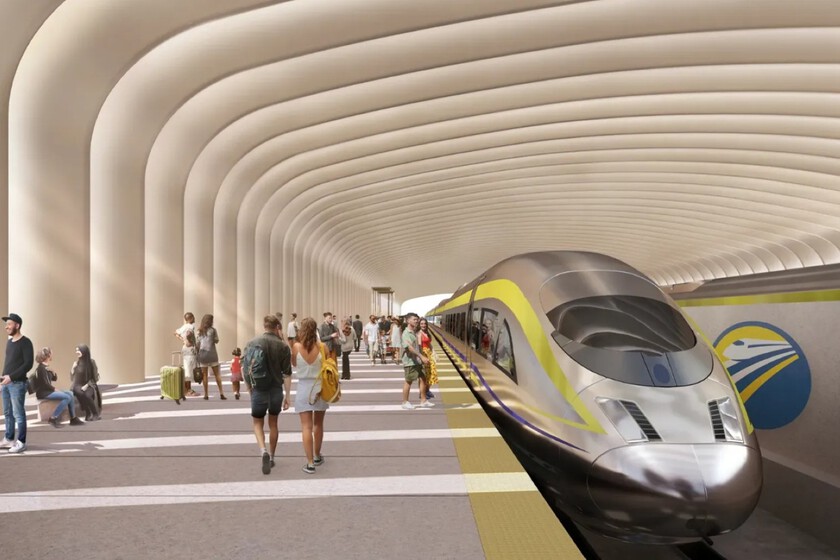
The United States has, for more than two decades, watched with something like envy as Japan, Europe, or China have advanced in railways. Yet while other countries normalized high-speed travel years ago, the major American project remains stalled in California, and there doesn’t appear to be a mid-term solution.
The core of the project was to link Los Angeles and San Francisco in under three hours with a train capable of more than 350 km/h, to cut internal flights, and to modernize mobility in the country’s wealthiest state. But the drawbacks have accumulated, costs have surged to about $126,000 million (€111,000 million), and there are still no operational tracks in place.
A Case Study in How a Major Project Becomes Complicated
In 2008, California voters approved bonds totaling $10,000 million to kick off the ‘California High-Speed Rail’. The total budget was then around $33,000 million (approximately €29,000 million) and the official forecast pointed to opening around 2020. But that timetable has long since been blown apart.
Years have passed, unforeseen events and problems have piled up and the current bill has risen to $126,000 million or about €111,000 million at the current exchange rate. In other words, almost four times the original forecast. By comparison, the Madrid–Barcelona AVE construction ended up costing €8,966 million.

Moreover, tens of billions more still need to be secured to complete the project, according to the California High-Speed Rail Authority itself in its business plans, as reported by U.S. outlets such as CBS News, Fox News, or The Fresno Bee.
On paper, the idea went far beyond merely linking Los Angeles and San Francisco. A vast railway network was projected to run across California from north to south, from Sacramento, the state capital, to San Diego on the Mexican border, also connecting the major metropolitan areas.
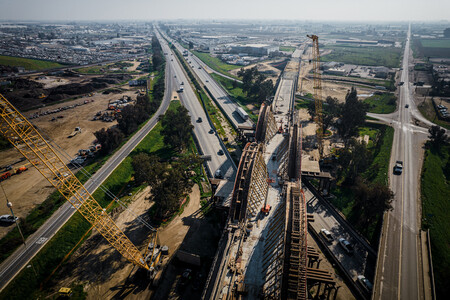
Today, the bulk of the project concentrates in the Central Valley, a large inland agricultural area less populated than the California coast. There, work is advancing mainly on the Merced-to-Bakersfield segment. And there is actually construction: in Fresno, underpasses, viaducts, and new road links are being built. Level crossings have also been eliminated and several key structures have been erected.
The train that was going to change the United States remains trapped between cost overruns, delays, and politics
The problem is that all of that is still far from meaning an operational high-speed line ready to carry passengers. But why has it twisted so much? Because almost every possible issue has converged in a mega-project like this: complex takings, thousands of private parcels to acquire, roads and public networks to relocate, expensive bridges and tunnels, seismic zones, lawsuits, continuous redesigns, and inflation in materials and labor.
Financing has also weighed heavily. The project has progressed in phases, depending on state bonds, federal funds, and constant political shifts. Each administration has pushed it in a different direction, and that tends to drive up timelines and costs.
The railway has also become a political instrument: its opponents call it a “train to nowhere,” while its supporters insist that canceling it now would waste everything invested and give up the country’s first real high-speed system.
The contrast is obvious when looking abroad: Japan inaugurated the Shinkansen in 1964, Spain counts among the world’s largest AVE networks, and Morocco opened its high-speed line in 2018. In the United States, that grand rail dream still in 2026 seems more like an eternal promise than a near-term reality.
Images | California High Speed Rail