
Enough to justify its place in an increasingly crowded lineup?
In a Nutshell
The Dacia Jogger Hybrid 155 hp Extreme 7-seat receives an update with a more powerful hybrid drive, a modernized lighting signature, and enhanced equipment. While it now offers driving pleasure that’s been raised and fuel consumption that’s lower, its new features and improved performance must contend with increased internal competition, notably the Eco-G version. Still, it preserves solid arguments like seven real seats and an attractive price. It remains a compelling choice for families seeking versatility and efficiency.
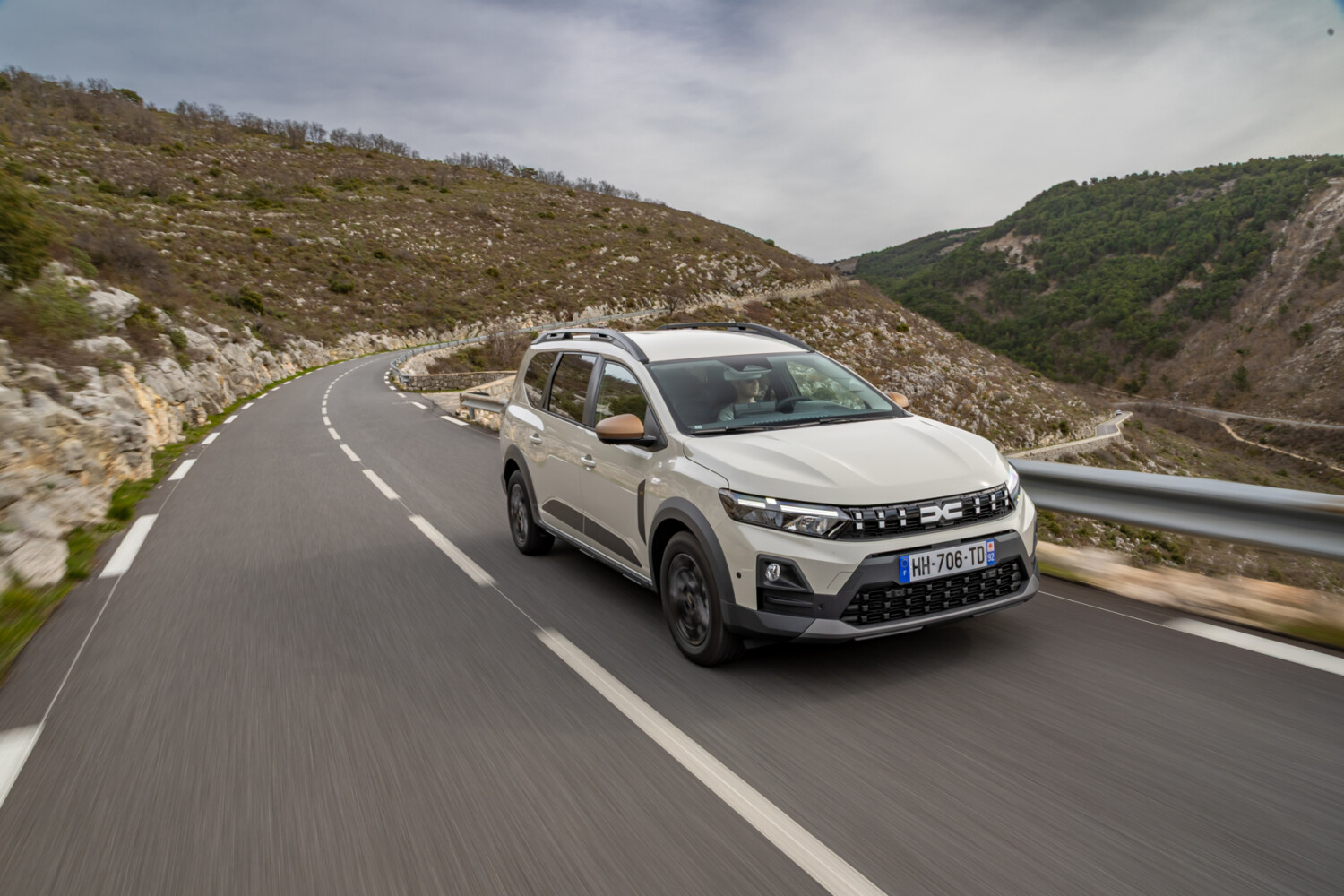
Dacia Jogger Hybrid 155 ch Extreme 7 places : a new pixel-inspired lighting signature
In the midst of spring-cleaning (a bit early, to be sure), Dacia hasn’t forgotten its Jogger. Yet, since the successive arrivals of the new Duster and Bigster, this troop carrier has kept a relatively low profile. It must be said that its prices aren’t far off from the flagship SUV in the lineup, which also boasts a roomier second row and, above all, a trendier look. Dacia therefore offers a few welcome tweaks. To harmonize it with the rest of the range, it gains a new pixel-inspired lighting signature. Inside, some materials switch tone, while the central screen grows from 8 to 10 inches and now accepts wireless smartphone mirroring with an inductive charger. It can also be upgraded with options, including a new multi-view rear-view camera (but not 360°), an Arkamys audio system, or heated seats… Enough to push the price past €30,000 if you go heavy. It’s the under-the-hood changes that are most notable, though.
Dacia Jogger Hybrid 155 ch Extreme 7 places : a new 1.8-liter 155-horsepower hybrid setup
The hybrid variant of the Jogger gets the new 1.8-liter 155 hp powertrain, replacing the old 140 hp unit. At the wheel, the improvements of this powertrain, already seen elsewhere from Renault and Dacia, are noticeable. The gearbox, still a dog-leg arrangement, is now a touch smoother and shows less hesitation on takeoff. The whole package is also quieter, though the Jogger’s economy-focused insulation still lets through plenty of mechanical noises, not to mention the wind noise at highway speeds. The other good news concerns fuel economy, which should drop by about 0.5 L/100 km, slipping to just under 6 L/100 km on average. Very satisfying given the vehicle’s size (4.55 m long) and especially its mission to take the whole family on vacation. The Jogger remains fairly comfortable, but its obvious lack of agility isn’t thrilling for the driver. Unfortunately for it, this hybrid powertrain now faces new internal competition.
Dacia Jogger Hybrid 155 ch Extreme 7 places : a meaningful bump in performance
Until now, it was the only option to skip a manual transmission on the Jogger, but it now faces the new Eco-G 120 hp, available with an automatic. A proposal that should prove far cheaper to run thanks to the lower cost of GPL. The price gap rises to around €3,000 at purchase, including the small CO2/weight penalty that comes with Eco-G. That makes it hard for the Hybrid 155 hp to assert itself as the default choice in the lineup, which until now accounted for roughly a third of Jogger sales. It’s worth noting that the hybrid remains more pleasant to use, thanks to its relative quietness and its smoothness, especially in town. And it offers a meaningful performance boost, especially when it comes to taking advantage of the seven seats offered by this version. That variant remains its only real argument against the Bigster. In short, the Jogger is more enjoyable than ever, even if it’s no longer the Swiss Army knife it once was.
Dacia Jogger Hybrid 155 ch Extreme 7 places : its advantages
- Increased driving pleasure
- Lower fuel consumption
- Modern equipment
Dacia Jogger Hybrid 155 ch Extreme 7 places : its drawbacks
- Internal competition
- Lightly underdeveloped sound insulation
- Lack of agility
Dacia Jogger Hybrid 155 ch Extreme 7 places : in measurements
(manufacturer data)
- Engine: inline-4 petrol + 2 electric motors
- Power: 155 hp combined (gasoline 109 hp at 5,500 rpm + electric 49 and 20 hp)
- Torque: 172 Nm at 3,000 rpm + 205 and 50 Nm (electric)
- Gearbox: 4-speed dog-leg + 2 electric motors
- Dimensions (L/W/H / wheelbase): 4.55 / 1.78 / 1.68 / 2.90 m
- Weight: 1,388 kg
- 0 to 100 km/h: 9 s
- Top speed: 180 km/h
- Average consumption: 4.4 l/100 km
- Price: €27,800
- CO2 emissions: 99 g/km
- CO2/weight penalty: €0
The Auto-Journal verdict: 4/5
The Jogger hasn’t lost what makes it strong: seven real seats at an attractive price. And this new hybrid setup is smoother and more economical. But it is no longer the default recommendation within its own lineup.
You can read our first test of the Dacia Jogger Hybrid 155 hp Extreme 7-seat in Auto-Journal issue 1204 dated March 5, 2026.
Comparison Table
| Features | Dacia Jogger Hybrid 155 ch Extreme |
|---|---|
| Powertrain | 4-cylinder petrol + 2 electric motors |
| Cumulative power | 155 hp (gas: 109 hp at 5500 rpm + electric: 49 & 20 hp) |
| Torque | Petrol: 172 Nm at 3000 rpm Electric: 205 & 50 Nm |
| Gearbox | 4-speed dog-leg + 2 electric motors |
| Dimensions (L/W/H / wheelbase) | 4.55 / 1.78 / 1.68 / 2.90 m |
| Weight | 1,388 kg |
| 0–100 km/h | 9 s |
| Top speed | 180 km/h |
| Average consumption | 4.4 l/100 km |
| Price | €27,800 |
| CO2 emissions | 99 g/km |
| CO2/weight penalty | €0 |
The essentials to remember
- The Dacia Jogger Hybrid 155 hp Extreme gains power and efficiency with a new 1.8-liter hybrid engine of 155 hp.
- It now offers modern equipment, including a new central display, wireless smartphone mirroring, and innovative comfort options.
- Fuel consumption drops to 4.4 l/100 km and CO2 emissions to 99 g/km, with no associated penalty.
- Its seven real seats and affordable price remain key advantages.
- It must, however, contend with strong internal competition, notably the cheaper-to-run Eco-G 120 hp version.
- Lack of sound insulation and agility remain its main weaknesses.
FAQ
What are the strengths of the Dacia Jogger Hybrid 155 ch Extreme?
The model stands out for its seven real seats, a smoother and more economical hybrid powertrain, and modern equipment.
What interior improvements were made to the Jogger Hybrid?
New materials, a central display that grows from 8 to 10 inches with wireless mirroring and a wireless charger, as well as options like a multi-view rear camera and heated seats.
What is the average fuel consumption of the Jogger Hybrid 155 ch Extreme?
The claimed average consumption is 4.4 l/100 km.
Does the Dacia Jogger Hybrid 155 ch Extreme incur an eco penalty?
No, it is exempt from CO2 and weight penalties.
Against what internal competition must the Jogger Hybrid 155 ch Extreme stand its ground?
It must contend with the arrival of the Jogger Eco-G 120 hp, which is more economical to run thanks to GPL.