
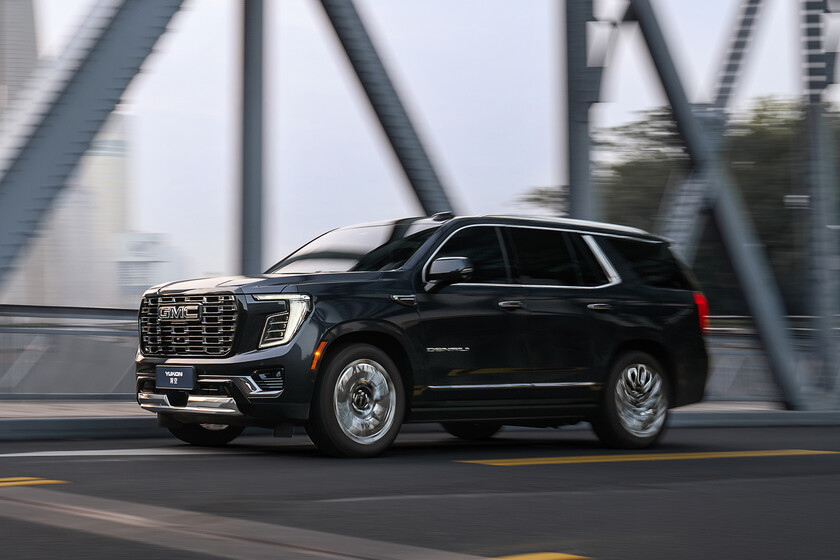
The obsession of the current occupant of the White House with a trade deficit he does not understand (not inherently bad per se) has put the automobile industry at the center of the trade tensions, initiated by himself, between the United States and Europe.
Beyond the figures and the tariffs, the real obstacle lies in the marked disinterest European consumers show toward most American cars, regarded as unsuitable. The reality is that in Europe, we have little to no interest in American cars.
Cars ill-suited for Europe
Donald Trump has complained on numerous occasions about not seeing American cars in Europe and about seeing only foreign cars in his own country. He did so during his first term leading the United States and he has repeated it in the second. This time, however, he went further and opened a tariff offensive in all directions. The import of new cars into the United States came to bear a 25% surcharge, especially for European cars, although later the trade agreement between Washington and Brussels left that levy for EU cars and components at a total of 15%.
Curiously, in Europe we do see American cars quite often. And more than we think. Of course there are the Teslas. However, the anecdotal Model S and Model X left Fremont, in California, while a large portion of the Teslas circulating in Europe have arrived from Shanghai or are manufactured in Germany, at the Berlin Gigafactory.

The BMW X3 is made in the United States for the whole world.
On the other hand, it turns out that the main exporter’s of cars from the United States is a German brand, BMW. Almost 57% of the cars produced by BMW at its Spartanburg, South Carolina, plant are shipped to around 120 global markets. BMW has been the largest exporter of cars by value from the United States for more than a decade. In fact, with the exception of the BMW X1 and the BMW X2, all of the German brand’s SUVs are manufactured exclusively in the United States, including of course the ones sold in Europe.
Moreover, in 2024, almost 50% of the BMWs sold in the United States came from the Spartanburg plant. The factory has an annual production capacity of up to 450,000 vehicles and employs more than 11,000 people. And BMW is not alone. Mercedes, Volkswagen, Nissan, Honda, Subaru, Toyota, Hyundai, and Volvo have factories on American soil. Yes, Trump will see many cars from foreign brands, but many are Made in USA.
The numbers speak for themselves and partly explain the stance of the United States. The EU still applies a 10% tariff on cars imported from the United States, while the United States is no longer at the old 2.5% for European passenger cars: after the tariff escalation of 2025 and the subsequent agreement with Brussels, European cars and components now bear a levy of 15% when entering the US market.
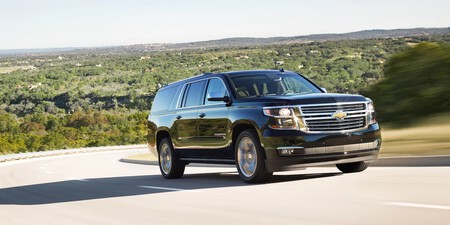
Chevrolet Suburban
Additionally, the European Union exports massively to the United States. The value of vehicles sent across the Atlantic amounts to almost €38.9 billion per year. By comparison, European imports of American cars barely reach €7.7 billion. In terms of volume, the difference is equally striking. Each year about 750,000 European cars are shipped to the United States, while only 165,000 vehicles manufactured in the United States reach Europe.
This colossal imbalance fuels the tensions. Washington struggles to accept that this goods deficit could be offset by other sectors, such as services, where American dominance is overwhelming (the weight of Google, Apple, Meta alone is immense). However, reducing the problem, or the supposed solution, to a simple matter of taxes and the trade balance would be a profound error in analysis. The reality is that American cars, in the sense of vehicles designed for the North American market, do not interest us in Europe. And tariffs aren’t going to change that.
The crux is not so much economic as cultural and practical. American cars, being largely designed for their domestic market, simply do not meet the expectations and constraints of the European market. This is something Ford has understood since the 1950s, when its European lineup often bore little resemblance to the American one, except for image cars such as the Ford Mustang, whether in coupe or electric form. General Motors, had Opel as its European range completely different from the American.
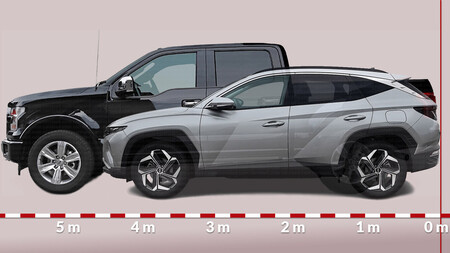
Even against a Hyundai Tucson, the Ford F-150, the best-selling car in the US, is enormous.
The reality is that American cars, due to their dimensions and engines, are not tailored to our needs. “In the United States, the average length of its 20 most popular cars is 5.00 meters, while the average length of the 20 best-selling models in Spain in 2024 was 4.21 meters. There is almost 80 centimeters of difference,” my colleague Álvaro wrote a year ago.
The Ford F-150 pickup was the best-selling vehicle in the United States in 2024; it tallied 732,139 registrations and measures 5.89 meters in length. In Europe, the best-selling car was the Dacia Sandero, a passenger car of 4.09 meters. There is a 1.80-meter gap. In fact, the two largest cars in the European Top 10 of best-sellers have been the Dacia Duster (4.34 m) and the Skoda Octavia (4.70 m).
And it is not only a matter of dimensions; the engine range is not adapted to our reality either. The smallest engine available in the Ford F-150 is a 2.7-liter petrol V6 with 325 hp, delivering an average consumption of 10.7 l/100 km. Even in a model we know well, such as the Toyota RAV4 (the third best-selling car in the United States in 2024), the engines can be different. Thus, the entry engine for the RAV4 on the other side of the Atlantic is a 2.5-liter four-cylinder engine producing 204 hp with an average consumption of 7.8 l/100 km.
Of course, with historically cheap gasoline, fuel consumption is not particularly relevant for most American buyers. Not so in Europe, where 95 octane gasoline often exceeds two euros per liter in several countries.
Ultimately, even if tariffs, had they worked, could have been a source of tension affecting trade flows and employment, they would not have been the fundamental cause of the low volume of American cars sold in Europe. The real problem is the product-market fit. American manufacturers largely do not offer models tailored to our market. And in fact, the few units they sell are halo cars such as the Ford Mustang, the Corvette, or Cadillac’s electric lineup.
Until American manufacturers propose cars aligned with European specifications (size, consumption, engines, emissions), interest from Europe’s consumers will remain limited, with or without tariffs.
Nevertheless, it is not in our interest to enter into a tariff war. The automotive sector is a cornerstone of the economy. According to the data presented in the Draghi report, commissioned by the EU to analyze European competitiveness, around 13.8 million people work directly or indirectly in this industry in Europe, representing about 6.1% of the total active population. Vehicle exports to the United States are a substantial part of this economic dynamism.