
China has for centuries astonished the world with colossal works like the Great Wall or the Terracotta Army. Today that tradition endures with infrastructures that seem impossible: the Huajiang Grand Canyon Bridge, the tallest in the world at 625 meters, or the Shenzhen-Zhongshan Link, a 24-kilometer mega-project that is simultaneously a macro-bridge, a tunnel, and a museum.
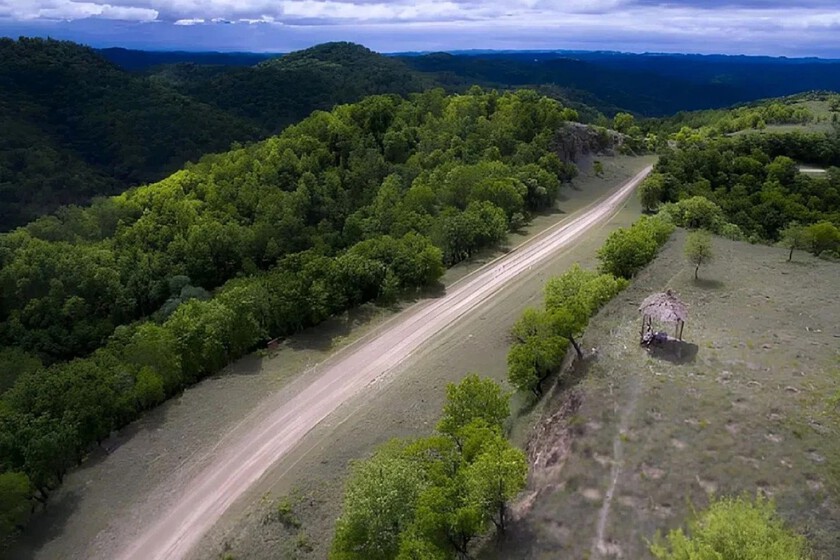
Now, to that list is added a much older historical jewel: an imperial road dating back more than two millennia that many specialists consider the predecessor to modern highways. Named the ‘Qin Straight Road’ or Qinzhidao, the 13-kilometer stretch has come to light thanks to excavations carried out by a team from the Yulin Institute for the Protection and Research of Cultural Heritage, in Shaanxi.
A Fast Road Designed 2,200 Years Ago
According to data gathered by National Geographic, the road spans a width of between 40 and 60 meters at certain points, measurements that still surprise today. Its main purpose was to rapidly move troops toward the empire’s northern frontier, a zone under constant pressure from the Xiongnu, nomadic peoples who for centuries posed a threat to imperial China.
Besides its size, what draws the most attention is the route itself. The engineers aimed to advance in a straight line whenever possible. To achieve this, they carved slopes, filled in ravines, and opened passages through the mountain. Archaeologists have identified as many as nine consecutive rock-cut steps, a colossal undertaking for a era without explosives or heavy machinery.
It is also remarkable the technique used to build the roadway bed. Various studies describe “layers of compacted earth measuring between 11 and 19 cm in thickness,” pressed by hand until achieving a hardness close to stone. The aim was to withstand the continuous passage of soldiers, supply carts, and animals, as well as to reduce erosion caused by rain and constant use.

The very existence of Qinzhidao had already appeared in the Historical Records of Sima Qian, which placed the start of the works around 212 BCE. However, much of its route remained a mystery. Aerial photography and satellite sensors allowed researchers to detect straight lines impossible in the mountains, which led to locating this hidden stretch after centuries.
But it wasn’t only a military route. Researchers have found ceramics, tiles, and construction debris pointing to a relay station along the route, something akin to an ancient service area where messengers and horses rested before continuing their journey. Chinese sources assert that the entire network surpassed 700 km and crossed territories of today’s Shaanxi, Gansu, and Inner Mongolia.
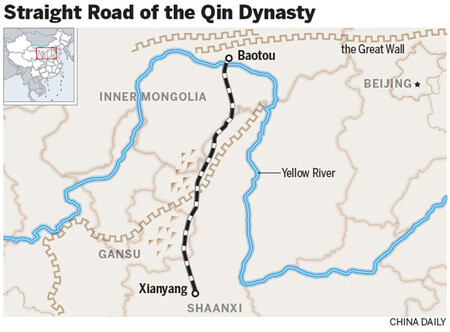
It is hard to imagine how such a structure could be erected without steel, excavators, or modern technology, but today, what has been a true “ghost road” for centuries leaves us with a very interesting idea: long before cars existed, China was already building grand roads intended to travel faster and to control vast territories.
Images | Government Shaanxi Province, SilkRoadDiaries, China Daily