By this point, there is no need for introductions when talking about Jaecoo (and its sister brand, Omoda). Although it is a very young company and has been in our market for less than two years, it has gained so much popularity—so quickly—that almost everyone knows it, and that even though for many months its range consisted of only one model, the Jaecoo 7.
Today, that lineup has grown, first from the bottom with the Jaecoo 5, and now from above with the Jaecoo 8 SHS, a large SUV that becomes the flagship of the Chinese company.
A rugged, large SUV that can be configured with five or seven seats
When Omoda and Jaecoo arrived in Spain, both brands bet on gasoline engines and on 100% electric cars, but they soon realized that (right now) the real business in our market is in hybrids and plug-in hybrids, at least in the short and medium term, because their sales keep rising, and as a result the electric and gasoline models from Omoda and Jaecoo have been complemented in recent months with hybrid (HEV) and plug-in hybrid (PHEV) alternatives.
Actually, the strategy is working quite well because the Omoda 5 HEV is in the Top 10 of the best-selling hybrids in Spain so far this year, while the Omoda 9 SHS hybrid plug-in is a “hit” and has cracked the Top 10 of the best-selling PHEVs in Spain since the start of 2026.

What’s most striking is that, as Omoda itself says, not even in their best forecasts were they expecting to sell so many units of the Omoda 9 SHS, but as I told you when I tested it a few months ago: it offers more than its German rivals for €25,000 less, and that attracts a lot of people, as do its 537 HP and its interesting plug-in hybrid setup with a 145 km electric range.
Well, since the flagship of Omoda is performing so well, Jaecoo has decided to replicate the formula in its own way, and the result is the Jaecoo 8 SHS. In essence, we are looking at the more serious brother of the Omoda 9 SHS.
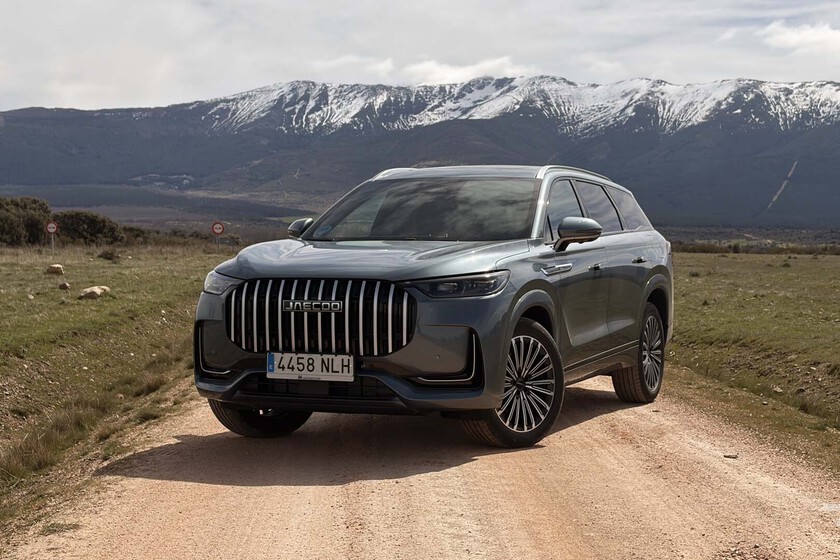
I’ll put it this way: Omoda has an aggressive design, with a pronounced coupé style and, overall, a younger and sportier focus, while the Jaecoo 8 SHS arrives with a more sober, rugged, and elegant look, a setup more oriented toward comfort and with extra practicality to be the more family-oriented of the two because it offers the option of configuring its interior with seven seats (the Omoda can only have five).
Thus, although the two share almost everything, they manage to differentiate themselves and carve out their own positioning: by image, by interior space, and by tuning, in fact, the Jaecoo 8 SHS does not reach the 537 HP of its brother and “settles” for 428 HP, though I’ll discuss this later.
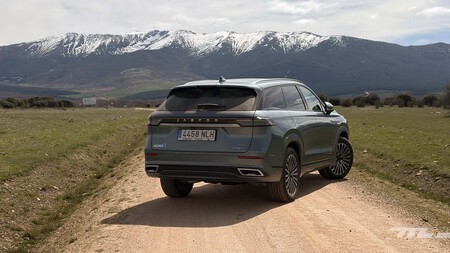
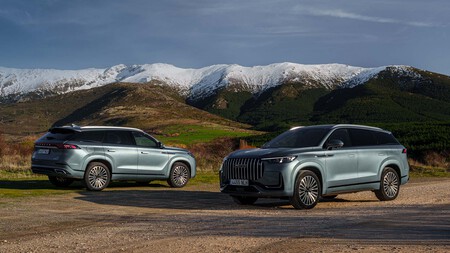
Returning to the exterior, not only does it have a less daring design with more presence, in the style of the big US SUVs, including a huge front grille that is becoming a hallmark of the brand, but it is also larger than the Omoda 9 SHS, reaching up to 4.82 meters in length, i.e., 5 cm more than the Omoda, although visually it seems much bigger due to its sculpted shapes and its massive 20-inch wheels.
Jaecoo 8 SHS: inside
That aesthetic sobriety also carries over to the interior. It follows the pattern of most SUVs on the market today, with two large screens as the main features (for the digital instrument cluster and the central infotainment, both 12.3 inches), very few physical buttons, a large central console, and very horizontal lines, so it isn’t innovative in this regard and doesn’t take design risks, unlike the Omoda. Let’s just say Jaecoo has aimed for a more European look.
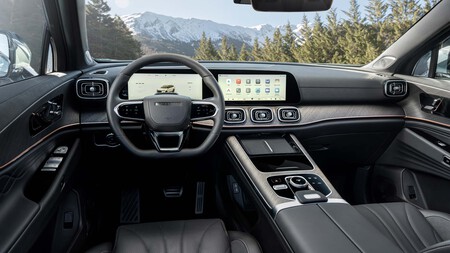
The driving position is comfortable (very high and not sporty at all). The seat plays a big role because it does not offer great body support, but it is very comfortable, has electric adjustments, is heated (and cooled, like the passenger’s, and, note, also the rear seats) and even has a massage function. Overall, this car is really well equipped.
On the other hand, there are many stowage spaces and the multimedia system, while well connected, works smoothly, though you need to spend some time getting used to its menus because it isn’t the most intuitive in its class and there are no physical buttons for key functions like the climate control.
What’s good is that by swiping down from the top of the central screen, a very useful quick-access menu unfolds, including the option to deactivate some ADAS (like the annoying speed-warning chime). It also allows you to activate a preconfigured profile with the ADAS you want to have on or off. It’s very useful.
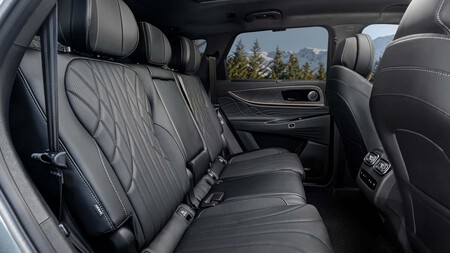
But there is something that stands out even more: the quality and the space. Let’s break it down. Since arriving in Spain, both Omoda and Jaecoo have shown they are well built, with materials pleasant to look at and to the touch and, above all, good fittings that convey solidity.
In the same way that the Omoda 9 SHS raised the bar in Omoda with higher-quality materials, the Jaecoo 8 SHS does the same for Jaecoo, placing it a couple of steps above the Jaecoo 7 in this regard, with lots of soft surfaces, good interior insulation, and fewer rough edges to refine.
I was especially struck by the sound when closing the doors; it is very round. Undoubtedly, it has earned the “premium” label, and all this demonstrates the room for improvement that Chinese brands, at least Omoda and Jaecoo, have ahead of them.
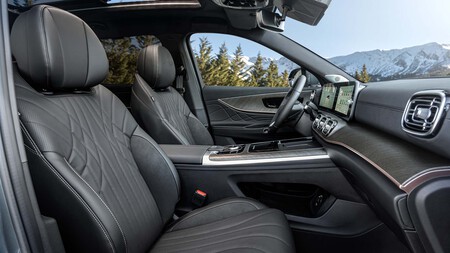
Regarding space, it is a large car on the outside and you can feel that inside, especially in the first and second rows, where there is plenty of leg and shoulder room, though not so much headroom because the floor is high, which is noticeable, albeit most adults won’t have a problem; it’s only an issue for very tall passengers. In the second row there are independent climate controls, USB ports, sun blinds, reclining backrests (in addition to heated and ventilated seats).

When a few years ago people wanted to boast about their car, the most common thing was to point to low consumption, power, or extras. Now, not so much. Technology has taken center stage. But it isn’t always where we expect it; it is found in places far less obvious.
Advice provided by the brand
In the seven-seat variant, the same logic applies to these extra seats as in other models in the segment, such as the Peugeot 5008, the Volkswagen Tayron, or the Renault Espace: they are only suitable for children because they are not spacious. Access to this area of the cabin is not easy (you reach it through the rear doors) and getting out requires some contortion.
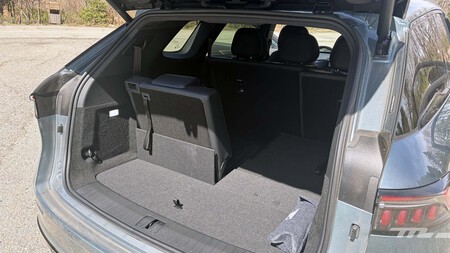
What’s good is that you have the option of these two extra seats, and when they aren’t needed they fold away in an instant and tuck flush with the boot floor, which has 738 liters of capacity (measured up to the roof) in this five-seat configuration. With the two rear seats deployed, volume drops to 200 liters.
Jaecoo 8 SHS: how it performs
Beyond space, equipment, and quality, the strong point of this Jaecoo 8 SHS is its plug-in hybrid setup, both for its 428 HP, its electric range, its total range, and its ability to recharge quickly. The recipe is identical to that of the Omoda 9 SHS, but with less power. Even so, until recently, figures above 400 HP were reserved for high-performance sports cars and very expensive SUVs.
Chinese brands, in a way, are democratizing power and high performance too, because this SUV, despite its family focus, its size and its weight (2,304 kg), does 0-100 km/h in 5.8 seconds. For reference, the Volkswagen Golf GTI Clubsport with 300 HP accelerates from 0 to 100 km/h in 5.6 seconds, so the Jaecoo is very fast.
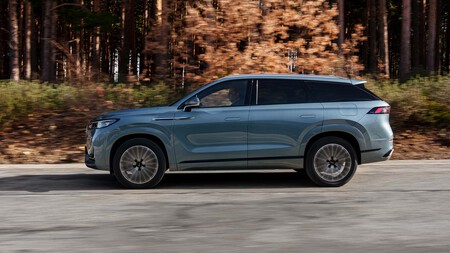
It also accelerates with a lot of poise, so you won’t have any trouble merging onto a highway or passing; in general, you won’t have performance problems, but don’t expect a car with a sporty feel.
The suspension is rather soft and the steering isn’t very informative; it’s similar to the Jaecoo 7 and that means it isn’t as “precise” as some of its European rivals because it is less direct, not quick, and it has too much assist, but it is very comfortable.
What is most noticeable at the wheel of the Jaecoo 8 SHS is the feel of the brake pedal because it seems to bite nothing in its initial travel; after a few kilometers you get used to it, but it is one of those things where Jaecoo has room for improvement.
In this regard, it is fair to say that the gear selector is much more precise than in the Jaecoo 5 and Jaecoo 8 because in those models you have to press the brake to the limit to engage D or R, whereas in the 8 you don’t need to and it operates more smoothly; it’s more comfortable.
Jaecoo has given absolute priority to comfort, so although the 8 SHS “goes” a lot, it doesn’t invite you to drive with a knife between your teeth all the time, but rather to drive calmly (and part of that calm comes from knowing it has plenty of muscle to pull away when needed).
View this post on Instagram
Since ride comfort is high, it also invites long trips, and this is helped a lot by the more than 1,000 km of total range that Jaecoo claims, although I haven’t had time to verify it during the initial drive.
The plug-in hybrid setup comprises a 1.5-litre four-cylinder turbo petrol engine, three electric motors, and a 34.46 kWh battery that allows for 134 km of pure-electric range. The good news is that the petrol tank holds 70 liters, so total range exceeds 1,000 km and you don’t have to refuel every couple of hours on the highway.
Additionally, the battery can be charged quickly, up to a maximum of 70 kW in DC, and that can be used on trips to recharge while you stretch your legs and sip a coffee to lower the average consumption on the next leg.
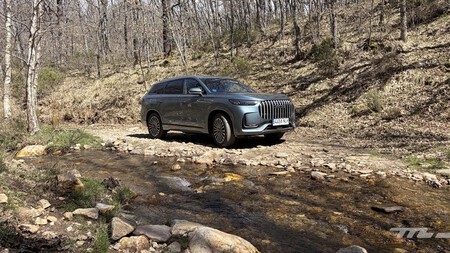
And there is another notable quality of the Jaecoo 8 SHS: its off-road capability. It is an SUV, but it doesn’t handle rough terrain poorly, which means it’s good for more than just gravel paths.
It is far from a Mercedes-Benz G-Class or a Ford Bronco; in fact, ground clearance is only 18 cm, but it is a step ahead of the Omoda 9 SHS because in addition to all-wheel drive, hill descent control and dedicated off-road, sand, and snow driving modes, there is a key ally when the going gets tough: a mechanical rear differential lock.
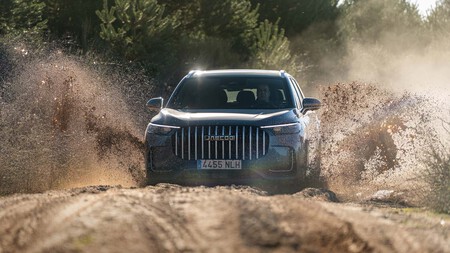
This feature makes a difference when mud or low-traction conditions arise because it helps you get out of trouble if used correctly, especially if you equip M+S tires rather than summer ones.
Price of the Jaecoo 8 SHS
How much does all this cost? Just like the Omoda 9 SHS, the Jaecoo 8 SHS offers an unbeatable value-for-money proposition and clearly outperforms rivals from traditional brands.
MSRP, before discounts or Auto+ Plan incentives, is €54,900 for the five-seat version and €55,750 for the seven-seat version (€850 more), always with the Exclusive trim, which is the only one available and includes everything since there are no options available, except exterior color and brown upholstery for the seven-seater (the standard is black in both versions).
With the launch campaign discounts and the Auto+ Plan incentives, the Jaecoo 8 SHS is available from €44,490.