
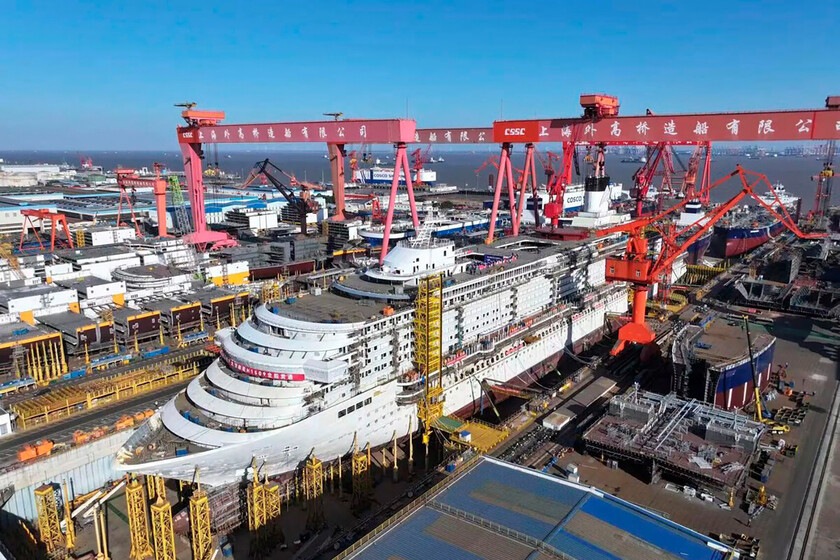
Starting from scratch, China has, in forty years, grown into a giant of shipbuilding, commanding 58% of the world market. After establishing itself in constructing simpler vessels, such as bulk carriers, China is now aiming at the last sector where Europe still holds the lead: the cruise-ship industry.
Nevertheless, that leadership is no longer exclusive: China has surged into the cruise sector with force.
China Now Also Builds Cruise Ships
For decades, Europe maintained an undisputed grip on the cruise industry, but China threatens that position. After twenty years of learning, China is ready to challenge the global leadership of European shipyards in the cruise sector. This market is regarded as the most complex in commercial shipbuilding. A long‑term threat to France’s Chantiers de l’Atlantique, the world number one, and to its closest followers, Italy’s Fincantieri and Germany’s Meyer Werft. These three European shipyards account for 90% of the cruise market.
According to the body that oversees the activity of Chinese state‑owned enterprises, the country has recently completed the construction of its second cruise ship. The flagship is the ‘Aida Huacheng, a 341‑meter‑long giant weighing 141,900 tons and hosting 2,144 cabins with the capacity for 5,232 passengers. Its 16 decks, according to its builders, will offer a wide range of leisure and entertainment facilities, though concrete details remain scarce.

What has been confirmed is that the vessel features two integrated desulfurization towers within an exhaust-gas cleaning system, whose function is to remove sulfur oxides from the engine’s exhaust gases, thereby reducing its environmental impact.
Despite the project’s size, the process—from dry-dock assembly to the integration of all systems—was completed in under nine months. Shanghai Waigaoqiao Shipbuilding, a subsidiary of the Chinese State Shipbuilding Corporation (CSSC), argues that this achievement positions them on a par with the major European shipyards. “It represents a firm step for China’s shipbuilding industry toward mastery of the key design and construction technologies,” the company stated.
China Enters the Map of the World’s Leading Shipyards
China has been climbing the ranks with patience, betting on increasingly sophisticated vessels. It started with bulkers and cargo ships, easier to build, and then stepped up the sophistication by adding more complex options to its portfolio, such as tankers, container ships, or Ro-Ro vessels to support Chinese car exports. And now they are entering the market of the most complex: LNG carriers and cruise ships.
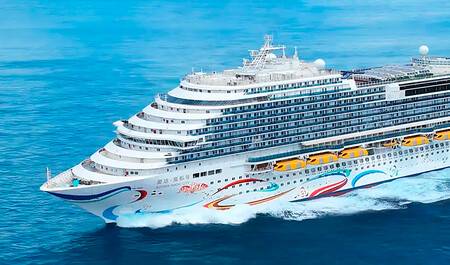
Between 2014 and 2022, the CMHI Haimen yard built ten small cruise ships with capacities between 350 and 400 passengers. In early 2023, the state-backed China State Shipbuilding Corporation (CSSC), the world’s top shipbuilder since its 2020 merger with CSIC, launched its first large cruise ship capable of carrying 6,700 passengers, which it delivered to the American Carnival in 2023, and received a second vessel of the same type in 2025.
“These two cruise ships are the product of a joint venture formed in 2018 between CSSC and Carnival. They are built from the plans and with the collaboration of the Italian firm Fincantieri. In exchange for a substantial sum of money (around 250 million euros, according to estimates) and the involvement of Italian equipment suppliers, Fincantieri agreed to accompany the construction of these two ships, designed identically to its own ships delivered some years ago,” notes Boris Fedorovsky, economic and technical advisor to Gican, the French naval industry union.
What these agreements reveal is something that unsettles more than one analyst: it is the Europeans themselves who are accelerating China’s ascent. Several experts agree that Fincantieri, by extending a hand to CSSC with the lucrative Chinese cruise-market in sight, unwittingly opened the door to a competitor that could eventually surpass them.
Since the early 2000s, China has replicated in shipbuilding the same strategy it followed in the battery and electric-vehicle sectors. The country began by gaining experience with simpler ships, such as bulk carriers and cargo ships, largely leveraging foreign know-how obtained through joint ventures, such as NACKS—an entity formed with the Japanese Kawasaki Heavy Industries—and CSSC, with the help of Fincantieri.
And today, China has become the world’s fifth country capable of designing and building large passenger cruise ships, thereby consolidating its position in an industry that until recently was almost exclusively European territory.
Images | CSSC, Adora Cruises