
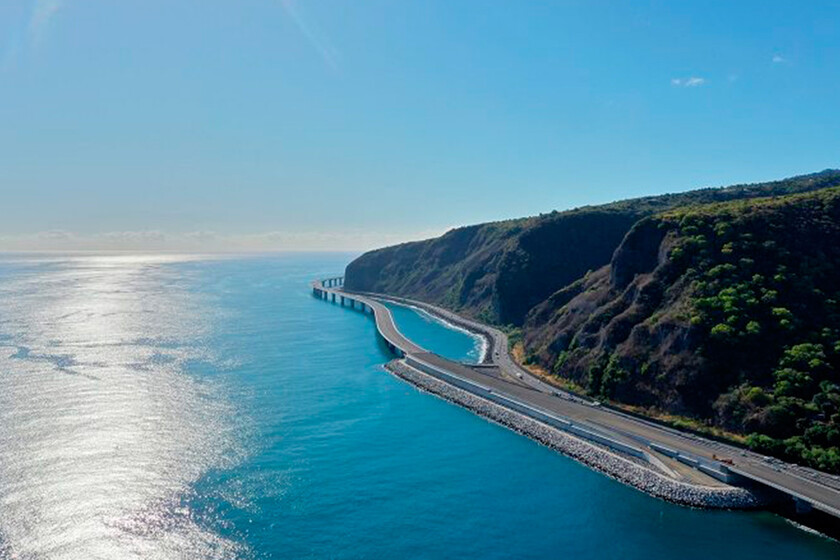
Regarded as the most expensive road on the planet, it has consumed around €2 billion, with an exceptionally high cost per kilometer. It is the Nouvelle Route du Littoral (NRL), an ambitious French project on the island of La Réunion and which, literally, has been built on the Indian Ocean. It stands as one of the most expensive and controversial government undertakings in France, following more than a decade of construction, delays, and design changes.
The Achilles’ heel of this ultramarine infrastructure was the segment planned over a seawall, which had to be halted because the necessary stone could not be supplied. This forced a redesign: it will ultimately be a viaduct and has just been restarted after years of suspension. It is expected to be fully completed by 2030.
Replacing the dangerous coastal road and 3 million tons of rock
This Nouvelle Route du Littoral (NRL) was conceived as the new coastal road to connect Saint-Denis, the island’s largest city, with La Possession. It replaces the old Route du Littoral (RN1), a road hugging the cliff exposed to all kinds of weather: rockfalls, floods from torrential rains, or the furious seas with high tide. This caused regular closures, endless maintenance tasks and not a few accidents with serious injuries and fatalities.
The French executive’s plan was to move the road out to sea, away from the cliff. According to the project’s main contractor, VINCI Construction Grands Projets, this new route “is designed to provide a safer road connection between the island’s two main urban nuclei.” Yet its construction, with high technical and logistical complexity, has faced numerous hurdles. Never more apt words.
The longest viaduct ever conceived on French soil. The total length of the NRL will be about 12 km when finished. It was designed with a large sea-spanning viaduct on piers, combined with sections on dikes and embankments. This highway sits between 80 and 300 m offshore, aiming to avoid the hazards and problems that the original coastal road presented. Construction as such began in 2015.
The main viaduct, 5.4 km long, has the honor of being the longest envisioned on French soil. At 30 m wide, it is a roadway with three lanes per direction, with one reserved for public transport and a bike lane. Linking with other sections on embankments and other viaducts, the road today spans a total of 8.7 km, between Saint-Denis and La Grande Chaloupe. It opened to traffic, in sections, between 2022 and 2023.
The impossible stretch over a dike. But problems arrived earlier, in 2019, with the final segment of this enormous road conquered by the sea, connecting to La Possession. The last part, projected over a dike, required around 3 million tons of rock. To obtain this material, two quarries—Saint-Leu and Bois-Blanc—near the coast would be exploited. However, these operations implied a significant environmental impact, causing damage to the coastline: several ecological associations challenged the authorizations in court.
The shutdown of the two quarries cut off the supply of the essential raw material for the dike. Thus, completing this stretch became unfeasible. Proposals emerged to extract rock from other sites, even outside the island, but such options would push the already astronomical bill of this ocean-spanning megaproject even higher. When planned, the cost was estimated at €1,600 million.
In 2020, construction of the dike stretch was officially halted, leaving the highway unfinished. What followed was a saga of million-euro claims between the builders and the administration. Yet this colossal project pressed on: in 2022 it was decided that the dike segment would become a aqueduct, linking with the portion of the first segment already in operation.
The most expensive highway in the world, with a final cost of €2.5 billion

The final chapter of this ambitious and problematic infrastructure was penned at the end of last year. In October, after more than five years of suspension, work resumed to raise the last stretch of this coastal road: a 2.5 km aqueduct from La Grande Chaloupe to La Possession, finally connecting with Saint-Denis.
Although not immediate, even if no more complications arise along the way. In the planned timetable we are in the initial phase, projected between November 2025 and July of this year 2026. The works are essentially preparatory, removing temporary structures and creating new connections with the old coastal road or preparing the infrastructure necessary for the new alignment laid on pillars.
It will not be until 2027 when proper construction begins, which will stretch for another three years until finally completing in 2030. Then, in theory, this sea highway will be ready at last. Fifteen years after it began to rise, the 70,000 drivers who use the old coastal road daily will be able to travel away from rockfalls and the sea’s swell.
€200 million per kilometer. The overruns stemming from legal battles and various compensation claims were set in 2024 at around €971 million, including interest. And the budgeted amount for this last 2.5 km stretch, including the structures partially completed on the old dike, has been estimated at about €59 million.
In total, the final cost is estimated to be around €2.5 billion. Extrapolated to the nearly 12 km that this NRL will span when finished, that equates to roughly €200 million per kilometer.
Images | VINCI Construction Grands Projets