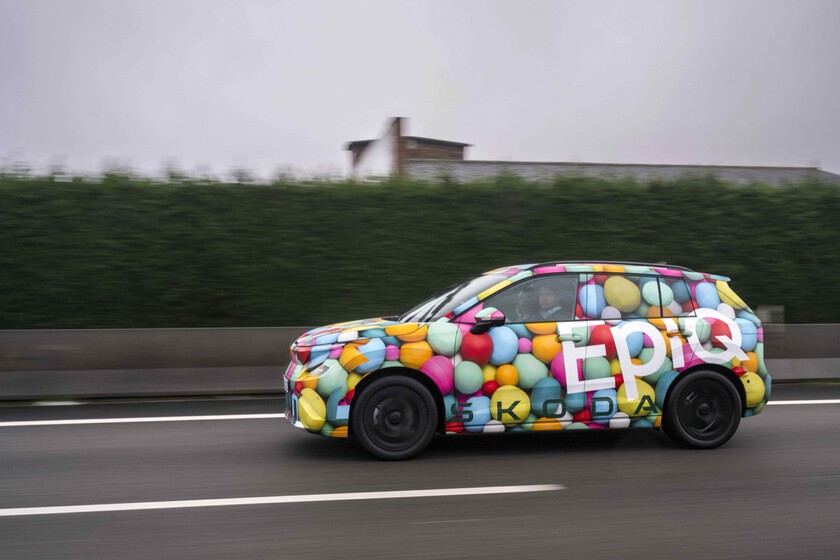
Škoda has quietly become one of the leading players in the European market for electric cars. This is demonstrated by the 175,000 units they sold in 2025 across their two electric models, the Enyaq and Elroq.
This latter model managed to position itself as the second best-selling electric car in Europe, facing with a solid and balanced offering the enormous Chinese surge and Tesla, which continues to hold a large share of the electric-vehicle market.
But undoubtedly, the arrival of the long-awaited this year 2026 will give a significant boost to its sales, as the new model promises to democratize electric mobility with promises of prices under 25,000 euros and a very attractive offer.
We were able to drive the Škoda Epiq for the first time, still under camouflage, to bring you first-hand driving impressions of this new model.
An electric SUV four meters long at Kamiq prices

Although its bodywork was camouflaged, we could drive it and study it in detail.
Since Škoda announced in 2024 the development of a new fully electric urban SUV, the project has taken many twists and turns. It is a key project within the Volkswagen Group to counter the irrisory price-focused product offensive arriving from China.
Not surprisingly, the Škoda Epiq, built on the German giant’s MEB+ platform, will be the twin brother of the Volkswagen ID.Cross, which will also be manufactured in Navarra, and of the CUPRA Raval and Volkswagen ID.Polo, which will be produced in Martorell.
The new Škoda Epiq, to position itself within the product range, will be very similar in dimensions to the and should be priced accordingly. Thus the customer will be able to choose on equal terms between combustion and electrification. However, conceptually and architecturally, it will be a very different car.
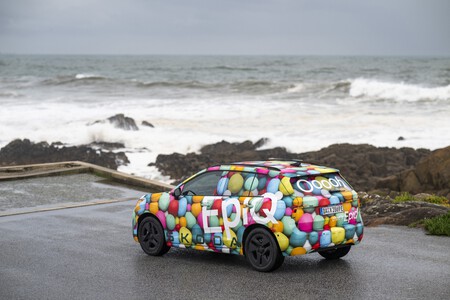
It will be the first Škoda model designed entirely under the Modern Solid umbrella
The MEB+ platform uses a “everything in front” architecture. That means the car has the electric motor located on the front axle, the battery also there, and the charging port on the right front fender. It is therefore a front-wheel-drive car, and this mechanical arrangement also allows maximizing interior space.
Three variants and two battery capacities
The new Škoda Epiq will come in three versions when it hits the market: Epiq 35, Epiq 40 and Epiq 55. The first two will use a 38.5 kWh battery, while the 55 will mount a 55 kWh pack. The smaller battery is of the LFP (lithium iron phosphate) type, while the larger one is NMC (nickel-manganese-cobalt).
As for power, there will also be three levels: 85 kW, 99 kW and 155 kW.
|
version |
Epiq 35 |
Epiq 40 |
Epiq 55 |
|---|---|---|---|
|
maximum power (kw) |
85 |
99 |
155 |
|
Maximum torque (nm) |
267 |
267 |
290 |
|
battery type |
LFP |
LFP |
NMC |
|
Total battery capacity |
38.5/37.0 |
38.5/37.0 |
55.0/51.7 |
|
Max charging power (AC/DC, kw) |
11/50 |
11/90 |
11/125 |
|
10-80% charging time (dc in minutes) |
TBD |
28 |
23 |
|
length x width x height / wheelbase (mm) |
4171 × 1798 × 1620 / 2601 |
4171 × 1798 × 1620 / 2601 |
4171 × 1798 × 1620 / 2601 |
|
boot capacity (liters) |
475 |
475 |
4 |
|
curb weight (with driver) (kg) |
1542 |
1542 |
1544 |
|
top speed (km/h) |
150 |
150 |
160 |
|
0-100 km/h acceleration (s) |
11 |
9.8 |
7.4 |
|
energy consumption (WLTP, kWh/100 km) |
13 |
13 |
13.1 |
|
range (km) |
315 |
315 |
430 |
All the data in the above table, especially the WLTP range and consumption figures, are still provisional pending homologation before sales.
Regarding charging capacity, all three variants support 11 kW AC charging, while DC charging power is 50, 90 and 125 kW for each variant respectively. This means that in the version capable of the highest charging power, you can take its battery from 10% to 80% in just 23 minutes, which is very good for a car intended primarily for urban use.
Distinctive design under the Modern Solid umbrella
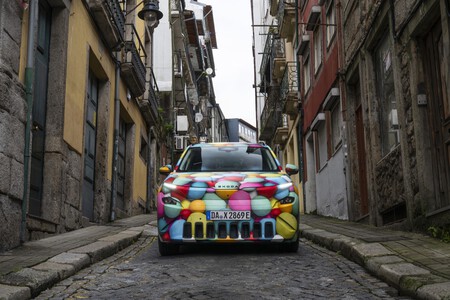
Air intakes at the bottom of the bumper are retained in the production version
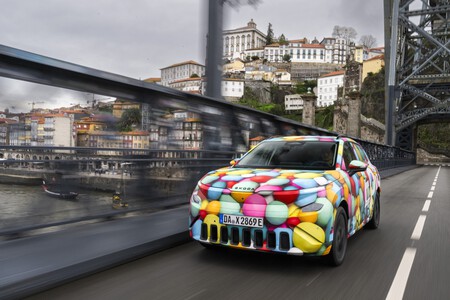
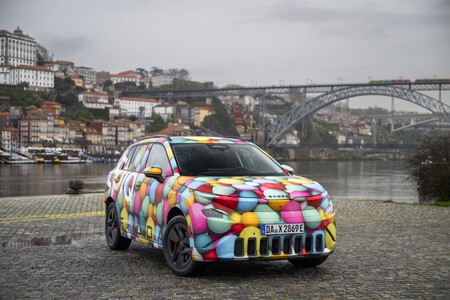
Although the Epiq units we tested near Porto wore a curious camouflage to hide its final design, we did have the chance to see a unit with the final design in a room where phones and cameras were obviously confiscated to prevent leaks of its appearance before its official public unveiling.
The thing I can say is that the new Epiq remains very faithful to the design of the 2024 concept car. Designed under the Modern Solid concept, whose first elements have already been incorporated into other Škoda models, this is the first model entirely designed with this approach, both exterior and interior.
Everything in the design serves a function, avoiding superfluous elements that don’t help achieve the aerodynamic coefficient cx = 0.275 or reduce consumption. The front is defined by the Tech Deck Face that we already know from models like the Elroq, where the most notable feature is the presence of the letters SKODA adorning the hood instead of the classic logo that had not evolved for almost a century.
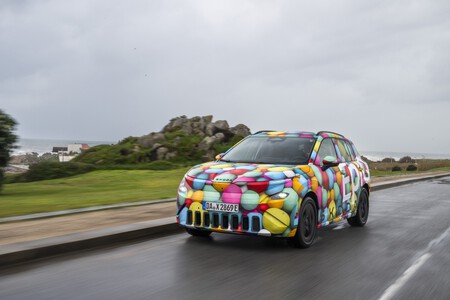
The front optics are split into two sections and they blend harmoniously into a striking and futuristic look, featuring a black line connecting both ends of the car.
At the bottom of the front bumper the vertical air intakes seen on the prototype are kept with almost no change. They are functional air intakes for the front-end mechanics, and their broad shapes are a key element in the car’s rugged appearance.
The bumper integrates barely perceptible air channels that route air toward the front wheels. The door handles are conventional and mechanical, a detail that is appreciated. Gone are the electric-handle features hidden in the body side seen on other group models in the past.
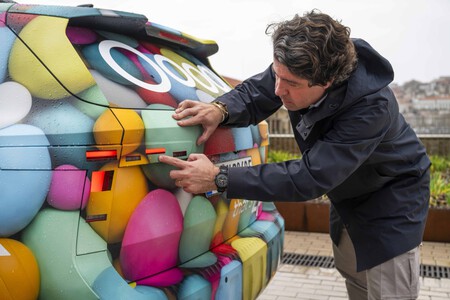
The rear lights, shaped like a T, will be one of its main identity features
I was particularly struck by the size and shape of the rear doors. They are super-wide for a four-meter-long car, and their upper frame extends far back, making it easier for passengers to get in and out. The design team told us this is deliberate because the car is conceived for families who often need to get kids in and out multiple times a day.
All the bodywork and wheel arches are outlined by a black plastic frame that reinforces the rugged look and also serves aerodynamic purposes by incorporating some appendages to reduce turbulence at the front axle and to optimize airflow under the smooth coverings.
The C-pillar of the body is extremely
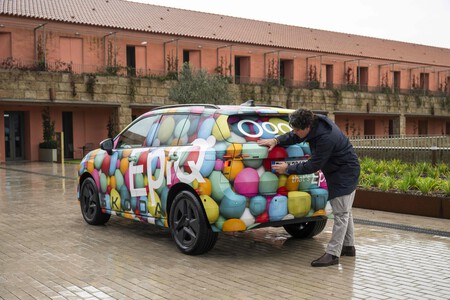
At the ends of this rear section you will find the other element that will define Škoda’s future design language. They are the T-shaped lights, where the horizontal segments partly occupy the tailgate and extend along the rear fenders, while the vertical segments sit at the ends to give it solidity.
These are lights with a design different from what the brand has typically offered, giving the design a forward-looking and minimalist feel at the same time.
At the wheel of the Škoda Epiq under heavy rain
We managed to embark on a one-hour route around the Porto area with the Škoda Epiq 55, the top-spec version in terms of power and battery capacity. The downpour from one of the many storms that hit the Atlantic belt of the Iberian Peninsula in January was the companion for the entire drive, but it did not prevent us from driving the car and getting a first feel for it.

What immediately stands out when you open the door is a cabin that could be considered rather conventional in its layout. Although part of the interior was still covered to mask its final shapes and materials, you can still get a sense of how the various elements are arranged.
I sit in the driver’s seat and the riding position is somewhat elevated. The controls are familiar to Volkswagen Group users, with a rotary gear selector mounted on the steering column and the traditional stalk on the left for the front and rear wipers.
We began the route using the wipers at full speed because the rain was intense. It seems to me that the available space is very generous in the front row, but also in the rear where the two brand representatives accompanied us to see how we handled this new creation.
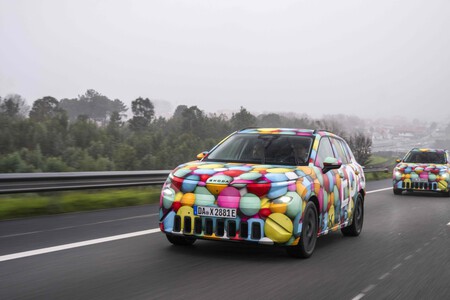
As with any electric car, the quiet ride and smoothness of the journey define its driving character. We were behind the wheel of the most powerful version, delivering 210 hp and nearly 290 Nm of torque, available instantly with each press of the accelerator.
Even though the road conditions were inundated with water, the car allowed confident and rapid merging onto the highway and starting from a standstill at intersections. It offered speed and security in these maneuvers.
When braking, the regenerative energy function is noticeable. As is typical with electric cars, the initial pedal travel is regenerative, and if you need more braking power, the brake pads and discs engage conventionally. By the way, the Epiq uses discs on both the front and rear axles.
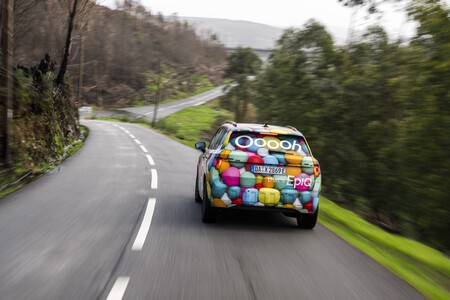
There are two forward-driving modes, D and B. In the latter there is noticeable deceleration when you lift off the accelerator to facilitate energy recovery without needing to use the brake too much. In fact, it is the first Škoda electric car that can be driven using only one pedal, the accelerator pedal.
The “one single pedal” concept even allows you to stop the car completely simply by keeping it in B and modulating the pressure on the accelerator pedal when coming to a halt.
The suspension and steering tuning clearly target ride comfort. It is a car that is soft on its responses and absorbs bumps and irregularities well with the current setup where the cars were fitted with 17″ wheels instead of the larger 19″ wheels with low-profile tires available as an option.
On the interior, I appreciate that physical buttons remain on the multifunction steering wheel, the convenient quick-access controls placed within easy reach on an extension of the dashboard, and the wide wireless charging area to place your smartphone between the front seats.
Behind the wheel, a small 5.3″ display provides basic car information, but the central 13″ screen is kept under a cover, unable to show its final graphics yet. The seats are comfortable and clad in recycled materials.
Although there are many hard plastic surfaces in the door panels or the upper part of the dashboard, overall the fit and finish appear reasonable for a car in its segment, size, and price range.
When we paused for a brief rain break, we could open the boot and explore it. It has a capacity of 475 liters, exploiting space downward, with two loading-floor height levels that are easy to adjust.
That’s 75 liters more than a Kamiq with similar dimensions. As is customary with Škoda, the car features numerous Simply Clever solutions that are very practical.
The umbrella tucked into the driver’s door, the ice-scraper on the boot lid, or modular hooks to secure cargo in the boot are some of the elements the new Epiq may offer.
Great expectations for the Škoda Epiq
Škoda is determined to push a line of fully electric SUVs. Following the successful Enyaq and Elroq, the Epiq will be the volume model and will later be complemented by a large SUV capable of seating up to seven passengers, which will be called Peaq.
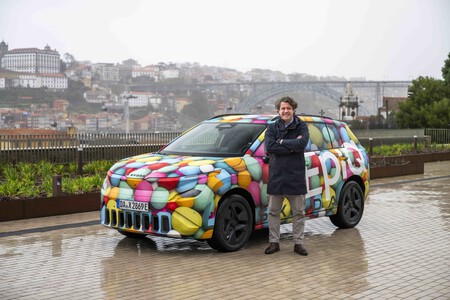
Meanwhile, I can assure you that this new product is very well positioned for its segment—the four-metre urban SUV class. The Škoda Epiq offers attractive design, generous interior space and practicality, with ranges of autonomy and charging power that are more than adequate for its intended use, and it behaves very well.
Now we only have to wait a few weeks until the final version is unveiled and we learn its official commercial offer to position itself as a competitor to other models in this increasingly crowded segment. The promise of being the option to democratize electric mobility with a “Made in Spain” product at a price under 25,000 euros is another of its main strengths.