
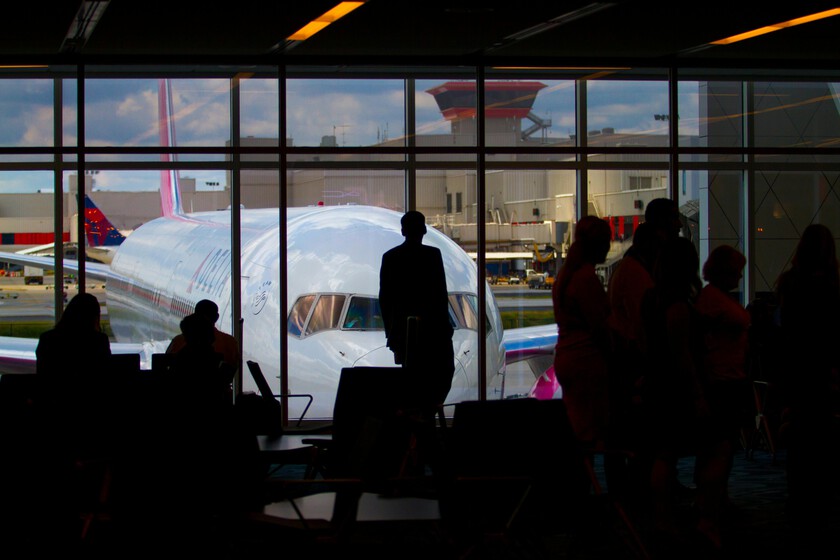
When we say that everything is being affected by the war that the United States and Israel have launched against Iran, we mean everything. Trump has yet to manage to explain the reason for this conflict, but after a month of activity it can be said that it is out of control: with no clear motive and no short-term end in sight, the human and economic consequences will continue to worsen.
Besides the price of gasoline for vehicles, European airlines are already warning that they will have to pass costs on to those who want to fly. Airlines elsewhere have already begun raising prices.
When the bridge between Europe and Asia is at war
The Gulf countries host megacenters that connect passengers from around the world, helping to link Europe with Asia and Oceania. Moreover, the Persian Gulf itself was one of the busiest air corridors in the world before traffic had to be diverted when the first attacks on Iran were launched in late February.
For now we are in a scenario where scarcity is not a risk factor as much as the speculation in the crude market is. And that is why we do not see a significant price drop regardless of what announcement Trump makes. According to The Guardian, EasyJet has ruled out any fears of imminent fuel shortages affecting flights in Europe, but a fare increase is on the table.
The controversial Ryanair chief executive, Michael O’Leary, has also downplayed the immediate changes, but he stated that if fuel price increases persist for six months, they would become a problem for airlines.

Meanwhile, long-haul airlines, such as Air France-KLM and Lufthansa, announced that they would add more flights via Asia, since Gulf carriers’ hubs are closed or operating at reduced levels. And while they believe they can contain the price escalation for now, it won’t last long.
For now, Air France and KLM have already raised their fares on long-haul flights for tickets issued from March 11, 2026. For those traveling in economy class, round-trip tickets will cost 50 euros more.
Jet fuel is at record highs
That is why the major European airlines recommend booking flights well in advance. For now, routes from Spain to countries such as France or China are seeing fare increases of about 9% to 14%. Destinations perceived as safe will be the most expensive, since demand in the medium term has fallen for those near the conflict zone.
The main issue is that kerosene is hitting record highs. According to IATA’s aircraft fuel monitor, the price of kerosene had already risen by 94% compared to the annual average by the end of last week, amid a conflict that escalates and de-escalates unpredictably.
Reuters data show that aviation fuel prices have surged in recent weeks, rising from $85-90 per barrel to $150-200 per barrel, which represents a heavy financial blow for a sector in which fuel accounts for up to a quarter of operating costs.
In fact, on Friday it stood at $1,713.50 per ton, about $215 per barrel. Here the Spanish tourism sector could benefit: trips to the Middle East could be substituted with destinations such as Spain, Portugal or Greece.
Images | Pexels