It took a long time, very long indeed, but it has finally arrived. Mazda is one of those brands with a special philosophy that tries to do things its own way, and electrified cars would not be an exception.
The Mazda6e has generated a lot of buzz, and at last we have been able to get our hands on this sedan with a lot to say, a lot of personality, in a world where almost every car seems to resemble another.
Mazda6e: Electric mobility in Japanese style

Mazda has so much personality that it sometimes becomes a brand that sails against the current. And there it is, presenting its naturally aspirated engines amid the electrification craze, but also with bold proposals like what has been its first electric car.
The MX-30 arrived with a disruptive approach, including the rear-hinged doors (suicide doors) or its cabin with recycled plastics and cork, or its an unusually small 35.5 kWh battery. The Mazda6e is another story: a much more conventional electric sedan, but not entirely.
This styling device also has a practical function: to indicate the battery level when the car is plugged in.
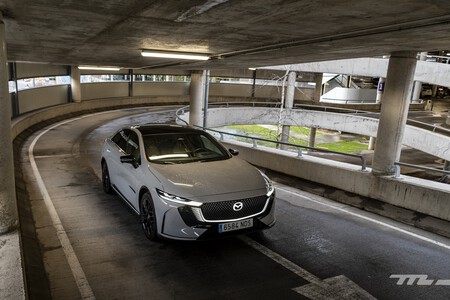
The side profile remains very Mazda with soft, fluid lines, emphasized by flush door handles, four-door windows with no frame, and very subtle ribs that follow the roofline’s gentle drop.
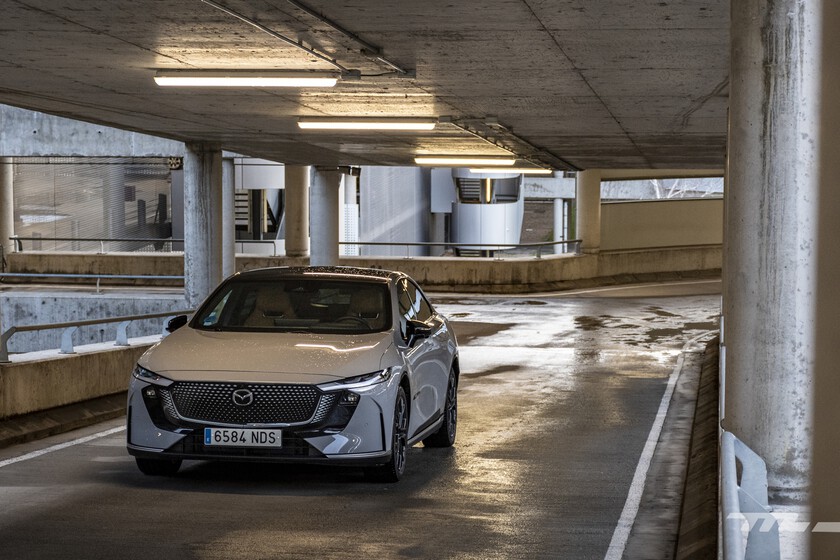
This grille is completely closed off because of the electric powertrain, yet it uses a three-dimensional pattern that simulates an open grille. Taking advantage of the surface, they have decided to join the trend of illuminated front grilles that greet you. And if you’re wondering, no, there are no gasoline engines anymore.
This stylistic feature also serves a practical purpose: to indicate the battery level when the car is connected to the grid.
The side profile remains unmistakably Mazda with smooth, flowing lines, highlighted by flush door handles, frameless four-door windows, and very subtle ridges that trace the lightly sloping roofline.
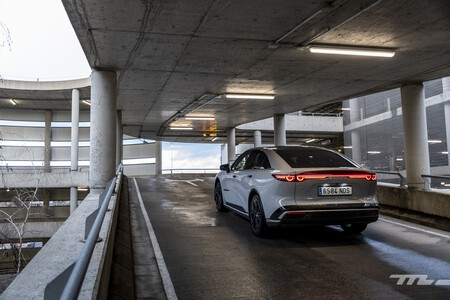
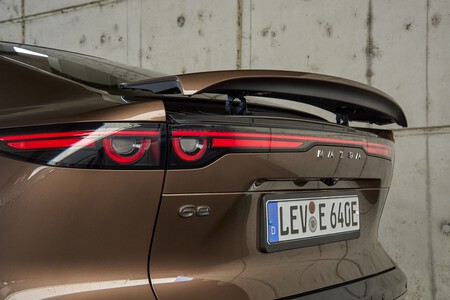
So subtle that at the rear you notice a very tall tail. Part of this height comes from the elevated position of the spoiler. Because yes, it has an integrated spoiler that deploys automatically at 90 km/h or that you can activate manually. Activating it unnecessarily isn’t particularly stylish.
The tail lights have a curious language, combining four semicircular shapes with horizontal lines that span from edge to edge. The brand says they drew inspiration from legendary models. There may be a remote likeness to the shapes used by RX-7.
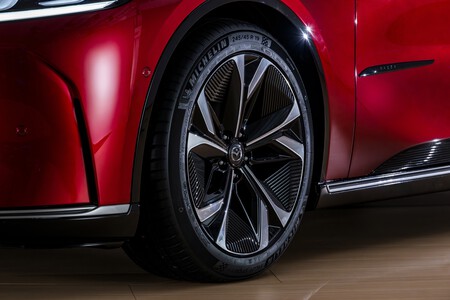
The 19-inch wheels are standard with an aerodynamic design aimed at reducing air turbulence in motion, while the overall length sits at 4.92 meters. It’s bigger than the previous Mazda6 and also appears more imposing.
An interior worth living in
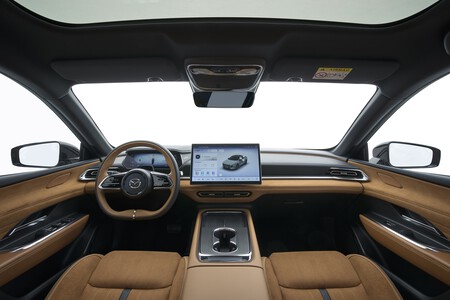
If on the outside it is a car that looks different, inside it feels different. The cabin of this Takumi Plus version of the Mazda6e is very unlike any other sedan, but also unlike the rest of Mazda’s range because there is a clear aesthetic break.
A Japanese minimalism that has driven the brand toward the touchscreen-for-everything trend, while wrapping it in a quality finish that, at this point in the game, we’re not used to seeing or touching.
Let me explain: in broad terms and with most functions moved to the central screen, it could be like any other modern car. The perception when you drive it, however, is not.
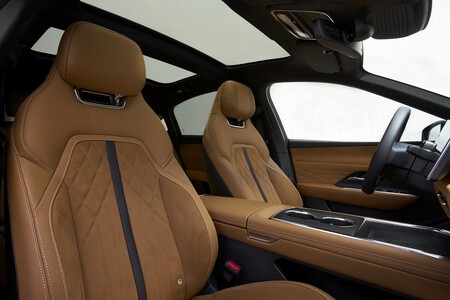
As soon as you sit down, you notice the cabin feels of a very high quality, something that is common across Mazda, but I noticed especially in this car. The Takumi Plus finish enhances certain details (the upholstery moves from suede and synthetic leather to suede and Napa leather), but the starting point is already superb in this Mazda6e.
The comfort of the seats, the tact of the buttons, the sounds when interacting with any component, the feel of the adjustments… everything sends your brain a very pleasant sensation. And with how well they’ve done this aspect, my conclusion is clear: I wish there were more physical buttons.
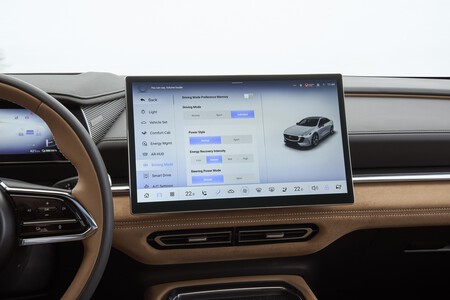
P ractically everything is controlled through the menus of the 14.6-inch central screen, and it’s a genuinely good infotainment system. It’s fast, fluid, visually nice… but it lacks the romance or the feedback of a physical button.
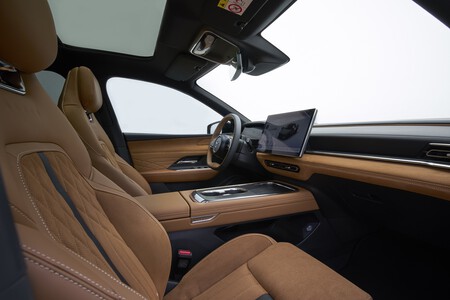
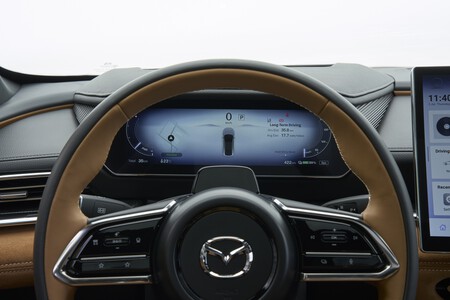
Putting that aside, as I said, it works wonderfully, its seating position is very good although its integration with the dashboard’s shapes isn’t as much, and it’s a perfect complement to the dashboard that is also digital in 10.2 inches. In neither case are there flourishes beyond ambient lighting, and elegance was chosen. A wise decision.
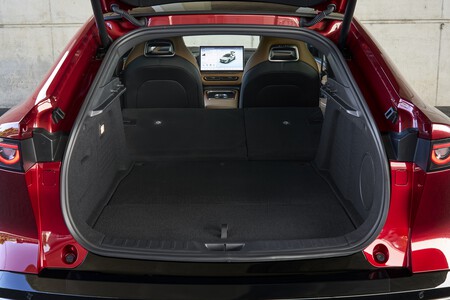
Overall the sense of space and quality is extremely high, leveraging the electric platform to generate a generous amount of space both in front and behind, plenty of storage compartments, and an abundance of upholstery materials that feel premium.
Regarding usable space, I was struck by the Mazda6e declaring a trunk of only 336 liters, which I honestly believe does not reflect the real volume. There’s more than fits in a 336-liter boot, and, in addition, you must add the extra frunk of 72 liters.
A couple of points that could be polished are the presentation of the head-up display with augmented reality that didn’t win me over and the control of some functions via voice commands. In some cases it works a bit too much, asking what it can help you with for no reason, and in others it’s quite difficult to get navigation commands understood.
Over 200 HP, over 500 km of range
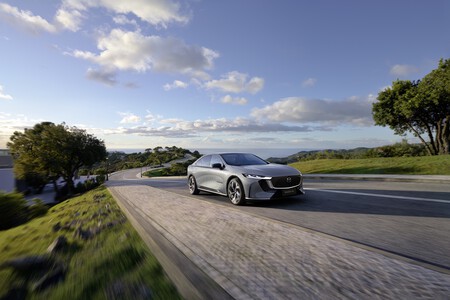
As with everything else, Mazda has given the 6e a distinctive presentation. There aren’t big power figures by default with how easy it is to extract horsepower from an electric motor. In fact, they fall into a curious contradiction.
This sedan arrives with two power and range levels: on one hand the entry motor with 258 HP, while the upper Long Range tier sits at 245 HP: a gap of 13 HP less.
From 479 km of range to 552 km, but if we look at the battery figures there’s a substantial difference: capacity goes from 68.8 (LFP) to 80 kWh (NMC) while the consumptions are virtually identical: 16.6 and 16.5 kWh per 100 km.
Taken to real-world terms I can say that at the end of this test the Mazda6e left us with consumption around 18 kWh/100 km, being a car that uses little and that it’s easy to coax into the mid-teens (around 15 kWh) in mixed driving, giving a real-world range that can exceed 400 km.
Another difference to consider depending on how you plan to use the car is that the normal version supports up to 165 kW charging while the Long Range is limited to only 90 kW. A figure clearly improvable, and where its rivals sit well above it.
In terms of driving dynamics I can’t compare the two powertrains because I only tested the Long Range, but I’d bet there aren’t big differences. Both variants place the motor at the rear and are rear-wheel drive, offering both a torque of 320 Nm and virtually similar performance on paper.
What I can tell you is that the Mazda6e is an incredibly pleasant car to use, with a linear and ultra-smooth delivery that stands out for its very damped dosing even in Sport mode.
It feels more like a gasoline engine in terms of throttle response than the instant response of an electric motor. It’s a matter of taste, but its response is more natural for someone who has always driven gasoline and doesn’t crave the electric’s immediate jab.
The suspensions are very comfortable, with a clear focus on ride comfort, excellent isolation, good management of irregularities, and some body roll whenCornering.
What has caught my eye is the level of interior sound insulation. It is very well achieved, especially for an electric car that lacks window frames on all the windows, but also in terms of road noise. It’s clear Japanese engineers have paid attention to the in-cabin experience.
The steering feels too isolated, and you don’t really sense what the front wheels are doing; I’ve felt the handling isn’t linear, but rather responds differently as you turn the wheel further.
It’s also true that it’s a large car that nears 5 meters, and that can be a drawback when maneuvering in tight spaces. When I parked it in my garage I had to perform more maneuvers than with other similar or even larger cars.
I’ve missed regulating the regenerative braking. There are no paddles to adjust it, and you can only modulate it (four levels) in one of the three driving modes and by going through the central screen. It also doesn’t have a one-pedal mode. This last feature seems essential. The paddles (or a button) are not so much.
By the way, this is one of those cars that you don’t even have to switch the ignition on or off. You simply get in, put it in D (or R), and when you leave it, it powers down by itself. I don’t love it or hate it, but it is a bit strange.
Mazda6e: more quality and cheaper than the average
Turning to pricing, the Mazda6e starts at €43,725 for the entry version and €46,975 for this Takumi Plus. A price that, while not the cheapest, makes you seriously question whether it is or not.
Of course there are more affordable options, of course. The first that comes to mind is the Tesla Model 3, which starts at €36,990 with a similar range, or the Long Range variant at €44,990. The Model 3, however, is noticeably smaller and has a lower level of finish.
The BYD Seal Design with a 570 km range costs a bit more (€48,490) and the Volkswagen ID.7 is simply much more expensive before discounts.
I would venture to say that among all these options, Mazda might be the least emotional, but the most rational. It’s an incredibly pleasant car to drive and a good companion for anyone looking for a vehicle with personality and a perceived quality well above average.
Mazda6e 2026 – Verdict
7.3
8
8
8
8
7
6
7
6
8
7
Pros
- Great value for money
- Interior space
- Premium finishes
Cons
- Soft feel of the accelerator pedal
- Intrusive voice control
- Soft suspensions when pushing the pace
The Mazda6e isn’t trying to be a sporty electric, nor does it pretend to be. It’s a car designed to please those inside it. In terms of sound insulation, material quality and finish level it’s exquisite.
It’s a car for those who value habitability over flashy design, but it’s also genuinely beautiful, with a lot of personality and unlike anything else on the market right now.
Perhaps its biggest drawback will be explaining to customers why the higher-end versions are less powerful—but that’s precisely Mazda: they do things their own way.
Mazda6e 2026 – Technical Data
|
Mazda6e Long Range |
|
|
|---|---|---|
|
Motor |
|
|
|
|
TYPE |
Rear electric |
|
MAX POWER |
180 kW (245 HP) |
|
|
|
MAX TORQUE |
320 Nm |
|
TRANSMISSION |
Automatic |
|
|
|
DRIVETRAIN |
Rear |
|
BATTERY |
||
|
CAPACITY |
80 kWh |
|
|
RANGE |
552 km |
|
|
CHARGING POWER |
90 kW |
|
|
Dimensions |
|
|
|
LENGTH |
4,921 mm |
|
|
|
WIDTH |
1,890 mm |
|
HEIGHT |
1,491 mm |
|
|
|
WHEELBASE |
2,895 mm |
|
WEIGHT |
2,037 kg |
|
|
|
BOOT CAPACITY |
336 + 72 liters |
|
Performance & Consumption |
|
|
|
0-100 km/h |
7.8 seconds |
|
|
Top speed |
175 km/h |
|
|
Official consumption |
16.5 kWh/100 km |
|
|
Average test consumption |
18 kWh/100 km |
|
|
price |
46,975 euros |
The car used for this test was loaned by Mazda. For more information, please consult our corporate relations guide.