
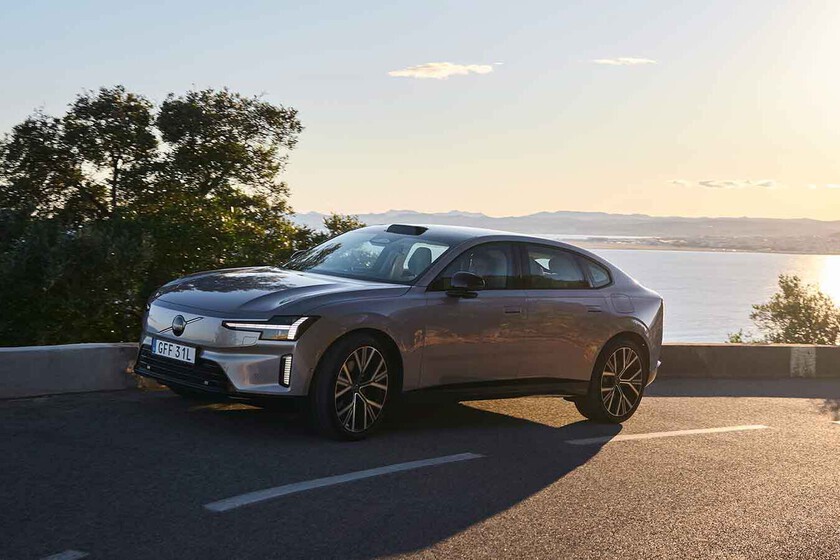
When we talk about Volvo’s 100% electric lineup, they’re all SUVs. But one of the latest zero-emission arrivals takes a different route: the Volvo ES90. It’s a sedan, albeit with five-door bodywork and subtle nods to SUV styling. It is therefore the Swedish firm’s first electric sedan.
Available only in electric form, it is a spacious 5-meter-long saloon that we’ve driven on a long route. And it can be described as a perfect travel car: tremendously comfortable and with fairly modest consumption for its size and weight. We are talking, however, about a car that starts above 71,000 euros.
Key points of the Volvo ES90
Sedan more than SUV. Design-wise, it’s true that this Volvo ES90 is a five-door sedan rather than a three-box design. It also sits 18 cm higher off the ground, a height somewhat above what’s usual for a sedan, and has pronounced wheel arches. But despite these SUV cues, at first glance it remains a sedan through and through, and it is also Volvo’s most aerodynamically efficient model to date (0.25 Cd). In the cabin, it is fully so as well.
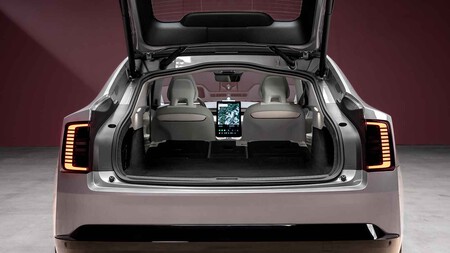
A cabin designed for long journeys. The generous interior space and excellent habitability are one of the pillars of this Volvo ES90. Its 5.0 m length, fixed by its 3.1 m wheelbase and nearly 2.0 m in width, all hint at this. The rear seats are exceptionally spacious and comfortable, especially the two outer positions, with the central seat being more restrained. The legroom is gigantic, truly a living room on wheels.

As for cargo space for travel, it has a small drawback: the trunk. While it covers a wide surface area with ample distance from the mouth to the rear seats, it’s not very deep: there is no false floor, with a front cavity for the charging cable but without taking full advantage of the space below. It is listed at 424 liters, below the average for this segment. Still, two large suitcases fit without issue, with room left for other small or medium items. It also offers a front trunk (frunk) of 27 liters, suitable for the charging cable or for a small sports bag.
|
largo |
ancho |
alto |
batalla |
maletero |
|
|---|---|---|---|---|---|
|
Volvo ES90 |
5,000 mm |
1,942 mm |
1,547 mm |
3,102 mm |
424 l – 1,256 l |
Inside, you’ll find several large storage pockets, a central tunnel platform with space for two large mobiles, half of which is wireless charging, two massive cupholders hidden behind a retractable curtain, and a generous storage trunk beneath the armrest.
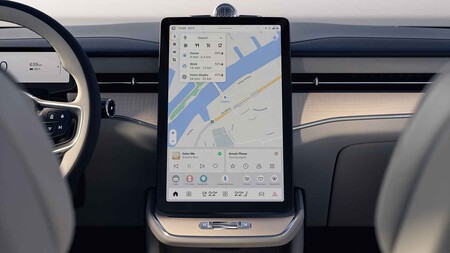
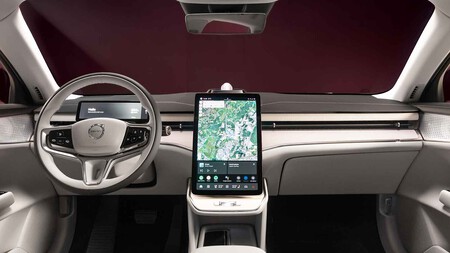
Con Google sin tener que conectar el móvil. El display multimedia del Volvo ES90 es una gran tableta en formato horizontal de 14,5 pulgadas con sistema operativo Android Automotive. Eso significa que su sistema operativo es de Google, por lo que no hace falta conectar el teléfono para disponer de apps como Google Maps o Waze. Además, tiene acceso directo a la tienda Google Play para descargar aplicaciones y el asistente inteligente es Google Assistant.
Es tremendamente sencillo de manejar, reduciendo los clics al mínimo y con accesos fijos a las funciones más utilizadas. Es como una tableta Android. Pero ello implica también que todo se maneje desde esta pantalla, incluida la climatización. Tiene acceso directo en la zona inferior de la pantalla, pero no se puede manejar con el dedo mientras circulamos.
Sin botones y llave digital. El Volvo ES90 tiene un claro enfoque digital. Su interior es pues diáfano sin botones físicos, más allá de un escueto mando bajo la pantalla para subir y bajar el volumen, o cambiar de emisora o canción, y los situados en el volante. El cuadro de instrumentos también es digital, de 9 pulgadas, con diferentes vistas y pudiendo replicar, por ejemplo, Google Maps cuando llevamos la navegación activada.
Unlike Tesla, its design is refined, with wood accents and others in fabric and a soft-touch finish. But relying entirely on the screen reduces functionality. For example, even the glovebox opens from the touchscreen. It also has no physical key: it uses a NFC technology card that you place on the wireless charging pad to start (once moving, you can remove it to charge the phone). It can also be opened from the app.
All safety and driver-assistance systems come as standard. In this Volvo ES90 there isn’t a single ADAS feature that isn’t included from the base trim at no extra cost. This broad range of assistance technologies is extensive, with systems that are usually extras or not included in base models even in premium brands: blind-spot monitoring, active cross-traffic alert, or adaptive headlights.
Also included are the City Safety suite with intersection assistance or vulnerable-user detection, and adaptive cruise control, plus other advanced systems such as occupant detection that senses movements down to less than a millimeter to counter the forgetting of children in the rear seats: if it detects an occupant after we close the car, it opens the doors and maintains climate control.
Only electric and a single Spain version
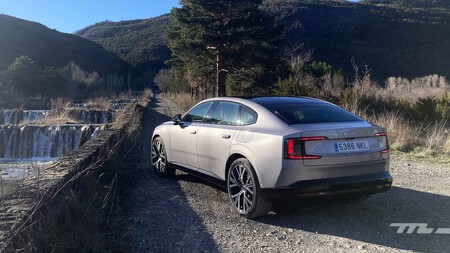
This Volvo ES90 sits on Volvo’s new electric platform, being the first to debut the 800-volt architecture. Yet it is no longer alone in this: the EX60, Volvo’s latest release which is the electric version of the XC60, also offers this technology. This sedan will be purely electric: there will be no hybrid variants and never an internal combustion engine in the equation.
The ES90 family is structured into three trims, two of them all-wheel drive with two motors. In the Spanish market, however, only and will be available the entry-level Single Motor configuration with a single rear-mounted motor. Even so, this Single Motor is more than capable with 333 CV and it is by no means short of moving this enormous electric car of 2.4 tons.
|
VOLVO ES90 SINGLE MOTOR |
|
|---|---|
|
MOTOR |
Electric rear motor |
|
POTENCIA / PAR |
333 CV (245 kW) – 480 Nm |
|
tracción |
Rear |
|
BATERÍA |
92 kWh (88 kWh) |
|
autonomía eléctrica (WLTP) |
651 km |
|
VELOCIDAD MÁXIMA |
180 km/h |
|
aceleración 0-100 km/h |
6,9 s |
|
ACELERACIÓN |
8 seconds |
|
CONSUMO |
15.9 – 18.5 kWh/100 km |
|
EMISIONES |
0 g/km CO₂ |
|
etiqueta dgt |
CERO |
The homologated range for this electric saloon is 651 km: more than the Tesla Model 3 Rear-Wheel Drive and almost the same as the two-motor Long Range’s claim (660 km), being larger and heavier. And it sits very close to the Mercedes EQE (663 km), which barely touches 5.0 m and weighs the same as this Volvo.
Behind the wheel of the Volvo ES90
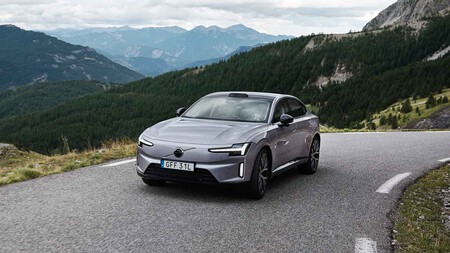
Conducibilidad para todos. The comfort this Volvo ES90 offers isn’t limited to its seats, even more so in the front seats with lumbar adjustment, but also in the driving experience itself. There aren’t driving modes as such, beyond Standard and an Off-Road mode we didn’t test. There are no paddles to control recuperation either. The modes are selected from the display with two taps.
The setup for driving is limited to the One Pedal function, with three positions: active (high retention, suitable for winding descents as it brakes as if the brake were on), automatic (retention applied based on speed and route, with varying intensity), or off (no retention). This is accessible via a one-click shortcut on the multimedia screen. Personally I would have preferred a physical control, even though it’s conveniently at hand, I still found myself glancing away from the road for a moment.
That leaves little room for those who like to fine-tune driving, but its system runs very well automatically: when you push the accelerator it responds quickly and it doesn’t back down from overtakes, even when fully loaded. Moreover, for a long, heavy car, it isn’t clumsy and handles tight, winding roads well. It is incredibly stable, including in corners.
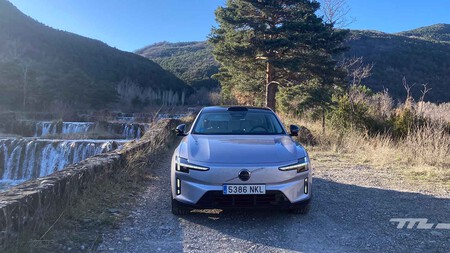
Silence at its peak. Another highlight is the high level of cabin insulation. We don’t hear the tires on the asphalt or the wind against the body. This is, in complete silence, before we play music. Volvo mentioned beforehand that this is their most soundproof car, and it is indeed: a true peace capsule isolated from the outside world.
Alongside that superb isolation there’s a well-balanced air suspension (in the highest trim we drove). It’s neither too hard nor too soft; it cushions every irregularity very well. This combination feels like floating above the pavement, making long trips less tiring.
Efficient highway consumption. Our 400-kilometer round trip ran from Zaragoza to the Pyrenean town of Formigal and back, on both highway and conventional roads. We were curious how energy use would fare on a trip at 90–120 km/h.
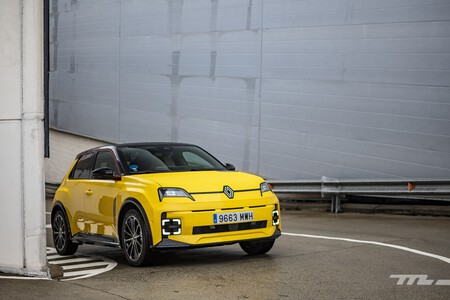
On the outbound leg, climbing, with normal driving, it averaged 22 kWh/100 km. On the return, downhill, it dropped to a modest 14 kWh/100 km. So it doesn’t deviate from the official figure much, noting the urban portion was minimal. Those are impressive numbers, especially when you compare with our Renault 5 E-Tech test, which averaged 18 kWh/100 km despite being much smaller and lighter.
With these ingredients, plus that interior comfort, I consider it a car especially suited for long journeys. The only caveat is the somewhat tight trunk for its size. And you’ll need to be prepared to pay the more than 70,000 euros it costs.
Plenty of equipment and few options
In Spain, the Volvo ES90 lineup consists of the base Core, followed by the mid-range Plus and the top-of-the-line Ultra. Being a premium model that starts above 70,000 euros, the entry is already well equipped.
The ES90 Core comes standard with heated front seats with electric adjustment (including memory) and two-position lumbar support. It also includes the aforementioned screens (9-inch instrument cluster and 15.5-inch central display), the digital key, wireless charging, four-zone climate control, power-opening boot with hands-free function, rear camera, 20-inch wheels, and the full suite of driver-assistance tech. It also includes the heat pump, essential for thermal management of electric vehicles.
The Plus adds four-way lumbar adjustment, electrically adjustable steering wheel, Head-Up Display, more advanced interior lighting with up to six ambience options, and a Bose 940 W 14-speaker sound system.
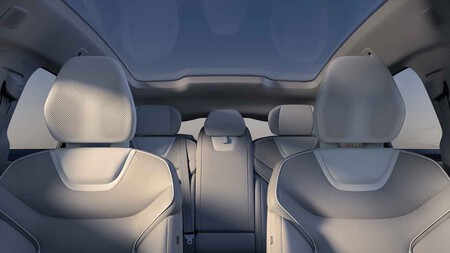
The electrochromic glass roof shifts from completely transparent to opaque at a click, from the display
The Volvo ES90 Ultra adds the aforementioned air suspension, heated and reclining rear seats, front-seat massage function, 360° camera with front, rear and side parking assist, Pixel headlights, and the electrochromic roof (it becomes opaque or transparent, though it does so all at once rather than in sections as with the Renault Scénic).
Extras are modest on this electric saloon: an even more premium Bowers & Wilkins 1460 W 15-speaker system with a subwoofer (2,900 euros), the electrochromic roof for the Plus trim (950 euros), the 360° camera for the Core and Plus (630 euros) or a retractable tow bar (1,188 euros). Additionally, on any trim you can add Iberdrola’s home charging Wallbox, including installation, for 1,878 euros.
From 71,250 euros and no incentives
Now available in our market, prices for this Volvo ES90 range from 71,252 euros for the Core to 83,473 euros for the Ultra. In either case it exceeds the incentive cap of the Auto+ Plan (up to 54,450 euros including VAT), so we cannot benefit from this recently introduced purchase aid.
|
precio |
|
|---|---|
|
eS90 Core Single Motor Extended Range |
71,252 euros |
|
ES90 Plus Single Motor Extended Range |
75,306 euros |
|
ES90 ultra Single Motor Extended Range |
83,473 euros |
Clearly we’re not talking about a cheap electric car, but if we compare it with other premium zero-emission sedans, such as the Audi A6 e-tron, it’s somewhat more affordable since the equivalent Performance variant (367 CV) already starts at around 81,000 euros. And this ES90 comes better equipped in terms of technology and comfort.
Find your ideal electric car
If you’ve considered buying an electric car, this will interest you. We’ve created the Personalized Electric Car Recommender, where in addition to seeing the models that fit your needs you’ll also get answers to the questions you’re likely to have, such as price, range, or nearby charging points.