Today, in the midst of the electric vehicle surge, there are cars like the electric prodigy Rimac Nevera which, thanks to its advanced technology, set more than 20 records in a single day, including a 0 to 100 km/h acceleration in 1.81 seconds. But to reach this point there are centuries of automotive history.
Henry Ford or John D. Rockefeller were pioneers in introducing iterative improvements in the automotive industry, but there were also lesser-known figures like Walter C. Baker, an engineer who was a visionary in the field of electric cars and who had a very clear objective: to build the first car capable of surpassing 160 km/h. And he achieved it.
Walter C. Baker, a 19th-Century “Time Traveler”

Walter C. Baker. Source: Lake View Cemetery
Between 1850 and 1900 the cars were radically different from how we know them today, as they were in their early stages of development. They were generally seen as strange and dangerous “horseless carriages,” capable of dizzying speeds for the era (well below 8 or 10 km/h) on the primitive roads of the time.
Usually powered by steam and with wooden wheels, these toys for the rich were reserved for very, very few privileged individuals.
But if we look at the earliest internal combustion engines, we have to go back to 1885, when a revolutionary project was born: the “Benz Patent-Motorwagen” or “Motorwagen” developed by Karl Benz, who patented it a year later.
It had a single-cylinder internal combustion engine and a top speed of about 16 km/h (roughly 10 mph). With it, Bertha Benz became the first person to undertake a road trip.
Around the same time, the first electric cars also emerged. One of the pioneers was the British engineer and entrepreneur Thomas Parker, who marketed a kind of electric “golf cart” in 1884. More advanced was the “Flocken Elektrowagen,” developed by the German Andreas Flocken in 1888, which featured a rechargeable battery and could reach speeds of up to 9 mph or 14 km/h.
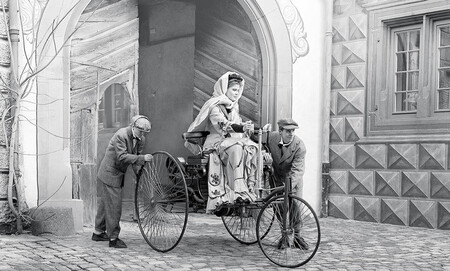
Recreation of an image of Bertha Benz and the “Motorwagen”
But one of the most revolutionary electric-car manufacturers in history was undoubtedly Walter C. Baker, an American engineer with a prodigious mind and marketing talents.
Among other things, he developed a suspension system with floating ball bearings (which allowed the wheels to spin without being affected by the vehicle’s weight in case of bearing failure), he invented the “great-grandfather of the seat belt,” and he sold thousands of electric cars in the early 20th century thanks to his clever campaigns.
The “Torpedo Baker”: an electric spacecraft that pulverized speed records
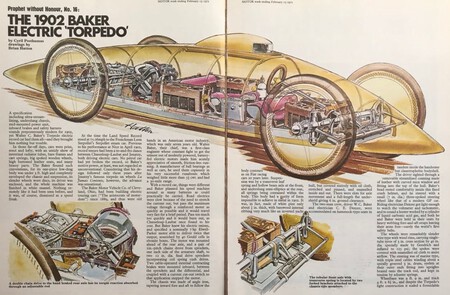
Source: Motor Magazine, February 1971.
Three years after founding the American Ball Bearing Company in 1895 and making his first attempts to electrify carriages, the Midwestern engineer decided to found the Baker Motor Vehicle Company with his brother-in-law and father-in-law to produce and sell electric vehicles in Cleveland (Ohio).
They found great success, even building Thomas Alva Edison’s first car, a two-seater that cost about $850 at the time. But Walter C. Baker was not only an inventive and brilliant engineer, he carried the demon of speed inside him.
Absolute speed records are part of automobile history, for ever since cars existed there has always been someone who wants to be the fastest. And they brought prestige and sold cars. The old saying “win on Sunday, sell on Monday” is very old, perhaps older than the car itself.
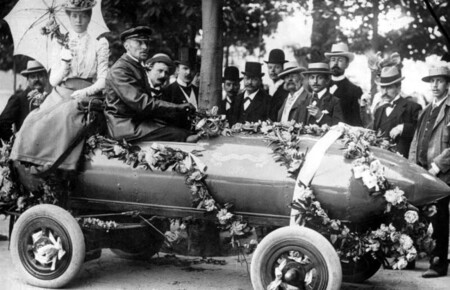
“Jamais Contente”, Source: PMW
In 1899, the first car to exceed 100 km/h was an electric car: named “La Jamais Contente” (the word for car in French is feminine), it was driven by the Belgian Camille Jenatzy. With this rival to beat in mind, Baker set out to prove that his electric cars were better built, more efficient, and faster than those of any other automobile manufacturer on the planet.
Thus, he poured a fortune into building the first of his three speed-chasing vehicles: the “Torpedo” Baker, unveiled in 1902. It truly looked like a submarine torpedo, completely different from the vehicles of the time, almost extraterrestrial.
With its 11 lead batteries powering an Elwell-Parker electric motor of 14 HP, it was then one of the fastest cars in the world. The slender wire-spoked wheels carried inner and outer disc tires, and to minimize the car’s frontal area and reduce wind resistance, the driver and passenger seats were mounted in tandem.
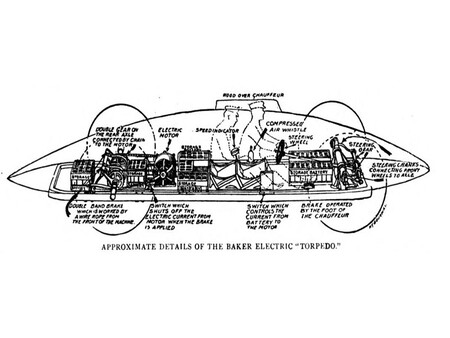
Archive
But the debut of the Torpedo on Staten Island on Memorial Day 1902 ended in tragedy. After managing to cover a kilometer in a little over 30 seconds on a paved street in New York and recording an average of 112 km/h (70 mph) in trials, the car lurched erratically upon exiting a bend and struck the trolley tracks. The wheels broke and the car toppled into the crowd, leaving two dead and numerous injuries.
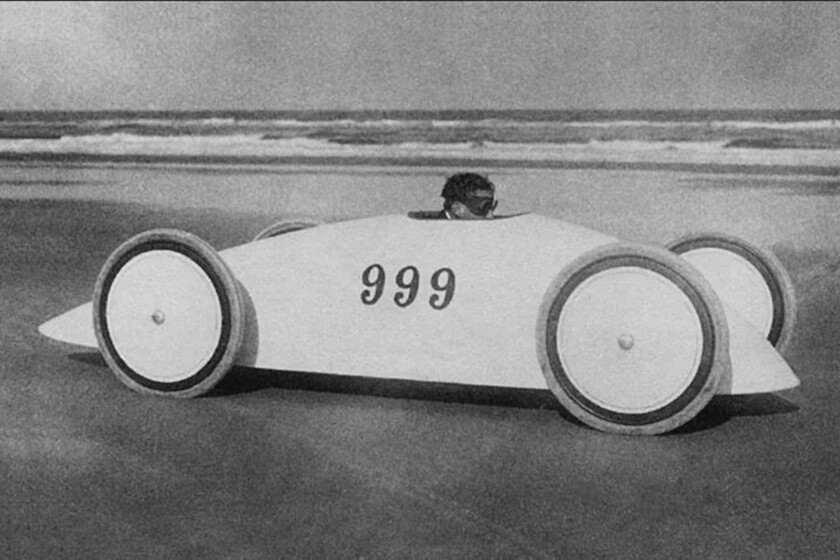
Following this unfortunate incident, speed trials on public roads in the U.S. were halted and moved to safer venues, such as the Daytona-Ormond beaches in Florida and their long sandy straights. Although Baker briefly gave up on the idea of setting records, two years later he had two “Torpedo Kid” cars ready, lighter, smaller, and more powerful than the original.
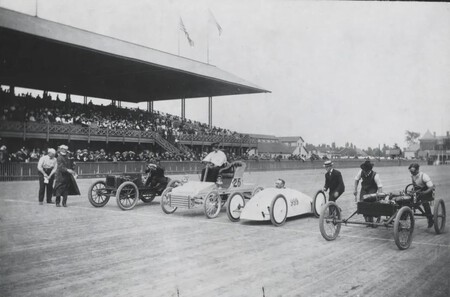
The car, nicknamed the “White Mouse,” recorded a top speed of 167.37 km/h, though Baker unofficially managed to exceed that record, surpassing 218 km/h, and although he once again had an accident, this time without injuries to mourn. He then decided to abandon speed records for good and continue selling cars with the prestige he had earned. His brand would become the market leader across the United States in the early 20th century, at the height of the industry’s expansion.
No car would come close to Baker’s unofficial speed on the Daytona beaches until Barney Oldfield (also from Ohio) took his famous Blitzen Benz, a 21.5-liter monster, to 210 km/h (131 mph) seven years later. It would be until 1968 for an electric vehicle to surpass Baker, when Jerry Kugel drove Autolite’s Lead Wedge to more than 225 km/h (139.89 mph) at the Bonneville Salt Flats.