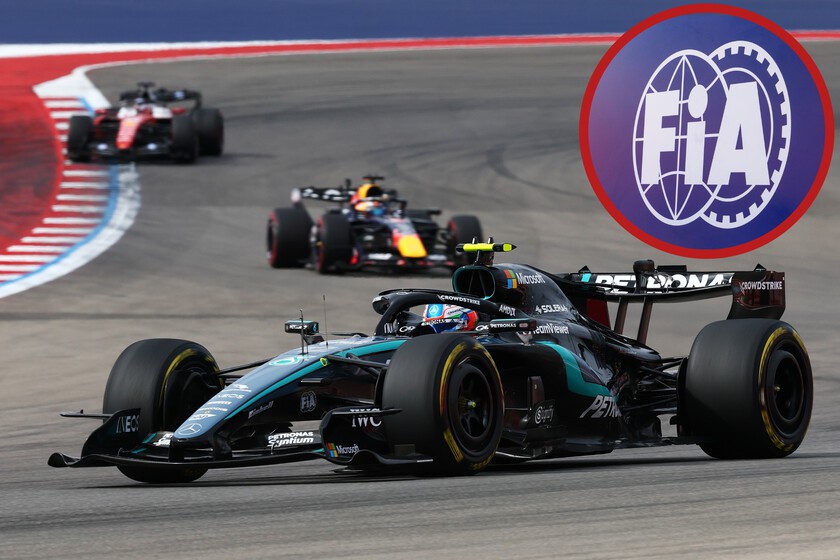
Kimi Antonelli is already the youngest champion in Formula 1 history, and Mercedes also holds the constructors’ title. Celebrations that have made many forget a very particular feature of their car: an 18:1 compression engine that is theoretically illegal, although in practice no one can prove it.
The trick is that the Mercedes engine, when stationary, complies with the legal ratio of 16:1, but in motion it shifts to 18:1. Red Bull, although using another method, would operate under the same parameters as well. According to Motorsport, the FIA has found a way to measure it in running conditions. Starting in 2027, Mercedes’ trick will be over.
A sensor will measure engine compression in real time
Mercedes has enjoyed an outsized dominance in the 2026 Formula 1 season. Although it has been tempered as the races progressed, the star-brand began with such an advantage that catching them proved impossible. The trick has always resided in its engine, which features an 18:1 compression ratio, higher than allowed, yet unprovable.
Until now. Because, according to Motorsport, the FIA has found a way to measure the engines’ compression while running, in real time. Specifically, the FIA will deploy a sensor starting next season to ensure that no one exceeds the 16:1 compression, the maximum allowed. The big question is how much this will affect Mercedes and Red Bull.
Theoretically, since Monaco the FIA has become stricter with measurements, and the results have been noticeable. Up to that point, Mercedes had won 100% of the races. After Monaco, they have won only six of fourteen, less than half. But now the regulator intends to dry up Mercedes’ trick entirely ahead of 2027.

The measure could also affect Red Bull, which, using a different method, through the cylinder head, would be achieving the same 18:1 compression as Mercedes. The FIA’s aim is to avoid an arms race that would drive up costs, and that is why they are also seeking to curb the blown exhausts that Ferrari has been using.
Additionally, remember that the next season will also alter the very nature of the engines, giving a bit more room for combustion. It is estimated that the electric portion will drop to only 40%, while currently it approaches 50%. These changes aren’t drastic, but they could alter the Formula 1 status quo in 2027.
We will see whether Mercedes can withstand the challenge or if it turns out that all they had in 2026 was simply a compression trick.
Images | Mercedes, FIA