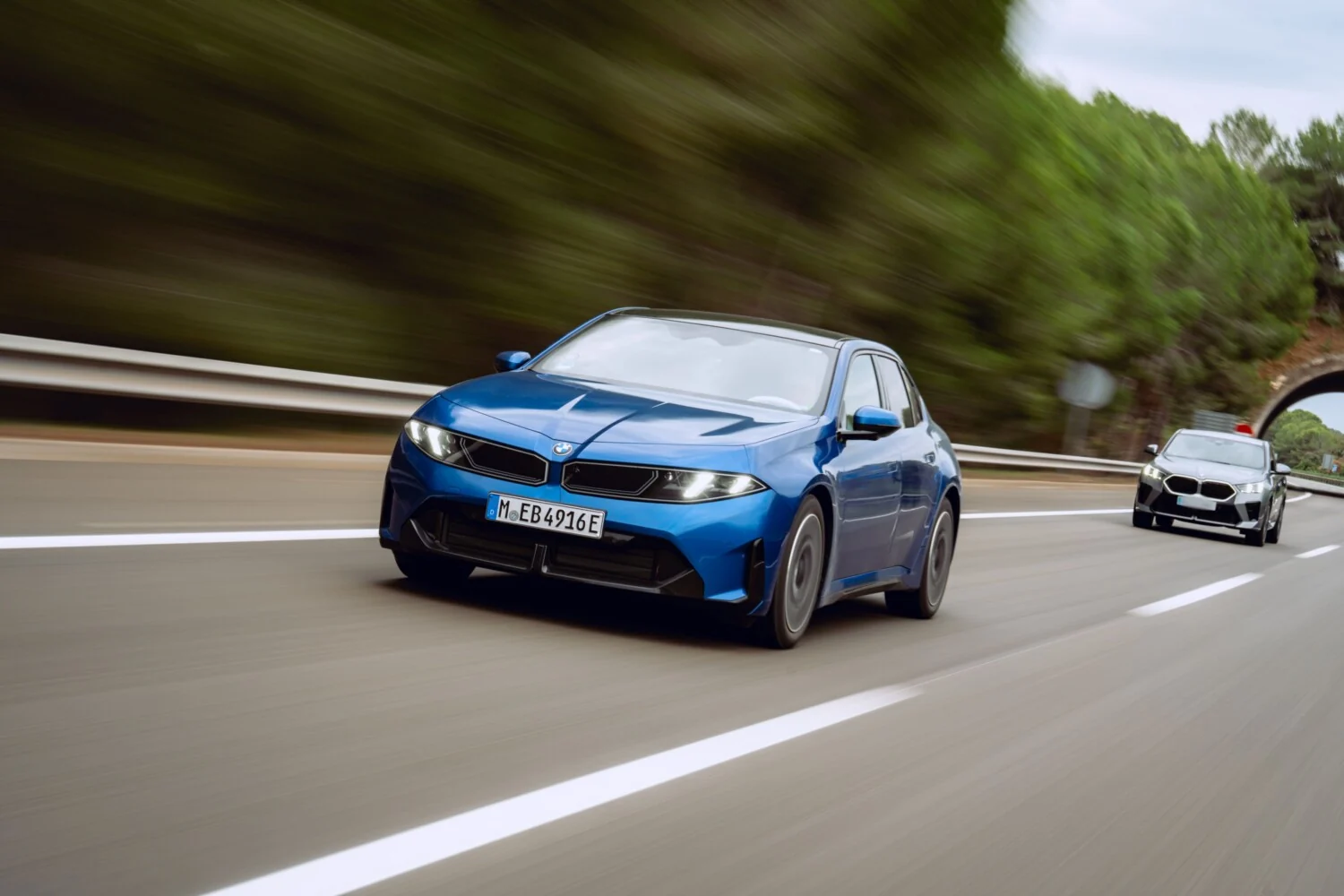
Crossing Europe in an electric car without stacking up long charging breaks: that was the challenge BMW tackled. Behind the wheel of the new i3 50 xDrive, an engineer covered 5,886.7 km from Norway to Spain. The total charging time is striking.
An Electric BMW i3 from Norway to Spain
The route tested the range of an electric car. It started at the North Cape, the northernmost point of Norway, and finished in Tarifa, at the southern tip of Spain. In between, eight countries, highways, back roads, and city driving. All behind the wheel of the new BMW i3 50 xDrive, an electric sedan from the Neue Klasse family.
This crossing was part of the “Paneuropeana” challenge, whose aim isn’t to go the fastest, but to minimize the total time spent charging. The legs and certain crossing points are predetermined; the charging stations chosen along the way are not. The route must therefore be carefully planned around the charging network, traffic, and weather.
In total, the driver spent three days, two hours and 41 minutes driving, at an average speed of 49.5 mph. BMW notes that only one engineer was aboard the i3. Two support vehicles trailed the journey.
Only 2 Hours 46 Minutes of Charging to Cover Nearly 3,660 Miles
The standout achievement isn’t speed; it’s the charging stops. Across 5,886.7 km (about 3,659 miles), BMW reports just 2 hours, 45 minutes, and 54 seconds of cumulative rapid charging. All sessions were on public charging stations, with an average charging power of roughly 275 kW. According to the manufacturer, this time shaves more than seven hours off the previous record set in 2017 for this challenge.
Another particularly notable figure: the average energy consumption was limited to 12.5 kWh per 100 km, or about 20 kWh per 100 miles, which is below the model’s WLTP range of 13.4–18 kWh per 100 km. A remarkable economy for a car with all-wheel drive, even if the exercise doesn’t necessarily reflect an impromptu road trip.
You must distinguish the time spent plugging in the car from the total travel time. Path planning and the choice of charging stops play a decisive role here. BMW frames this as a demonstration of efficiency as much as a charging-record.
The New BMW i3 Promises Up to 912 km of Range
This performance highlights the capabilities of the new BMW i3 50 xDrive. Its battery delivers 108.7 kWh of usable capacity, and its 800-volt architecture enables a peak charging power of up to 400 kW. According to BMW, ten minutes on a compatible charger can recover up to 423 km of range, WLTP.
The sedan can reach up to 912 km of WLTP-rated range. It doesn’t sacrifice performance: its two electric motors deliver a combined 469 hp and 645 Nm (476 lb-ft), with a sprint from 0 to 60 mph in 4.7 seconds. Its aerodynamics also contribute to efficiency, with a drag coefficient of 0.21.
To put this voyage in perspective: it was a staged journey with an engineer at the helm and chase vehicles. The numbers showcase the technology’s potential, not a guaranteed consumption for every driver. But they underscore the strides made in long-distance electric travel.