Seeing a 1955 Chevrolet draped in rear fins hooked up to a Tesla fast charger is enough to raise an eyebrow for any enthusiast. You’d expect to hear the rumble of a big V8, not the light hiss of an electric motor and the click of a high‑power connector.
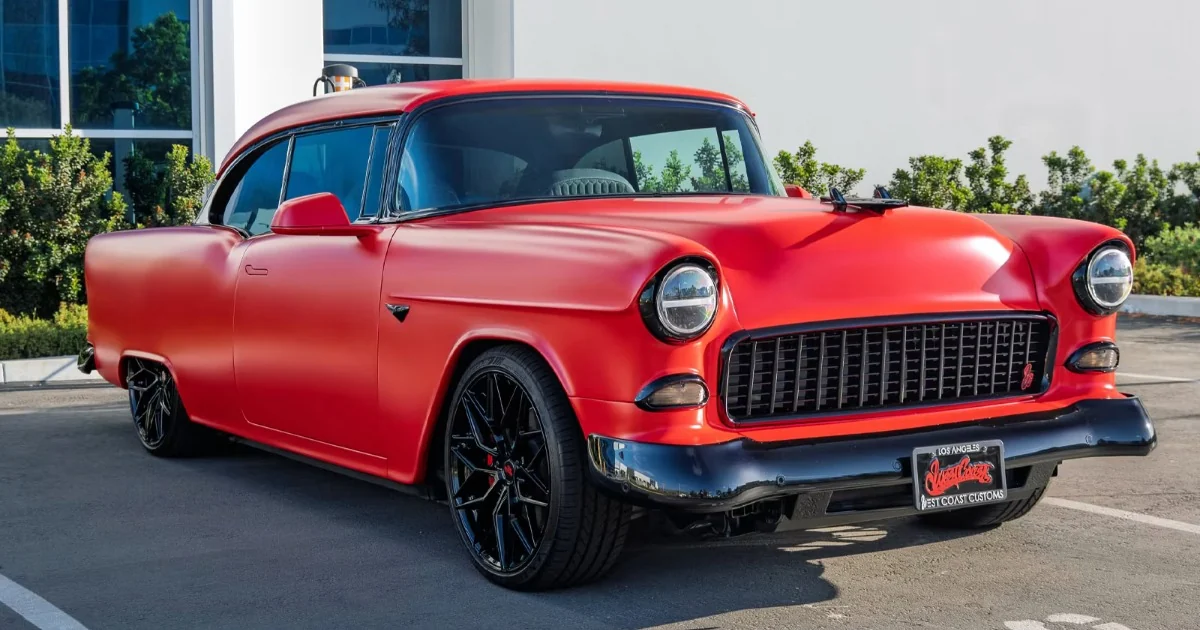
Behind this scene that’s been circulating widely on social media lies one of the most ambitious electric restomods of the moment. Dubbed Project B-Zero, this build from West Coast Customs couples the sheet metal of a 1955 Chevrolet Bel Air with the complete underpinnings of a Tesla Model 3. The backstory involves an American client, Troy Swope, founder of a company focused on ecology, who wanted to electrify his collection and turn his Bel Air into a rolling showcase for his Terramtech enterprise. And this isn’t a mere engine swap; it’s a nearly intact Tesla hidden beneath a 1950s icon.
Chevrolet Bel Air 1955: from a ’50s icon to the ideal base for an electric restomod
The Chevrolet Bel Air first appeared in 1950, but its golden era spans 1955 through 1957, a period fans call the “Tri‑Five.” For the year 1955 alone, Chevrolet moved more than 800,000 units. With its tail fins, ubiquitous chrome, and a 4.6‑liter V8 capable of up to 283 hp with fuel injection, the Bel Air quickly became a symbol of optimistic 1950s America—the era of neon‑lit diners and the infant highways that defined a nation.
Seventy years later, a Bel Air in good condition easily tops six figures at prestigious auctions. Some collectors restore it in strict factory‑correct fashion, others turn it into the base for spectacular custom builds. It’s precisely this second camp that West Coast Customs embraced, the California shop widely known from MTV’s Pimp My Ride and its show Inside West Coast Customs. Used to high‑profile projects—and more recently to builds on Tesla and even Cybertruck—the workshop wanted to demonstrate just how far a restomod can go when you graft a modern electric chassis beneath a legendary body.
A Tesla Model 3 hidden under the Bel Air’s bodywork
Technically, Project B-Zero sits on the chassis of a Tesla Model 3 Performance. The Bel Air therefore retains all‑wheel drive with two electric motors—one per axle—for a combined roughly 510 hp. The zero‑to‑60 mph sprint is estimated at about 3.1 to 3.5 seconds, a world apart from the V8 era’s performance. The long‑range battery pack, around 82 kWh, remains tucked into the floor, which dramatically lowers the center of gravity. Result: the ride and handling bear little resemblance to a foggy, roll‑prone ’50s American cruiser.
EPA‑style range falls between about 450 and 500 km per charge, slightly less than a stock Model 3 due to the heavier classic body and its aerodynamics. The charging port is hidden in the rear, behind styling elements faithful to the original design, and the car remains fully compatible with the Tesla Supercharger network up to 250 kW, delivering a 10–80% fill in roughly 25–30 minutes. To keep Autopilot and Self‑Park functioning, the team had to reposition the windshield cameras, pillar cameras, and ultrasonic sensors around the car, camouflaging them within the bumpers and sills. It’s a meticulous job, because Tesla’s software won’t tolerate a miscalibration.
Project B-Zero: look in Cherry Satin Red, Tesla interior, and the price tag of such folly
Styling-wise, West Coast Customs started from scratch. The 1955 body was fully stripped, treated for rust, and repainted in an exclusive Cherry Satin Red—a deep, satin finish that catches light without being flashy, highlighting the Bel Air’s muscular lines. All chrome was vanished in a “Chrome Delete” approach: the honeycomb front grille, window surrounds, and bumpers give way to gleaming black details. Bespoke 20‑inch forged wheels in satin black complete the ensemble, as do high‑intensity LED headlights crafted specifically for the vintage round lamps and the taillights integrated into the rear fins. Under the skin, an Air Ride pneumatic suspension lets you lower or raise the car with a press, while electronic stability management handles the weight of the vintage shell.
The interior hardly resembles the original Bel Air, except for the general shape of the dashboard, which was hand‑modified to house a 15‑inch Tesla touchscreen. From that central display you control climate, navigation, and driving modes—Chill, Sport, or Track—along with OTA software updates. The once‑vinyl benches gave way to Alcantara‑trimmed bucket seats, with a hand‑stitched hexagonal pattern. The steering column and wheel were adapted to the Tesla architecture, the cabin and doors received substantial sound insulation to mask creaks and wind noises from a 1950s shell, and the rear trunk discreetly houses all the pneumatic plumbing. West Coast Customs has not released an official price for this one‑off, described as a technical demonstrator. Comparable projects from the shop typically run between roughly $180,000 and $250,000, translating to about €170,000–€230,000, while 1955 Bel Air restomods with modern V8s often command $300,000–$350,000, or roughly €280,000–€325,000. In this context, it wouldn’t be surprising if this Tesla‑powered Bel Air commands well beyond those figures if it ever enters the market, especially since it sits among a small family of electrified Bel Airs—from Brian Dilley’s 1957 Bel Air with a 60 kWh pack and 300 hp to Roadster Shop’s ambitious “Belectro Air” targeting more than 1,200 hp—while adding its own set of questions about crash safety and airbag recalibration that have not been publicly detailed.