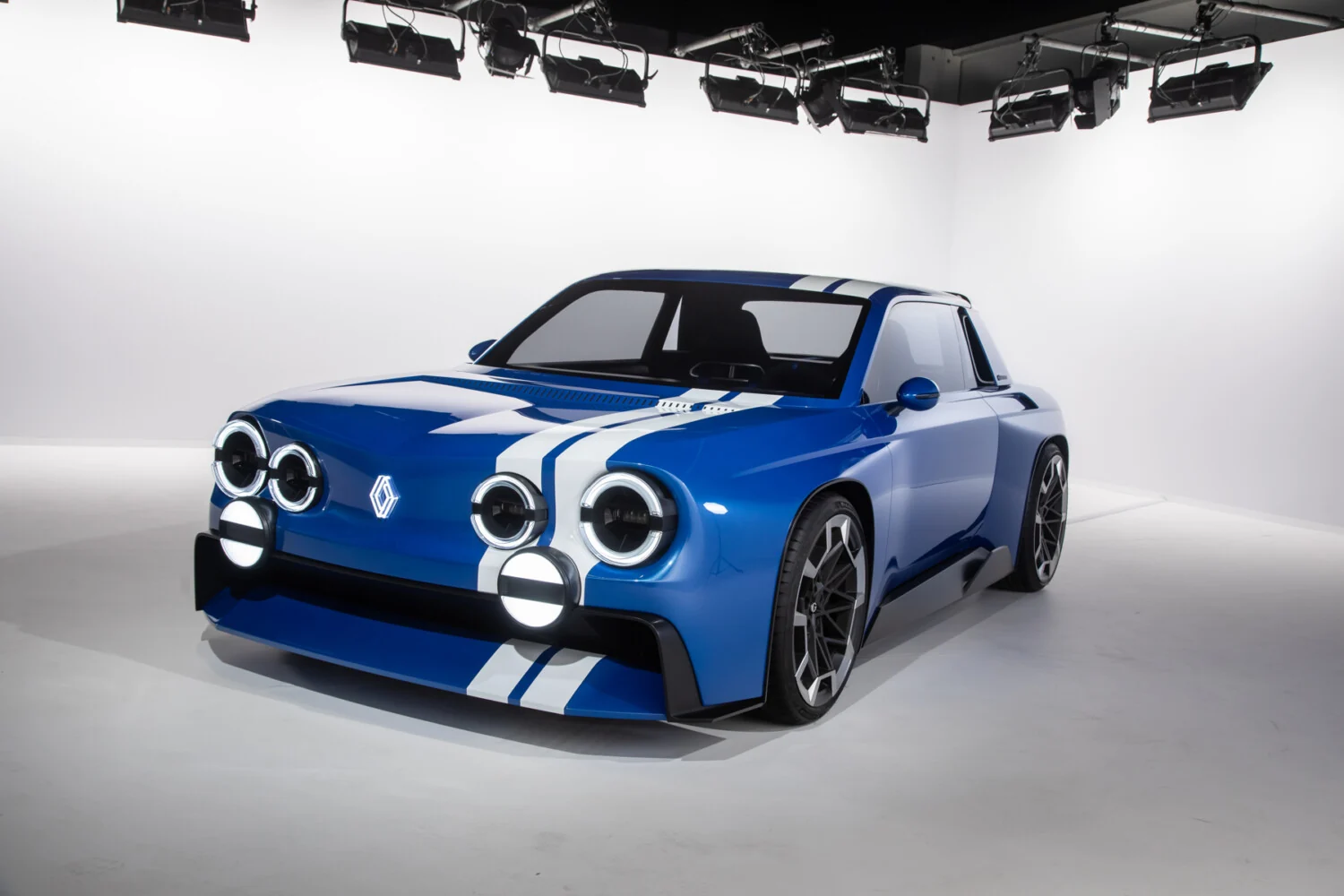
On Renault’s stand at the recent Paris Motor Show 2026, the brand showcased two concept cars. The first, a large vehicle close to the size of an Espace, offered little in the way of future design directions from Renault. The second, dubbed the “Renault 8 Gordini Concept,” speaks more to the heart. For this design exercise, the Losange team went it alone this time. Whereas the Renault 5 Diamant was conceived with designer Pierre Gonalons, and Ora ïto contributed to the R17 electric restomod show car, the R8 Gordini Concept is the result of an internal competition. The brand’s designers produced roughly 300 sketches, two of which yielded 1:5-scale mockups. Then the definitive proposal, overseen by Kevin Gonçalves (our photo) for the exterior design, condensed several of the initial directions. Behind this styling exercise also lies Renault’s wish to revive the Gordini name. Renault hadn’t used it since the Twingo, Clio, and Wind Gordini editions sold between 2010 and 2013. Those were strictly marketing specials with a specific presentation and no mechanical evolution. That marketing-only choice drew reproach from purists who were reluctant to see the “Amédée Gordini” badge reduced to blue paint and two white stripes.
Show car
These two visual signatures are plainly present on the 2026 concept. They had already dressed the compact, square sedan born in 1964 — modest in its original conception, but capable, once prepared, of delivering thrilling sensations. The new entrant, however, stops short of promising a specific driving experience. It does pack a 270-hp electric motor, but its future is scoped to a place in Renault’s planned museum in Flins, in the Yvelines department, near Paris, with opening planned for late 2027. It’s worth noting that while this concept draws from the R8 Gordini, its blue paint takes a few liberties with history. It’s darker than the original Bleu de France, featuring a rich pearlescent three-layer finish that shimmers under showroom lights and is highly sparkly, designed to catch the eye at an auto show. Depending on the light, the shade can brighten and recall a touch of its illustrious elder.
Proportions Change Everything
The Renault 8 Gordini Concept stays true to the rear-wheel-drive architecture of its predecessor. Beyond that, it distances itself. The small four-door sedan is transformed into a coupe measuring 4.12 m in length, 1.88 m in width, and just 1.27 m in height. Compared with the original Gordini, it is 13 cm longer and 39 cm wider, while dropping 14 cm in height. In other words, the vehicle’s presence is markedly different. It sits on 19-inch wheels at the front and 20-inch wheels at the rear — the same dimensions as a BMW M4 Competition, whereas the original Gordini rode on 15-inch wheels. This showroom-grade model leans into the spectacular, with its broad stance, rectangular wheel arches, and oversized rear fenders giving it both authority and modernity, even if its three-box silhouette evokes a species now rare in European catalogs.
Under the carbon skin lies, as noted, a 270-hp electric motor. Beyond that, Renault offers no details: battery capacity (concealed behind the seats to preserve floor space), total weight, or performance figures. It’s a deliberate display of “non-communication” that shifts the spotlight onto the style itself. Even so, despite the proportions diverging greatly from the car born more than six decades ago, the references to the past are abundant. The slanted front face houses six round headlights integrated into the bodywork, a clear nod to the long-range headlights of Gordini rally cars. At the rear, the flush taillights disappear when switched off. Impressive.
Additionally, the crease that used to run along the Renault 8’s flanks has been reinterpreted. Once purely decorative, it now serves to channel air toward a lateral intake. The torpedo-shaped mirrors, the front and rear vents, and the new Gordini monogram, elegantly crafted in a retro style, also sustain the link with Renault’s history.
Inside, Renault rejects the current trend of abundant screens. The big center display is absent, and you immediately notice how a cabin can feel more refined with restraint. The dashboard consists of a single brushed aluminum strip, with several circular instruments seemingly floating in front of the driver. Renault aimed to echo the original model’s spirit, but with contemporary materials and styling. The six small gauges conceal screens, yet their integration is deft enough not to break the ambiance. Aluminum and Alcantara replace much of the plastic.
Subliminal Message
Next to the passenger, corduroy adds an unexpected warmth. The more practical observers will note the absence of a glove box — a quirk that won’t ruin a concept that will spend its life on showroom floors before heading to a museum. The two bucket seats are stunning. The central portion of the seats in corduroy pays homage to the flat, headrest-free seats of the original Renault 8. On the door panels, the stitching evokes the markers of a race track. In several places, references to Renault’s historic model and its sporting past multiply. Stéphane Maiore, the head of interior design, and his team call them Easter eggs — little design surprises to be discovered. All of this communicates, with a certain playfulness, that an electric car can evoke desire and emotion — provided it is made to do so.
Find our feature on the new Renault 8 Gordini Concept (2026) in Auto-Journal issue no. 1218, dated October 1, 2026.