A dream voyage along the big American highways is usually imagined in a big, comfy SUV or a high-strung grand tourer. Definitely not in a tiny 1990s Geo Metro convertible. Powered by a 1.0-liter three-cylinder engine that sits far from today’s horsepower standards. And yet. That’s exactly the bet a driver took. He was determined to shake up the rules of the famous Cannonball Run from New York to Los Angeles.
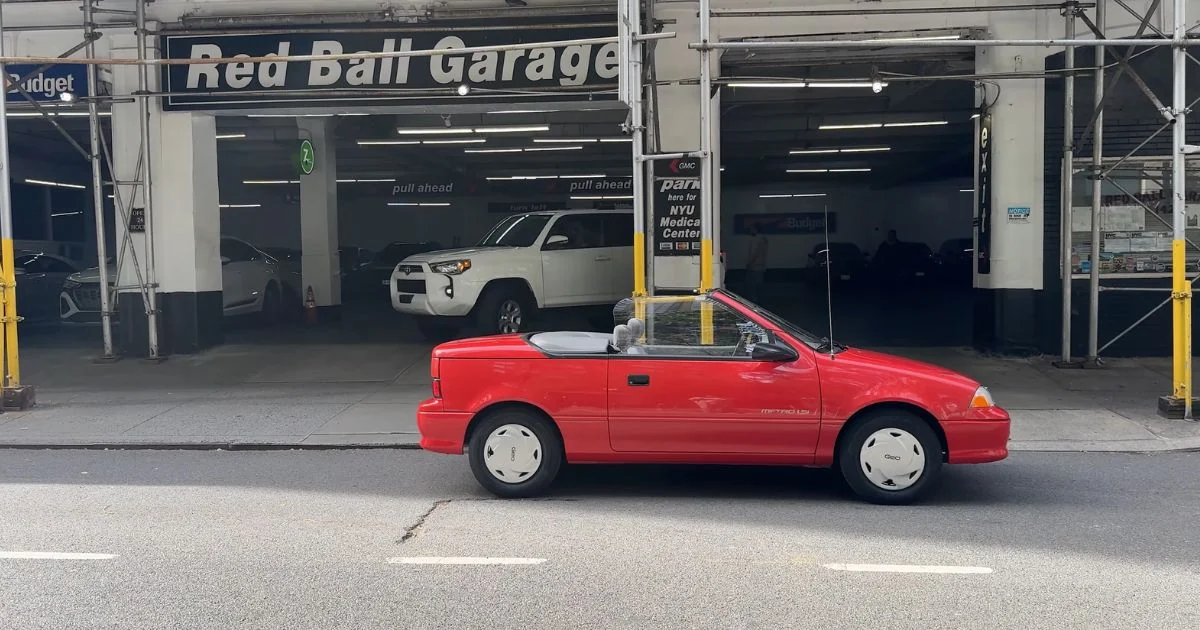
His name was Mitchell Kohrmann, captivated by the record-breaking trips between New York and Los Angeles. For his own challenge, he chose to traverse the United States in a 1992 Geo Metro LSi convertible. Under the hood sat a 1.0-liter three-cylinder engine rated at 55 hp on the tech sheet of the day. With this modest setup, he linked Red Ball Garage in Manhattan to the Portofino Inn on the Pacific coast. A journey of 4,570 km (approximately 2,840 miles). Covered in 49 hours, 11 minutes, and 18 seconds, it offers a different perspective on what a Cannonball represents.
A New York–Los Angeles Cannonball in a 43‑HP Geo Metro
The most famous Cannonball runs are undertaken in large sedans or very powerful supercars, often with a logistics setup worthy of a small racing team. Kohrmann, for his part, looked at these cross-country expeditions with a critical eye. Then he complicated the challenge in his own way: by choosing one of the slowest cars he could find. In his video, he concedes that his Geo Metro struggles to climb hills, and that is precisely the point of his challenge.
His objective wasn’t to outpace the wealthiest crews. He wanted to offer what he describes as a “Cannonball for the everyman.” No extra fuel tanks to lengthen relays, no spotter crew watching for police. Just a driver and a small, simple-to-repair car, reports the American site The Drive. The route nevertheless follows the Cannonball ritual, starting at Red Ball Garage in stylish Manhattan and finishing at the Portofino Inn just a few steps from the Pacific Ocean.
Geo Metro: The 43‑HP Microcar Facing 2,840 Miles of Highway
Produced between 1989 and 1994, Kohrmann’s Geo Metro LSi was a variant of the Suzuki Cultus. A second generation followed in 1995 and was sold until 2001, with the Chevrolet Metro badge starting in 1998. Some versions managed as low as 4.7 L/100 km (about 50 mpg). It was among the cheapest new cars, selling for around $10,000, which is a little under €9,500 today. In exchange, the Metro remained underpowered and spartan, with safety levels well below those of modern compact cars.
Before setting out, Mitchell Kohrmann had his little Metro placed on the dyno. The verdict showed 43 hp at the wheels, far less than the 55 hp claimed on the spec sheet at the time. He also calculated that climbing into the Rockies, the engine’s effective power dropped to roughly 26 hp. Driving a car this light and underpowered across thousands of miles of highway remains a singular challenge. This Metro marathon stands in counterpoint to recent Cannonballs, which center on high speeds in pursuit of records.