Toyota Corolla: A Popular Car That Became a Global Hit
To understand the Corolla’s success, you have to look back to the early 1960s, a period when Japan was enjoying brisk economic growth and cars were becoming a staple in households. Toyota decided to ride that wave by developing a car that was affordable yet comfortable and well-equipped enough to meet the rising expectations of drivers.
The first-generation Corolla debuted at the Tokyo Motor Show in October 1966 and went on sale in Japan the following month. It came in two- and four-door sedans as well as a station wagon. Under the hood sat a 1.1-liter gasoline engine delivering 60 horsepower.
Despite its budget positioning, the Corolla stood out for several features ahead of its time. Notably, it offered disc brakes. The model quickly found buyers, and by 1969—just three years after its launch—the Corolla was the best-selling car in Japan. The second generation, introduced in 1970, crossed the one‑million-sales mark and ultimately reached 2.4 million units sold.
Over the years, Toyota kept refining its compact car by expanding the range of body styles and powertrains. Sedans, wagons, coupes, and sport variants appeared to serve different markets. This diversification significantly contributed to the model’s international growth and helped cement Toyota’s reputation for reliability.
Twelve Generations to Adapt to Shifts in the Auto Market
One of the Corolla’s core strengths has always been its ability to reinvent itself. Across twelve generations, the model has evolved substantially, in both engineering and design philosophy.
The fifth generation, launched in 1983, marked a major turning point. For the first time, a portion of the lineup adopted front-wheel-drive architecture, freeing up interior space. Toyota kept several rear-wheel-drive versions, which gave rise to the iconic AE86. This 1.6-liter, 130-horsepower coupe/ hatchback became a true enthusiast’s favorite, in large part thanks to its memorable appearance in the manga and anime Initial D. It’s worth noting, though, that the AE86 carried the Corolla brand in most markets outside Japan; in Japan, it was sold as Levin and Trueno and not as Corolla. The AE86 name, however, endured worldwide as a shorthand for that generation’s sportier variant.
In the 1990s, Toyota began tailoring the Corolla more specifically to different markets. The eighth generation, launched in 1995, signaled a strategic shift with the development of Europe‑specific versions and expanded production on the continent.
In 2007, the Corolla name even shifted on certain markets. In Europe and Japan, the compact was sold under the Auris name, while the four‑door sedan continued to wear the Corolla badge. It wasn’t until the twelfth generation, in 2019, that Toyota finally dropped the Auris moniker in Europe and reunited the lineup under the Corolla name.
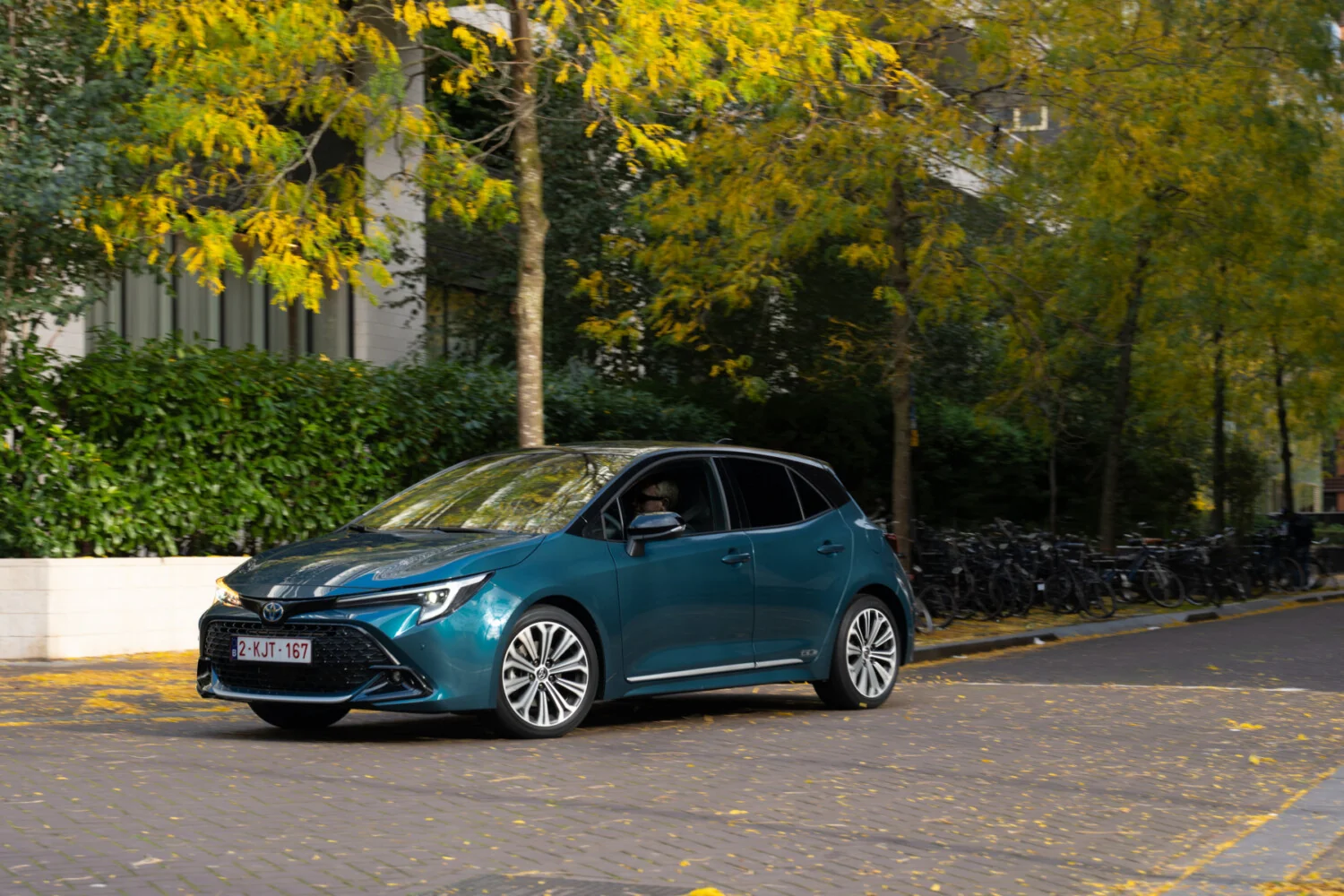
The latest generation sits on the TNGA platform and launched in Europe with an exclusively hybrid lineup. It’s offered with two engine options, 1.8 and 2.0 liters, and is available as a five‑door hatch, the Touring Sports wagon, and a four‑door sedan.
Over 57 Million Sold and Production in 12 Countries
If the Corolla has become a worldwide model, it’s because Toyota steadily expanded production beyond Japan. The first cars were shipped to Europe as early as April 1967. By 1971, the company began assembling Corollas in Portugal from knock‑down kits supplied by Toyota.
Mass production in Europe began in 1994, in Turkey. Today, the various Corolla variants are built on 15 plants across 12 countries. In Europe, the five‑door hatch and Touring Sports are primarily produced in the United Kingdom, while the four‑door sedan is assembled in Turkey.
In Europe alone, Toyota claims nearly 9.5 million Corolla sales since launch, accounting for roughly one‑sixth of the total global figure.
The maker has also kept the model competitive in motorsport. The Corolla contributed to Toyota’s world championship in rallying in 1999, helping secure the manufacturers’ title.
Sixty years after its debut, the Corolla remains a core model for Toyota. With more than 57 million units sold, it holds a special place in automotive history. Its success rests on a straightforward formula: a versatile, affordable car that can adapt to changing times. A philosophy Toyota clearly intends to carry forward.