In Brief
In the early 1970s, an American physician buys a brand-new Plymouth Superbird, but his wife flatly refuses to ride in the car as long as its imposing rear wing stays in place. The owner opts to remove the wing so the family can enjoy the car, a decision that left lasting marks on the vehicle. Decades later, this unrestored Superbird, marked by its personal history, has become a true collectible piece, carefully preserved by Gary Myers in Oregon. The car now tells the remarkable story of a NASCAR model that was as coveted as it was unconventional, both in NASCAR’s history and in the lives of its owners.
Imagine buying one of the most extreme cars ever homologated for the road and, once home, facing a hard veto: no one in your household will ride in it until it stops looking like a race car. That’s precisely what happened to an American doctor in the early 1970s with a muscle car that was impossible to miss, crowned by a rear wing worthy of a fighter jet.
To keep peace at home, the owner eventually had the gigantic rear wing removed, not realizing he was marring what would become a future holy grail for collectors. Decades later, that same car—a Plymouth Superbird from 1970, still entirely original—rests dry in the basement of an old dealership in Vernonia, Oregon. And every trace left by this couple’s story now speaks to the extraordinary arc of a NASCAR missile turned untouchable treasure.
A 1970 Plymouth Road Runner Superbird Frozen in Time, Hidden in Oregon
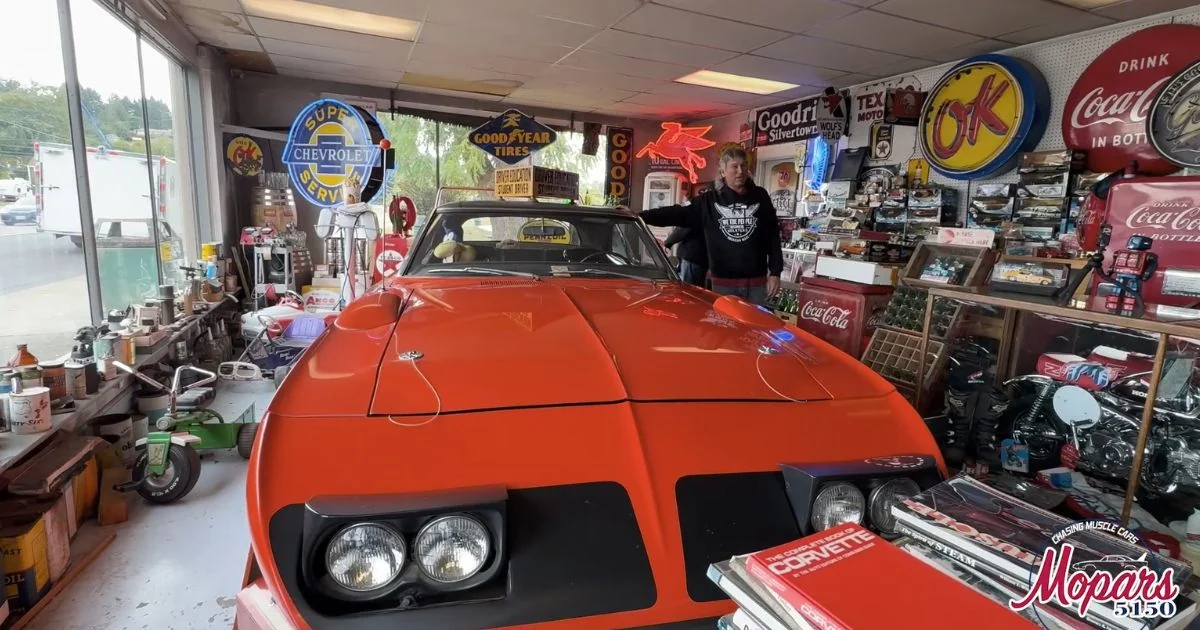
Vernonia, a small forested town in Oregon, is often drenched by rain and gives little away about what lies behind the weathered brick of the former Vernonia Auto Company. The shop, once opened in 1938 to sell Chevrolets, today hides a genuine underground labyrinth of American muscle cars. At the entrance, a 1938 porcelain neon sign greets visitors as if they were stepping into a showroom frozen in time. It’s here that collector-restorer Gary Myers oversees several rare Mopar machines, captured in a YouTube video by Mopars5150.
In the middle of this cavern, all eyes inevitably fall on one car: a Plymouth Road Runner Superbird 1970, with a four-speed manual and a “pistol-grip” shifter, showing about 64,000 miles. It has never been restored: original paint, original vinyl roof, and above all, all of its factory dents and scars still visible. The 48-centimeter steel nose was grafted onto the Road Runner’s chassis with wings and a 1970 Dodge Coronet hood. One must admit that the late-1969 build was a mad rush: air pockets in the filler, rough-cut lines around the nose, wires sticking out of the hinges, paint runs on the door jambs, and even grease-marked numbers—one a seven on one side and a six on the other—still legible on the Dana 60 rear axle.
From NASCAR’s Wars to the Plymouth Superbird’s Arrival at a Doctor
To understand why Plymouth dared such a spectacular body, you have to go back to NASCAR’s high-speed battles of 1969. At the time, the Chrysler Corporation was being dominated by Ford’s Torino Talladega, which had a sleeker profile. Richard Petty, a three-time champion, even left Plymouth for Ford after failing to secure a car with a rear wing comparable to the Dodge Charger Daytona. The comeback arrived in 1970: Plymouth developed the Plymouth Superbird 1970, based on the Road Runner, for a single season with a clear target of reclaiming glory on the track. Dodge had built 503 Charger Daytona cars for 1969, and the officials then stacked the deck by requiring a production-ready car for two dealerships, i.e., at least 1,920 Superbirds had to be produced.
Plymouth took it a step further for safety, and the most widely accepted figures today suggest around 1,935 units total, all assembled in late 1969, notably at Lynch Road and Clairpointe plants in Detroit. Under the hood, buyers could choose from three big-block V8s: the 426 Hemi of 7.0 liters, rated at 425 hp and about 664 Nm, built in only 135 units; the 440 Six-Barrel of 7.2 liters and 390 hp, produced in 716 units; and the 440 Super Commando 4-barrel, 7.2 liters and 375 hp, assembled in 1,084 units, of which 485 came with a 4-speed—like the car Gary Myers owns. But in 1970, despite its engineering prowess, its gigantic 24-inch aluminum wing, just over 60 cm, frightened away more than a few potential buyers.
When the Giant Wing Changed the Destiny of This Plymouth Superbird
That’s the context in which the Superbird now kept in Vernonia found its first home. A doctor bought it new “at cost,” with the condition that it remain six months in the showroom to attract attention. A rolling billboard of sorts that, in the end, did not quite roll. And because this extreme winged car drew more curiosity than customers, the owner eventually had the rear wing removed so the car could be used by the family.
To enjoy the new muscle car with his family, the owner agreed to remove the aluminum wing that was the sole identity of the Superbird. The modification left fine scratch marks around the cutouts in the trunk lid that had held the mast for the wing. At the time, it was a perfectly understandable domestic compromise. Yet, knowing that a fully original Superbird is today incredibly valuable, those little marks read as a kind of sacrilege now, but they’ve become a crucial historical detail for enthusiasts who can read the car as a book opened to its era.
The life of this Plymouth Superbird then took a different pace. The doctor’s son used it to drive to college and to hit the slopes, with a ski rack strapped to the vinyl roof’s posts. The contact points still leave visible wear today. In June 1999, an old friend sent Gary Myers to inspect the car in Lowell, Oregon as a joke, certain he would find nothing special. At the site, Gary found a genuine time capsule: he saw the ski-rack marks, bought the car, and confirmed the whole story by calling the original owner’s son, astonished that he’d noticed those details.
The Superbird still carried three original production documents, known as “broadcast sheets,” one tucked under the central floor mat, along with its vintage window sticker and a factory-stamped spare tire. Gary Myers and his wife have already driven it up Interstate 5 to Woodburn, weaving between distracted drivers and 40-foot trailers, nearly 12 meters of asphalt. Today, this true survivor rests safely out of the elements in the dim corner of the old dealership. Non-restored and complete survivors of this kind now routinely fetch six figures, with sale estimates running from $250,000 to $350,000. Gary, for his part, has made a choice: this piece of history will never be sold in his lifetime and will continue to tell, to those who listen, the story of a wing that was too conspicuous for a time that wasn’t yet ready.
Comparison Table
| Model | Year | Engine | Power | Production | Estimated Value |
|---|---|---|---|---|---|
| Plymouth Superbird (426 Hemi) | 1970 | V8 7.0L | 425 hp / 664 Nm | 135 units | 250 000 – 350 000 $ (230 000 – 325 000 €) |
| Plymouth Superbird (440 Six-Barrel) | 1970 | V8 7.2L | 390 hp | 716 units | 250 000 – 350 000 $ (230 000 – 325 000 €) |
| Plymouth Superbird (440 Super Commando 4 corps) | 1970 | V8 7.2L | 375 hp | 1 084 units (485 with 4-speed) | 250 000 – 350 000 $ (230 000 – 325 000 €) |
Key Takeaways
- An American doctor bought a new 1970 Plymouth Superbird, but his wife wouldn’t ride in it because of the rear wing.
- The owner had the wing removed, stamping the car’s history with this family compromise.
- The car, never restored and retaining all of its original marks, has become a rare piece of American automotive heritage.
- Purchased by Gary Myers, it is now preserved as a singular testament to its era, tucked away in an old Vernonia, Oregon, shop.
- The 1970 Plymouth Superbird is highly sought after, with only about 1,935 produced and current values surpassing $250,000.
FAQ
Why did the doctor’s wife refuse to ride in the Plymouth Superbird?
She found the rear wing too conspicuous and equated the car with a race car, which turned her off.
What did the owner do to win his wife’s approval?
He had the gigantic rear wing removed so the car could be used by the family.
What happened to the Plymouth Superbird after that modification?
After serving the family, it was discovered by Gary Myers, who preserved it intact and unrestored as a collectible piece.
How many Plymouth Superbirds were produced in 1970?
About 1,935 units were assembled, all toward the end of 1969.
What is the current value of an original Superbird?
An unrestored, complete Plymouth Superbird can exceed $250,000 to $350,000.