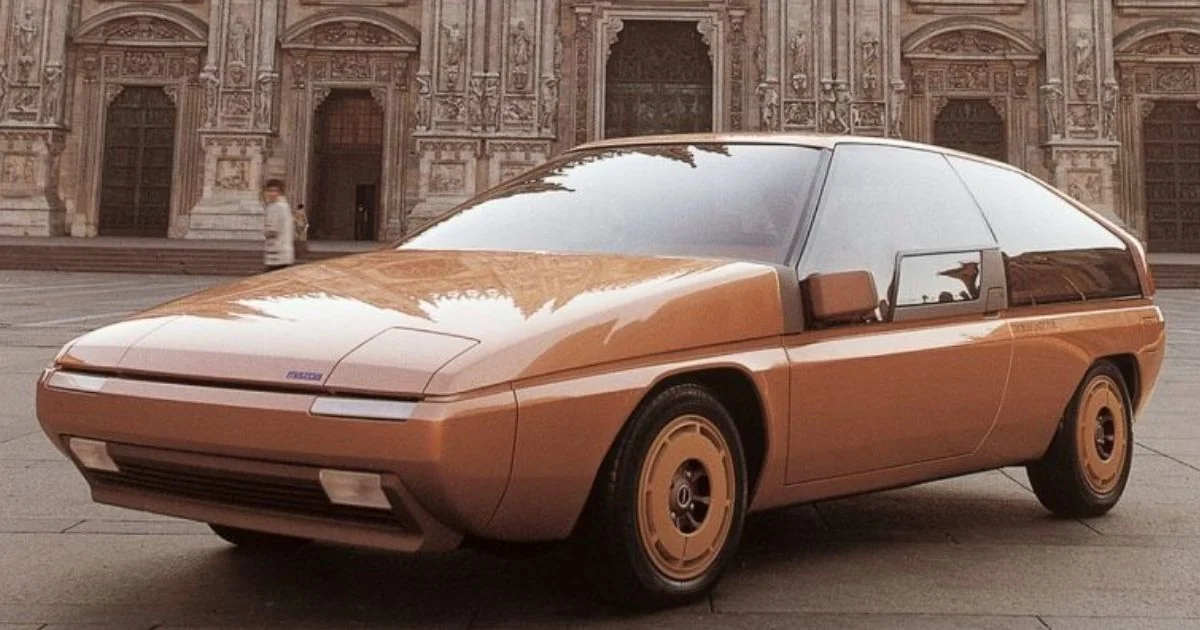
The debates over Tesla’s yoke-style steering wheels or the futuristic rectangles found in certain Lexus models have kept people talking in recent years. Yet at the very dawn of the 1980s, Mazda had already pushed the envelope even further: with the Mazda MX-81 Aria, unveiled in 1981, the company literally replaced the steering wheel with a rectangular block surrounding a television-like screen, steered by a sliding belt mechanism that turns the wheels.
This concept car, built with the Italian coachbuilder Bertone and based on the compact Mazda 323, became the first to wear the MX badge for “Mazda eXperimental.” Unveiled at the Tokyo Motor Show in 1981, the MX-81 Aria was meant to embody Mazda’s vision of the future of interior styling and ergonomics. Nearly forty years before dashboards could be fully digital, this study already integrated instrumentation, navigation, and controls… directly into that peculiar steering block, a device that continues to fascinate all who encounter the car in a museum today.
The Mazda MX-81 Aria, Mazda eXperimental Manifest Signed by Bertone
For this first Mazda eXperimental project, the automaker tapped Marc Deschamps, then head of design at Bertone. Mazda gave him free rein, with a single constraint: start from a Mazda 323 technical base. The result was a compact three-door coupe, about 3.94 meters long, 1.69 meters wide, and only 1.28 meters tall, powered by a 1.5-liter turbocharged four-cylinder delivering around 130 horsepower to the front wheels through an automatic transmission. The objective was crystal clear: push design boundaries and demonstrate how far Mazda could go in daring styling and audacious ideas.
From the outside, the Mazda MX-81 Aria adopted a wedge-shaped silhouette typical of Bertone’s designs of the era, with flush glass, hidden door handles, aerodynamically shaped wheels, and retractable headlights. Even the wipers were concealed beneath a folding panel. The result: an announced drag coefficient of 0.29, remarkable for a 1981 concept. The cabin was bathed in light thanks to the expansive glass area, but since the glass didn’t open, Mazda provided small secondary windows to pass a toll ticket or admit a small airflow. A detail that justifies the name: “Aria” means “air” in Italian, a nod to the importance placed on the onboard atmosphere.
A Rectangular Steering Belt Around a CRT Screen
Yet the real leap happened inside. Instead of a conventional steering wheel, the driver faced a fixed rectangular block mounted in front of him, inside which was integrated a CRT screen that replaced the instrument cluster. The central screen displayed the usual information (speed, engine data) and was intended to serve as the interface for a JVC navigation system, controlled via a wired remote stored in a floor console. All around, a ring of pushbuttons gathered the controls for turn signals, wipers, fog lights, horn, and various electrical functions, while air conditioning and the radio remained offset elsewhere on the dashboard.
To steer the wheels, Mazda and Bertone devised an even more surprising solution: a “belt” of plastic links, topped with little rubber blocks and a fabric pad, sliding around the screen block. The driver would grab these blocks and pull them left or right to steer. Mazda notes that this steering system was fully functional on the prototype, although no publicly documented real-world driving sequences exist. Part of the instrumentation remained fake, though: a secondary speed display on the left fixed at 120 km/h, an outside temperature gauge stuck at 30°C (86°F), and even the digital clock above the sun visor were decals. By contrast, the screen could actually illuminate, and the cassette player and radio tuner were fully operational, proving that this rolling laboratory was more than a static mock-up.
From Oblivion to Museum: the MX-81 Aria’s Second Life
After its Tokyo Show debut in 1981, the Mazda MX-81 Aria went on to attend a string of shows before fading from the public eye. Mazda did not intend to put it into production, although the brand explained at the time that several technologies showcased on the concept might appear on future models. That proved true for the careful aerodynamics, the navigation systems, and even the driving-assistance radar. However, the belt-steering with a CRT screen did not find a production descendant, and Mazda never adopted such an extreme cockpit layout in a road car. The company has not offered further clarification on this point.
Like many concepts, the MX-81 was stowed away in a Mazda warehouse in Hiroshima under a cover, alongside other MX studies like the MX-02 and MX-03. Time and humidity damaged the interior and caused some body shop issues, but the car remained largely intact. Around 2019, as Mazda prepared to launch the MX-30 crossover and celebrate nearly forty years of MX models, the marketing team requested updates on this pioneer. The car was located, removed from its slumber, and taken to Hiroshima for a mechanical freshening: engine, cooling system, and fuel supply were refreshed. In March 2020, with the mechanicals in working order, it was shipped to Italy for restoration by SuperStile in Moncalieri, which steam-cleaned the car, preserved as many original parts as possible, and reproduced only the most damaged components, including the mechanisms for the retractable headlights and some interior trim.
The finishing touch was a new coat of paint in its original gold color. Mazda then seized the moment to reunite the freshly restored MX-81 Aria with the MX-30 on Milan’s Piazza del Duomo, the very spot where the 1981 concept’s press photos had been shot. For the brand, the symbolism was powerful: as it celebrated its centennial in 2020, Mazda highlighted the earliest MX model and its extraordinary cockpit. Since July 2021, the concept has enjoyed a calmer existence at Mazda Classic – Automobil Museum Frey in Augsburg, Germany, where visitors can study up close this belt-steering and its cathode-ray-tube screen, as if they were stepping into a science-fiction movie set.
This renaissance also carries a poignant note for Bertone. Marc Deschamps, the designer who sketched the lines and crafted the Aria’s interior, passed away in October 2026 at the age of 82 after spending his final years in care following a serious fall. According to available information, he did get to witness his concept’s revival and its return to the international stage. It’s a testament to a quirky steering wheel around a television screen—an idea unique in its time, and unforgettable for anyone who ever crossed paths with it.