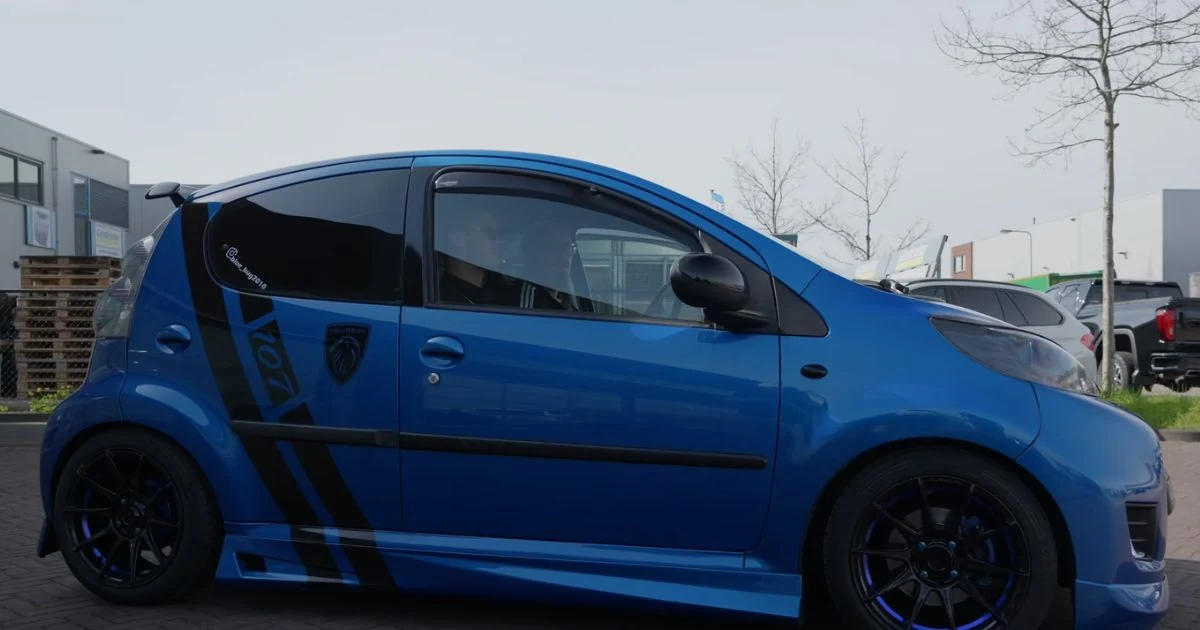
For many, a Peugeot 107 is just a practical, affordable city car—the perfect companion for city living and the basics of driving. For Jeffrey, it’s something entirely different: his first car has become both a hobby and a rolling laboratory, and a five-year project that he hasn’t paused, even as he uses it every day.
The story began simply during the Covid era, with a different wheel set. And there, the transformation took on an entirely new scale over the years: suspension, bodywork, lighting, interior—almost everything has been touched. What stands out is that Jeffrey keeps racking up long trips in this Peugeot 107 tuning, between family visits and European road trips, as if nothing had changed.
From the Little City Car to Jeffrey’s Peugeot 107 Tuning
Originally, the 107 is an A-segment city car, developed on a shared platform with the Citroën C1 and Toyota Aygo. It comes with a small 1.0-liter three-cylinder petrol engine producing 68 hp, a curb weight under 900 kg (roughly 1,980 pounds), and a decidedly urban mission. On paper, it’s the very definition of a simple, economical, easy-to-park car, designed more for everyday trips than for cruising the highway for hours.
Jeffrey, for his part, did something else. For him, this 107 is his first car, but also his passion, with a project that has been ongoing for about five years. It all started with a simple wheel swap during the lockdown period, which opened the door to a cascade of more ambitious modifications. No details are given about the budget involved, but the result clearly shows he didn’t settle for two or three accessories.
Suspensions, Body Kit, and Interior: The Key Choices on Jeffrey’s Peugeot 107
Over time, the little Peugeot has undergone a metamorphosis. It now features:
- a coilover setup, i.e., adjustable coilovers,
- a full body kit,
- custom, tailor-made front headlights,
- sport seats inside,
- an upgraded audio installation,
- numerous black accents on the bodywork.
The bottom line is simple: nearly everything you see on the car has been reworked, on the outside as well as the inside. The coilovers allow lowering the car and tuning the stiffness, which markedly changes the handling of a lightweight compact. The sport seats provide better support, especially on long drives, and the upgraded audio helps make long trips more bearable in such a small cabin. Again, there are no specifics given about the exact parts used.
30,000 to 40,000 km per year: a Peugeot 107 Tuning That Keeps the Long Journeys Coming
This 107 isn’t a show car that sits in a garage. Jeffrey covers between 30,000 and 40,000 kilometers per year to visit family and for road trips across Germany, France, Luxembourg, and even England. His car is used for what a car is meant to do: drive, and often far from home. Under the hood, you’ll still find the familiar three-cylinder engine, simply remapped. There are no exact horsepower figures given for Jeffrey’s 107, and the aim clearly isn’t to set acceleration records.
The appeal lies in its featherweight, direct steering, and the almost “kart” feel a well-balanced small city car can deliver, whether on a twisty coastal dyke road or through the Ardennes. For this 1.0-liter, 68-hp engine, tuners generally estimate that a reasonable remap can push it to roughly 75 hp and around 110 Nm of torque, a modest gain that makes throttle response more pleasant without turning the car into a rocket. There are no details on the exact mapping Jeffrey uses, but choosing to stay with this engine and approach speaks volumes.
This kind of heavy use inevitably raises questions about reliability. The case of another Peugeot 107 showing 597,793 km on the odometer, still with a valid inspection, shows that this model can absorb very high mileage when properly cared for. And once again, we’re talking about an A-segment city car. Jeffrey’s 107 embodies that same idea, a Peugeot 107 tuning project pursued over years that doesn’t sacrifice long trips or daily use, and that continues to evolve year after year.