In Brief
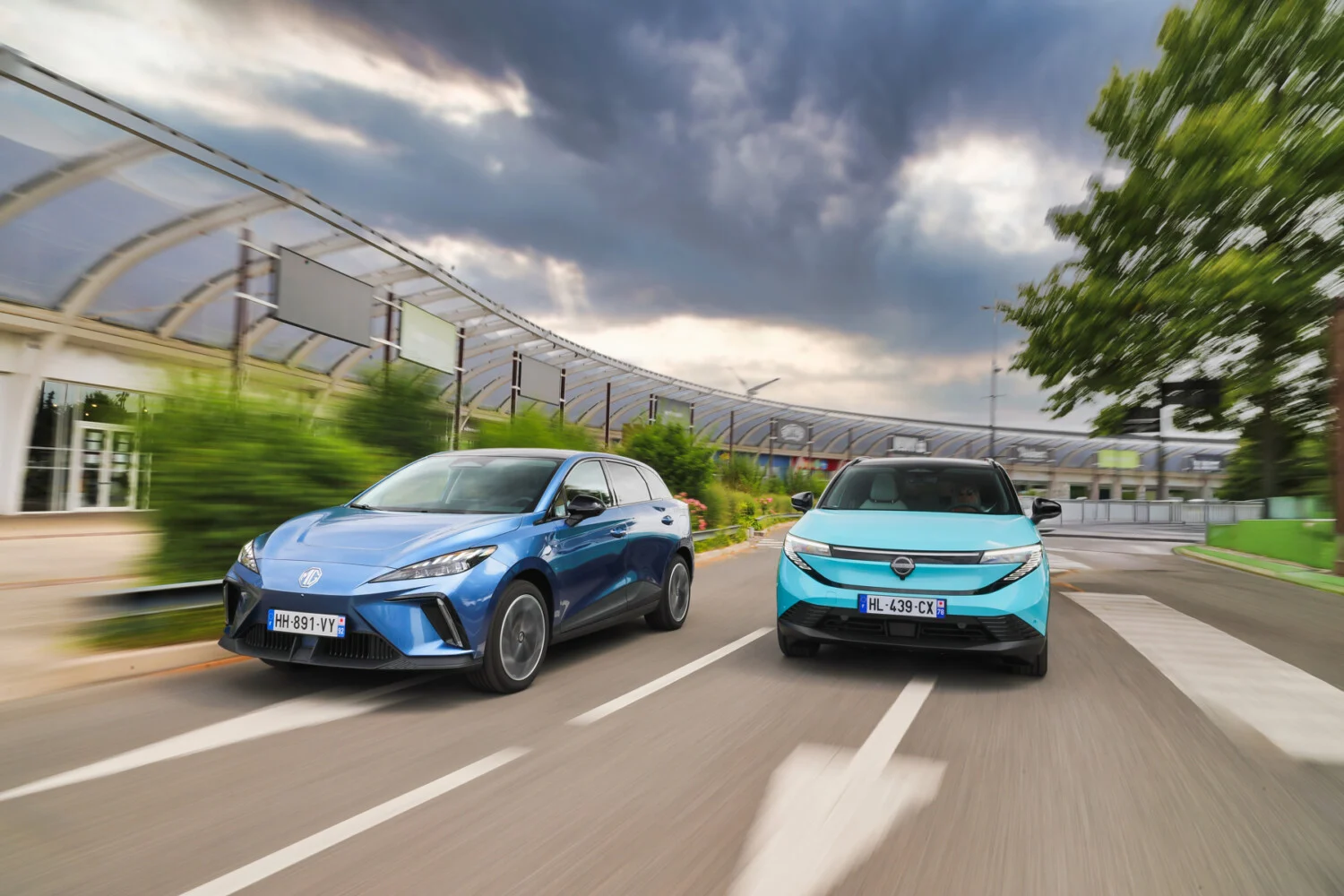
The comparison between the Nissan Leaf and the MG4 EV sheds light on two opposing philosophies of electric vehicles in 2026: the Leaf wins over with its generous cargo area, its equipment, and its comfort, while the MG4 wins over with its dynamism, its performance, and a remarkably aggressive price. The MG4 takes the lead on price/performance and efficiency, but the Leaf remains a reassuring benchmark for families thanks to its interior space and well-rounded equipment. The choice therefore depends on budget, driving expectations, or practical needs.
It’s almost “mechanical”: the confirmed and stabilized rise in traditional fuels seems to give a real boost to EV sales. An effect that Chinese manufacturers, highly responsive and investing in some cases in new brands to enter the market, intend to capitalize on. MG, one of the first to strike the European market, has a head start and is already coming back with a refreshed MG4, hoping to steady the ship after a lukewarm 2025. It also faces competition from its compatriots in a segment sensitive to fashion trends and constant technical progress: in 2025, only 2,500 MG were sold, i.e., 70% less than in 2024. For its part, Nissan is back (finally!) on the scene with its Leaf, a pioneer of the category since the first mass-market electric car appeared in 2010 – 700,000 units produced since. The second generation took over in 2018 and held the line for eight years, a canonical age in the tech world of EVs… To clearly signal its renewal, the Leaf goes “SUV-ish,” following the current trend, and aims to be as uncontroversial as possible. It offers a choice between two batteries: a 52 kWh net unit (starting at €35,300) best suited for reasonable mileage, and a 75 kWh net unit, which is our focus today and officially priced at €47,000 in the high-end Evolve trim. That should help it just about qualify for government incentives. The MG4 also offers two batteries: a 64 kWh gross (from €28,490), and the 77 kWh gross, the subject of this comparison, marketed through the end of September at €33,990 after a €3,000 discount.
Nissan Leaf 217 ch/79,1 kWh Evolve vs MG4 EV 245 ch/77 kWh Premium: On the Road?
Now that the precedent is set: the old Leaf wasn’t a very dynamic car. But back then, shorter ranges didn’t encourage buyers to push the engines, though they were already lively, and to enjoy chassis dynamics. Today, with technological progress, significantly lower consumption, and higher battery capacities, the situation has changed. And to lure the undecided, even the skeptics, manufacturers no longer settle for simply offering efficient cars; they try to make them more enjoyable to drive. The new Leaf still benefits from Renault–Nissan synergies and uses the AmpR Medium platform (formerly known as CMFEV), shared notably with the Megane E-Tech, a very pleasant traction system to drive at all speeds. As a proper family car, the Nissan aims to be very safe and easy to handle, with precise steering and solid assist. The ride comfort is also satisfactory and it filters road imperfections well across all road surfaces. On that front, the package is solid. But unfortunately, its high curb weight (1,920 kg on our scale) tames any urge for dynamic performance and makes it rather dull to drive. Of course, some buyers won’t care about my views, but the competition is such that I feel obliged to warn those who still enjoy driving. The 217 hp output isn’t in doubt, delivering 0-100 km/h in 7.8 seconds and a quarter-mile in 29.2 seconds—numbers that are quite respectable for the segment and still leave ample power in reserve. The MG4 isn’t short of power, boasting 245 hp. But where the Chinese rival makes the difference is in its weight: 1,725 kg. That nearly 200 kg gap immediately shows up in performance and, more importantly, handling. It’s also worth noting that the MG4 is rear-wheel drive, an architecture that naturally lends itself to dynamic driving. The steering is lively, but so is the suspension, which is firmer. It transmits low-speed imperfections more sharply, which detracts from comfort, but it better controls body roll and allows for a more engaged drive. This MG4 remains, despite its facelift, one of the most dynamic and engaging propositions in the class in terms of driving feel. All of that translates into near-sporting performance, with a 0-100 km/h time of 6.4 seconds and a 1,000-meter dash of 27.2 seconds. The EV is thus very strong. So, while the new Leaf delivers a safe behavior in all conditions, the MG4 clearly dominates the “On the Road” chapter. Who says the Chinese can’t build cars?
Nissan Leaf 217 ch/79,1 kWh Evolve vs MG4 EV 245 ch/77 kWh Premium: Interior Life
The Leaf’s newly SUV-oriented profile modernizes its previously somewhat “timid” electric approach. The dashboard design inevitably echoes the large Ariya SUV, with a calm and pleasant ambience. The build quality is solid, and Nissan actually listened to feedback from the early units we tested at the end of 2025. Some hard plastics remain, as is often the case in modern cars. Our top-of-the-line Evolve features two 14.3-inch displays (12.3 inches on the entry Engage), powered by a very capable Google Automotive system, which delivers smooth operation (with an impressively effective trip planner) even if navigation through menus can still be a bit clunky and requires some acclimation. The driving position is well-suited, and the cabin space is reasonably generous, except for rear legroom, which is a bit tight (25 cm vs. 27 in its rival). It’s the relatively high floor in the second row that bothers taller passengers, forcing knees to stay somewhat raised and feet to have limited space under the front seats. Not a deal-breaker, but less comfortable on long trips. A bright point is the trunk, offering 460 liters of cargo space, which remains ample, even though the loading lip is fairly tall. Finally, the standard Bose audio setup on our version is particularly impressive, with 9 speakers including one in the driver’s headrest, ideal for navigation prompts. The MG4, which arrived in France in mid-2022 with aggressive pricing, drew sharp criticism for rather average build quality. Aware of these shortcomings, the brand has worked hard to improve. The materials are much nicer and the ergonomics have improved significantly with the return of physical controls for essential functions like air conditioning—a definite plus. The 12.8-inch central screen is clear and, like the Leaf, provides all the connectivity you need, though its trip planner is somewhat less relevant than the Leaf’s. The driving position, more sedan-like and thus lower, will appeal to active drivers but may disappoint those who appreciate that small raised vantage point that lets you dominate the road, as with today’s rival. That said, despite its shorter overall length (4.29 m vs. 4.35 m for the Leaf), the MG4 benefits from a longer wheelbase that helps provide better legroom. But when it comes to cargo, there’s no miracle: 335 dm³ isn’t enough to match the Leaf’s space or most rivals in the segment. Another downside for MG is sound insulation; the Leaf is notably better at keeping wind noise down.
Nissan Leaf 217 ch/79,1 kWh Evolve vs MG4 EV 245 ch/77 kWh Premium: Budget?
This is often where victory is decided. Our two contenders prove to be quite frugal, averaging 16.4 kWh/100 km for the Leaf and 15.4 kWh/100 km for the MG4. Those numbers translate into impressive real-world ranges: about 465 miles for the Leaf and 495 for the MG4. We’re looking at EVs that are practical for long trips—MG has a slight edge—that even high-mileage drivers could adopt. However, be aware that the maximum charging power remains below class leaders: 150 kW for the Leaf and 144 kW for the MG4 on fast chargers. Both cars are also very well equipped as standard, with Leaf adding extras like a massaging driver seat, synthetic leather upholstery, and a very capable audio setup we’ve mentioned. However, that abundance of standard equipment comes at a price, with roughly €10,000 more in favor of the MG4 when you account for the government bonus that the Leaf enjoys by virtue of being built in England, whereas MG would likely become eligible by 2028 when it sets up European production. Viewed this way, the MG4, available only in Premium trim (€33,990 through September; €3,000 more afterward), appears the better overall choice across all categories. But if you’re drawn to the Leaf, opt for the entry Engage version, already well equipped, which after the bonus lists at €36,765—roughly the price of the MG4 Premium fully loaded once its discount ends.
Nissan Leaf 217 ch/79,1 kWh Evolve: Its Pros
- Comprehensive equipment
- Spacious cargo area
- Safe handling…
Nissan Leaf 217 ch/79,1 kWh Evolve: Its Cons
- … but lacks drive to match MG
- Complicated touchscreen
- High rear floor
MG4 EV 245 ch/77 kWh Premium: Its Pros
- Competitive pricing
- Performance/efficiency
- Precise handling
MG4 EV 245 ch/77 kWh Premium: Its Cons
- Firm ride
- Cargo volume
- Competition from 64 kWh version
Nissan Leaf 217 ch/79,1 kWh Evolve vs MG4 EV 245 ch/77 kWh Premium: Verdicts?
- On the road: MG4 EV
- In-cabin life: Nissan Leaf
- Budget: MG4 EV
Auto-Journal’s Pick: MG4
The Leaf is a solid, well‑cushioned car that consumes little. But the MG4 has refined its package without raising the bill, delivering an unbeatable price/performance ratio. And it’s even more efficient. Families, on the other hand, may lean toward the Leaf for its more generous trunk.
Nissan Leaf 217 ch/79,1 kWh Evolve: In Figures
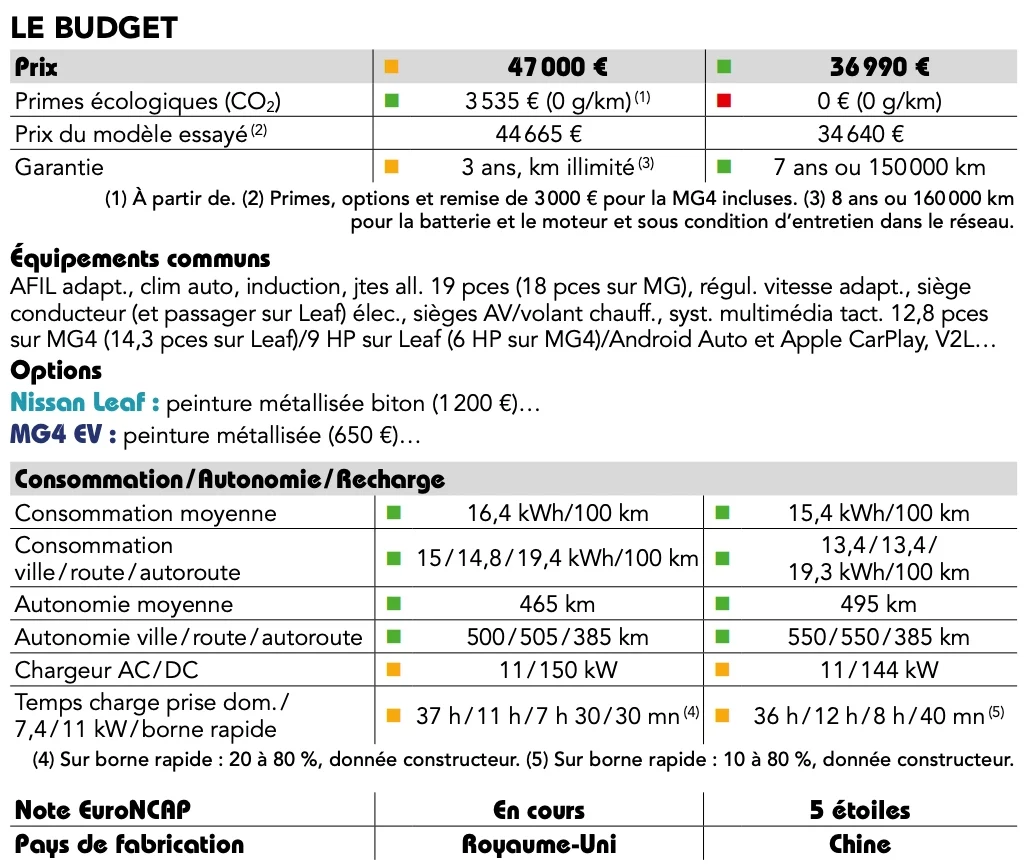
Find our comparative test between the Nissan Leaf 217 ch/79,1 kWh Evolve and MG4 EV 245 ch/77 kWh Premium in Auto Journal issue no. 1217, dated 17/09/2026.
Comparison Table
| Model | Power (hp) | Battery (kWh) | Weight (kg) | 0-100 km/h (s) | 1,000 m dash (s) | Eff. (kWh/100km) | Range (km) | Cargo (dm³) | Price (after discount) |
|---|---|---|---|---|---|---|---|---|---|
| Nissan Leaf Evolve | 217 | 79,1 | 1920 | 7,8 | 29,2 | 16,4 | 465 | 460 | 47 000 € |
| MG4 EV Premium | 245 | 77 | 1725 | 6,4 | 27,2 | 15,4 | 495 | 335 | 33 990 € |
Key Takeaways
- The MG4 EV shows a highly competitive price/performance ratio and superior performance.
- The Nissan Leaf shines with its large trunk, comfort, and quietness.
- Both models offer solid ranges, but the MG4 EV takes the edge (495 km vs. 465 km).
- The budget remains favorable to the MG4, much cheaper for comparable equipment.
- The Leaf provides a safe, secure driving experience, but less dynamic than its rival.
- Each model meets different expectations: dynamism and price for the MG4, space and comfort for the Leaf.
FAQ
Which model offers the best range between the Nissan Leaf and the MG4 EV?
The MG4 EV shows an average range of 495 km, higher than the Nissan Leaf at about 465 km.
Which vehicle is the faster from 0 to 100 km/h?
The MG4 EV (6.4 s) is quicker than the Nissan Leaf (7.8 s) in the 0-100 km/h test.
Which model has more cargo space?
The Nissan Leaf offers a 460 dm³ cargo area, notably larger than the MG4’s 335 dm³.
What are the price differences between the MG4 EV and the Nissan Leaf?
The MG4 EV Premium is offered at €33,990 after discount, while the Nissan Leaf Evolve hits €47,000.
Which model is more comfortable for passengers?
The Leaf, with its smooth ride and good sound insulation, proves more pleasant for passengers.
Is the MG4 EV eligible for the green bonus?
Not yet, but the brand foresees possible eligibility by 2028 with European production.