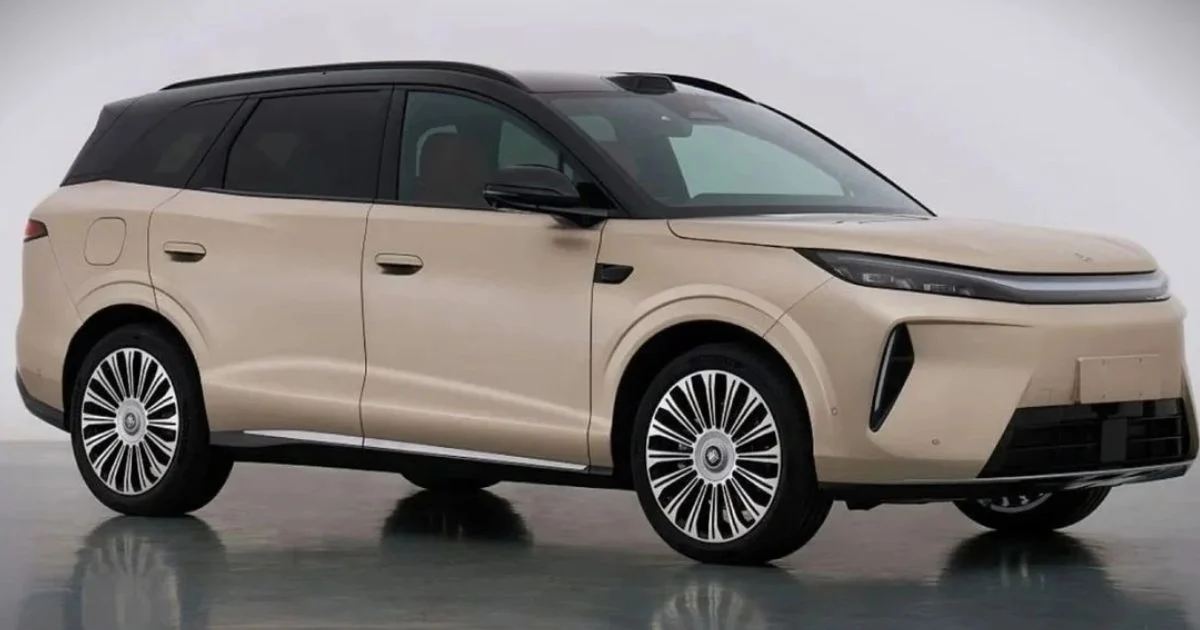
Two screens larger than 30 inches facing the driver and front passenger, in a family SUV measuring 5.05 meters long… On paper, you’d almost mistake it for a high-tech living room rather than a car. Yet this is what BYD is preparing with the next generation of its flagship electric SUV, the Tang, whose homologation sheet has just resurfaced in China and says a lot about the automaker’s shift: even bigger, even more powerful, but above all focused on the in-cabin experience.
Slated for the Q4 2026 launch on the Chinese market, this BYD Tang EV of the third generation shifts its philosophy according to CarNewsChina. It remains a large 100% electric SUV, now limited to 5 seats while its predecessor offered 6 or 7. And it prioritizes its presentation like never before, with an XXL interior dominated by a dual giant-screen setup and a new interface dubbed the “Giant Screen UI”, to the point that the technical sheet showing 691 hp becomes almost secondary.
A new BYD Tang EV: longer, more powerful… but only five seats
Documents published by China’s Ministry of Industry and Information Technology (MIIT) reveal the measurements of this large electric SUV. The new Tang EV measures 5,045 mm (about 198.6 in) long, 1,980 mm (about 78.0 in) wide, and 1,740 mm (about 68.5 in) tall, with a wheelbase of 2,950 mm (roughly 116.1 in). It gains 145 mm in length and 130 mm in wheelbase compared to the second-generation Tang EV, providing more rear legroom and a stronger road presence.
In return, BYD abandons the old model’s 6- and 7-seat configurations: the homologation sheet lists only a 5-seat version. Curb weight reaches 2,520 kg (about 5,554 lb), with a maximum gross vehicle weight rating of 2,975 kg (roughly 6,552 lb). In the lineup, the true “7-seat” role now falls to the Da Tang EV, launched in mid‑2026 in China, at 5,263 mm long, with three rows and pricing from around 239,900 yuan (about €33,000). BYD has not yet detailed the price positioning of this new Tang EV relative to its larger sibling: no specifics are given yet.
XXL interior, giant dual screens and a tech arsenal for the BYD Tang EV
If the bodywork moves forward in small increments, it’s the interior that marks a real break. The first official images show a very horizontal cockpit, dominated by two monumental panels: a panoramic display of about 35.4 inches at the base of the windshield and a central screen of about 30 inches, stretched across most of the dashboard. BYD adds its new modular Giant Screen UI, designed as a giant tablet where you can resize and organize windows (navigation, music, climate control, vehicle info) almost on a custom basis. A virtual assistant avatar, named Xiao Mianbao, responds to voice commands, enhancing the “connected living room” vibe even further.
The ambiance clearly targets “premium accessible”: matte leather upholstery, new hues Dune Beige and Amber Brown, an expansive glass roof with ambient lighting sweeping the full width of the dashboard and into the door panels. In the rear, BYD emphasizes a second row with a backrest recline up to 130 degrees, taking advantage of the longer wheelbase and the absence of a third row to offer a true travel seat for passengers. Under the surface, the specs match the ambition, with a two-motor version announced at 515 kW (about 691 hp combined) and a top speed of 250 km/h (roughly 155 mph), a significant jump over the old Tang EV’s all‑wheel drive.
In terms of energy, the third-generation Tang EV relies on a lithium iron phosphate (LFP) battery from BYD’s FinDreams family, using the company’s own Blade Battery 2.0 technology. The range lineup should offer capacities of 88.7 and 105.8 kWh, paired with a range up to 850 km (CLTC Chinese cycle). BYD also touts a “Flash Charging” feature capable of taking the battery from 10% to 70% in five minutes under optimal conditions. The homologation documents, however, do not specify the exact capacity and range that would be associated with the 515 kW two-motor version: at this stage, no reliable figures are given on that point.
The chassis doesn’t stop at the basics either. The new BYD Tang EV can be equipped with the air-spring suspension DiSus-A, capable of adjusting height and stiffness in real time, with road preview to smooth out irregularities. On the driver-assistance front, the images show a roof-integrated LiDAR and cameras tucked into the front fenders, paired with the DiPilot 300 package, known in its market as “God’s Eye B.” The detailed list of features and whether this gear is standard or optional remains to be confirmed for this variant. As for a potential Europe-wide rollout, BYD has not weighed in yet, leaving this spectacular rolling lounge initially confined to the Chinese market.