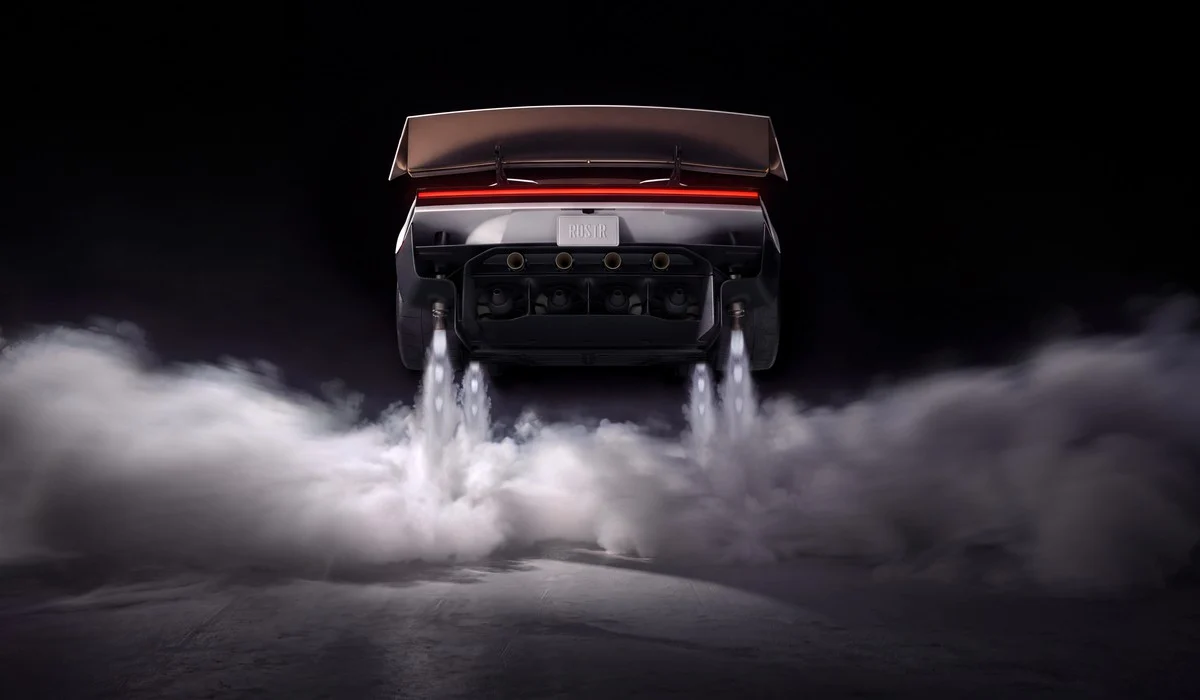
Tesla unveiled the new Roadster this Friday at a grand Texas event held at SpaceX’s McGregor rocket-testing facility. The technical specs are staggering, featuring a 0 to 60 mph in under one second and the car’s potential to lift off. This isn’t just a leap like BYD’s Yangwang U9 showcased recently; it’s a real takeoff. The promise is bold, perhaps a touch too bold. One wonders whether we’ll ever actually see a Tesla Roadster fly.
A Car That Flies, Seriously?
When I woke up on Friday, October 16, I felt like the world was turned on its head. The first image I encountered on social media was a Tesla Roadster, new model name clearly attached, performing a slow half-loop, stuck to a ramp and capable of a mid-air turn before landing gently.
Tesla would reportedly have equipped its Roadster with multiple air thrusters. To run, the car carries two carbon-fiber tanks of 600 liters, with 250 kg of compressed air and ten nozzles to steer the vehicle in the air. It can vault over several cars, even when coming in almost stationary, and execute a kickflip—a skateboard staple—before settling down with no obvious damage.
So yes, the Roadster shown is capable of an ascent never before seen. The thrusters’ thrust reaches 80 kN, roughly a tenth of the thrust of a Falcon 9 rocket, but that does not make it a flying car. Even if you could afford one, you wouldn’t be able to fly with it like an airplane, a drone, or a helicopter. And even for the extraordinary hops it promises, nothing is truly guaranteed.
Pessimism Is Warranted
Tesla has a history of making grandiloquent, spectacular, and almost unbelievable announcements. Take, for instance, the Tesla Roadster unveiled in 2017, which was supposed to sprint from 0 to 60 mph in one second. Preorders were taken, but the car never reached production. Nine years later, Tesla unveils what still isn’t a production version of that 2017 Roadster. This thruster-equipped Roadster reads like another marketing move to generate buzz on social media, boost its stock price, and line up cash from preorders, open between $50,000 and $250,000.
Additionally, not all Tesla Roadsters will be able to perform this aerial maneuver. There are three variants. The Performance version can hit 0-60 mph in 1.6 seconds and features active aerodynamics with an air-suction system. A deposit of $50,000 is required: $5,000 upfront, then $45,000 within ten days.
Next comes the Thrust version, which reaches 0-60 mph in 0.81 seconds with the help of rear-mounted cold-gas thrusters. Expect a $250,000 deposit, with $50,000 due immediately and the remaining $200,000 within ten days.
Finally, for the Rocket version, equipped with ten thrusters capable of lifting the car off the ground, buyers must settle for a single-seat car with an unspecified deposit. Moreover, you must be invited by the brand to purchase it. The lack of transparency around the purchase terms for this car, which would not be road-legal, heightens the skepticism surrounding the Tesla Roadster Rocket. Will it ever become a reality? Will a handful of billionaires be able to perform aerial feats in it? It remains far from certain.
One thing is certain: after the abandonment of the Tesla Roadster 2.0, the American automaker is under intense scrutiny with the Tesla Roadster 3.0 to maintain the trust of customers and investors. But it must be admitted that its styling—evoking an Italian supercar from the 1980s—works well.