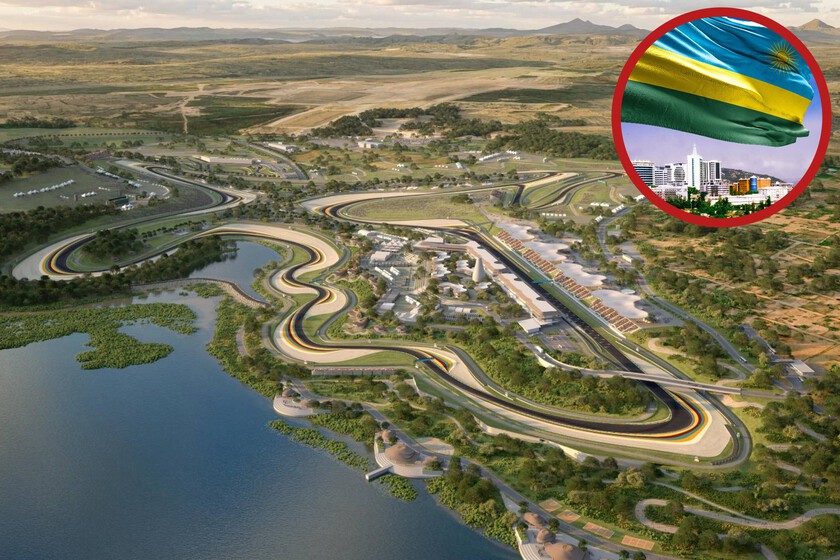
It’s official. Formula 1 will return to racing in Africa. 33 years after the last race in South Africa, Formula 1 has a new ally on the African continent: Rwanda. With no fixed date yet, and the vague indication of “from 2030,” Formula 1 has confirmed that the grand circus will return to Africa.
The issue lies in the numbers. In a country with a poverty rate of 27.4% and with average wages at rock-bottom, the government plans to spend around 300 million euros on a Formula 1 Grand Prix. And it is not the only lavish project the Rwandan government has embarked on in recent times.
Formula 1 returns to Africa with no fixed date
While the country is still trying to close the wounds of its past, Rwanda has embarked on a project few saw coming: hosting a Formula 1 Grand Prix. Liberty Media, owner of the world championship, has confirmed that the grand circus will return to Africa and that it will do so in Rwanda, but with no fixed date. They only specify that it will be “from 2030”.
The move has sparked an immediate reaction for its perceived hypocrisy. Explained by Norman Ishimwe, president of ‘Jambo’ and cofounder of ‘All for Rwanda’, associations dedicated to rebuilding the country after the terrible events of the late 20th century. For Ishimwe, “Rwanda is building one of Africa’s most prestigious projects at a time when basic investments in education, health, and household incomes remain urgent.”
And in Rwanda the average monthly wage of a worker is 39,000 Rwandan francs. At the exchange rate, that is 23.65 euros per month. A figure that places more than a quarter of Rwanda’s population on the poverty threshold. However, the estimate is that the government will spend around 300 million euros on Formula 1.

Only the circuit’s construction is fixed at 240 million euros, a figure that must be added to around 16 million more annually for track maintenance, and the Formula 1 fee, which in the case of a country without a tradition like Rwanda is unlikely to fall below 35 million per year, potentially rising to 50.
Formula 1 hasn’t run in Africa since 1993, when the last Grand Prix of South Africa was held. In all its history, Formula 1 has only visited another African country besides South Africa: Morocco, where a single decisive race was held in 1958. Surely no one would have bet 33 years ago that the next race in Africa would be in Rwanda.
BREAKING: Formula 1 returns to Africa with 10 year agreement to race in Rwanda
The African Grand Prix is set to join the F1 calendar in the early 2030s
#F1 https://t.co/IlsKseMnNa
— Formula 1 (@F1) October 13, 2026
The big question is whether it makes sense for Rwanda to spend 23% of its annual allocation for health, education, and social protection on a three-day event, even if it is Formula 1.
Images | Formula 1