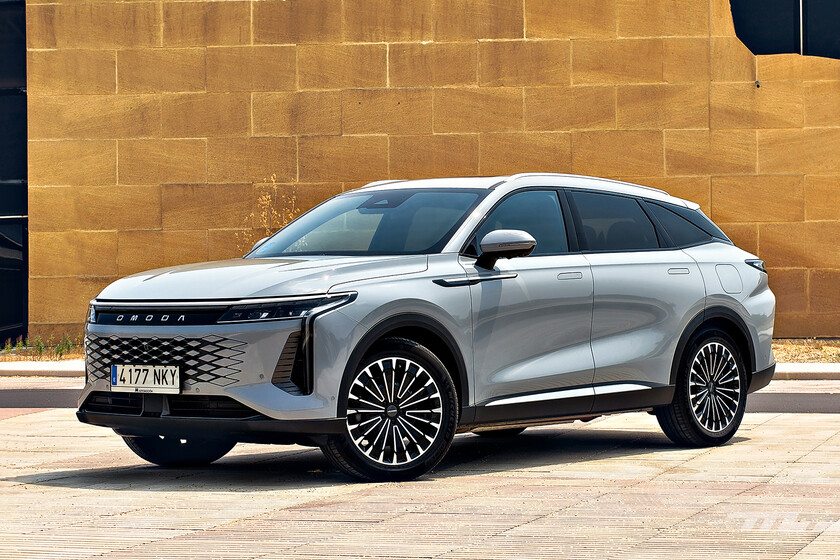
Omoda 9 SHS. It sounds like a B-movie spaceship, but it isn’t. It is one of the models that has helped make Omoda-Jaecoo – one does not go without the other – the twelfth best-selling brand in Spain so far this year, listing almost 30,000 cars. The Omoda 9 SHS is the flagship of these two brands from the Chery group. And its contribution isn’t merely anecdotal, as it sells at an average of 420 units per month, more than 3,200 so far this year.
And what does it have that other cars don’t? More than 1,000 km of range, more than 500 hp, more standard equipment than the options list of a German car, and a price of 50,000 euros. And all this with the same presence that Porsche Cayenne had in its early days.
Omoda 9 SHS: Look at me
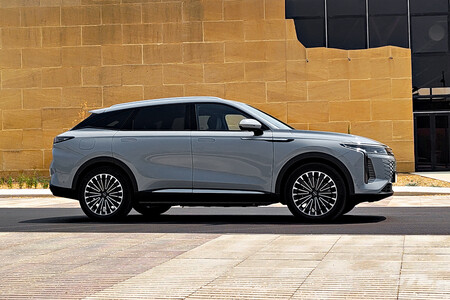
With a length of 4.78 m, the Omoda 9 is more of an SUV the size of the new Audi Q5 (4.72 m), the Mercedes GLC (4.85 m) or the BMW X3 (4.76 m). The Omoda 9 is equipped with a 34.46 kWh battery, which allows a remarkably respectable homologated electric range of 145 km. That makes it the second PHEV with the greatest electric range on the market, behind the Lynk & Co 08 and its 200 km homologated.
p
Technologically, the Omoda 9 is unquestionably advanced. It uses a particularly sophisticated plug-in hybrid architecture that couples a four-cylinder gasoline engine, 1.5 turbo with Miller cycle, 145 hp (215 Nm), to three electric motors.

In normal driving, the rear electric motor of 238 hp alone guarantees propulsion. The two front electric motors, 122 hp and 102 hp, reinforce traction and performance when the driver pushes the accelerator or selects the more dynamic driving modes. In total, Omoda flaunts 537 hp and 650 Nm of torque, figures worthy of a Mercedes-AMG or a gasoline Porsche Macan.
What it’s like to drive it
Behind the wheel, however, the Omoda 9 does not live up to its spec sheet and its appearance – with its four exhaust outlets, for instance – suggests. 0 to 100 km/h is achieved in just under five seconds and 80 to 120 km/h in 4.1 seconds. So it can’t be accused of being slow. No, the issue is more about how it moves.
The steering (you can be in Comfort or Sport) is blatantly imprecise and provides no information about what the wheels are doing. That makes it abrupt in the bends, because you have to constantly correct the trajectory. At a brisk pace, the front end feels a little overwhelmed, always trying to head straight.
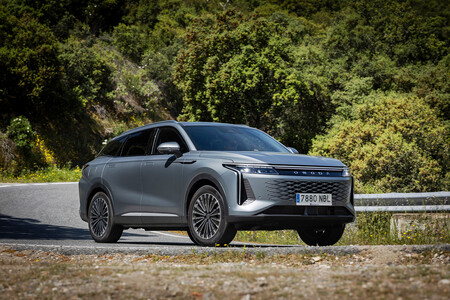
The chassis’ handling control isn’t what you’d expect from a car boasting nearly 540 hp. The snout sinks during braking and the roll in corners isn’t just a feeling because the leather seats don’t hold you — the car truly leans. Here, the 2,270 kg of the car are noticeable, and a lot. Even though there are three adaptive suspension settings (Normal, Mid, Sport), the difference between them isn’t particularly noticeable.
The Sport mode doesn’t improve anything; it only revs the engine— fairly loudly— to recharge the battery and ensure the electric motors always have the energy needed to deliver all their power.
The Omoda 9, despite its power and looks, doesn’t want to be jostled around; it’s a car meant for the most relaxed driving. Its forte are national roads at a calm pace and highways at a gentle pace where it moves with ease, comfort, refinement, and quiet. It behaves then like a true high-end car. In that regard it is an excellent long-distance traveler, also shining for its low consumption.
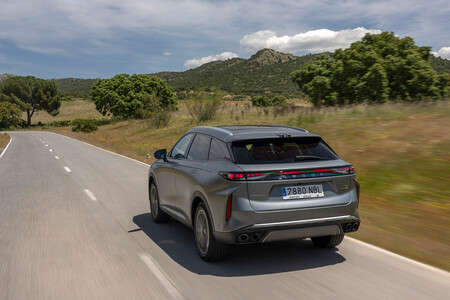
That’s something I could verify on a short multi-day trip from Tarragona to Toulouse, France, passing through Puigcerdá and returning to Barcelona via Perpignan. In the end, it was 853 km that I could cover with a single battery recharge and a single tank of gasoline. They aren’t the 1,125 km WLTP range the brand boasted, but more than 800 km of range remains an impressive figure.
In terms of efficiency and range, not everything is as flawless as it might seem. On secondary roads, consumption hovers around 3.5 l/100 km, while on the highway at 130 km/h it rises to 7 l/100 km.
As with every PHEV, even this one resembles more an EREV than a PHEV, so charging the battery is essential to achieve low consumption. Especially because below “25 km of range,” the gasoline engine recharges the battery to reach those 20-25 km of minimum range, which can push consumption up to 8.5 l/100 km if you drive briskly on the highway.
Al final, el consumo medio en este periplo ha sido de 7,8 l/100 km. No es especialmente bajo, pero para ser un coche de 2,2 toneladas con una imponente superficie frontal, no está nada mal. Incluso la autonomía eléctrica sale bien parada, con algo más de 80 km en 100% eléctrico. Eso sí, la buena autonomía del coche se explica, en parte, por su depósito de 70 litros.
ADAS, software
The balance is fairly positive, right? Let’s say yes, if not for the driving aids and the multimedia system that give an exasperating sense of being in a somewhat unfinished car, or one rushed and not well thought out.
The ADAS driving aids are extremely intrusive. For example, the lane-keeping assistant exerts too strong a touch on the steering wheel, to the point of making the wheel jerk to keep the car centered in the lane. And that’s because, for the system, the car must always be exactly in the middle of the lane, not a little to the right or left.
As for the speed limit assistant, while you can disable the alert of exceeding the limit from a shortcut on the touchscreen, that is not the case for the alert of changing the limit on the road. For that you must go to the assistance menu each time. And it is essential to do so. In just 300 meters on the AP-7, with no service roads or exits, it told me the limit changed to 100 km/h and suddenly to 30 km/h and then to 80 km/h, only to return to 120 km/h. And this on every road. Insufferable.
In the city, any motorcycle or car passing by ends up triggering the cameras and the car’s 3D view on the screen. And the same happens when we activate the turn signal; the problem is that the 3D view occupies the entire screen. It isn’t necessary; I know at a red light there’s a car or motorcycle next to me and I’m not going to park, I just want the navigation.
Another example. The gasoline and battery level indicators are expressed in kilometers of range, not in a percentage that everyone can understand. When the fuel level drops below 70 km, the kilometers disappear and only the word “low” remains. To cap it, the refueling alert, with beep included, pops up every 10 minutes.
Interior
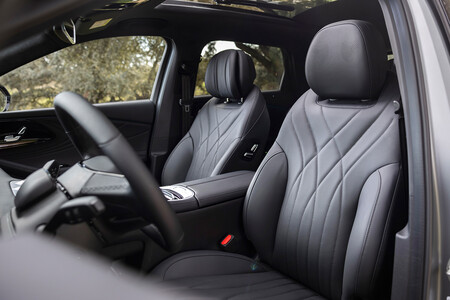
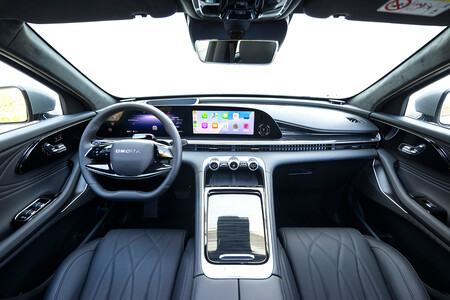
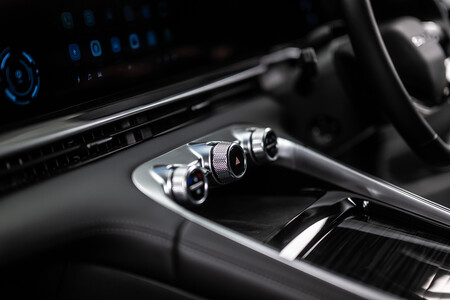
On board the Omoda 9, there is a distinct Mercedes-like feel. The seat-adjustment controls located on the door panels, the twin aligned displays, and the imposing central tunnel with its sliding hatch in Piano Black finish directly evoke the interiors of the German star-brand from a generation ago. There are worse references, to be honest. In any case, the finish is meticulous and the leather interior comes as standard.
The screens add up to 24.6 inches and are protected under a scratch-resistant Gorilla Glass, Omoda says. In use, what stands out most is a slight lack of responsiveness on occasion. Sometimes you have to tap the screen several times to select the desired menu, and some translations are a bit dubious. Beyond these small details, the Apple CarPlay and Android Auto, with or without cable, work very well.
On the other hand, moving from Android Auto –in my case– to the car’s Home menu requires digging through Android apps, and thus a couple of actions on the Android Auto screen are required, including an icon labeled “Omoda Exit”… because apparently it was very difficult to put a “Home” icon outside, as they did for the car’s audio volume. Or even, heresy, a physical button.
Lavish Equipment
If there’s a section where the Omoda truly leaves its rivals behind, it’s certainly in the level of standard equipment. It is lavish. There’s no need to rummage through an endless options list because there isn’t one. The only option is matte paint (gray or black), priced at 800 euros. Of course, whether you view the glass half full or half empty, you’ll think it’s quite positive or, alternatively, that it offers no customization options at all.
The panoramic roof or the head-up display, for example, are standard, like it or not, want them or not. The same goes for leather upholstery and the Sony 14-speaker multimedia system. Never before in a car has the oft-quoted “full equipment” motto been so true.
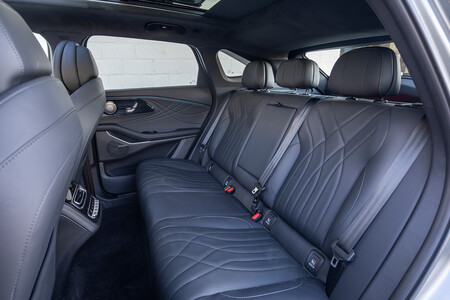
To give you an idea, even the rear seats are ventilated and heated, as are the fronts, of course. Rear seats also have electronically adjustable reclining backs. Another example: the car includes a V2L feature to power an electrical device if needed. A feature that many electric cars do not have, by the way.
Besides this luxury treatment, the rear passengers also enjoy a very generous amount of space. The boot, on the other hand, has a volume of 471 liters. It is quite spacious, though it is more deep than tall, so in practice you’ll have to contend with a relatively limited loading height.
And the price?
This is undoubtedly its strongest trump. Officially, the Omoda 9 SHS is priced at 50,900 euros. In practice, the brand’s commercial policy is very aggressive, with discounts, without Auto+ Plan subsidies or the scrapping of an old car, which can lower the price to as little as 42,500 euros.
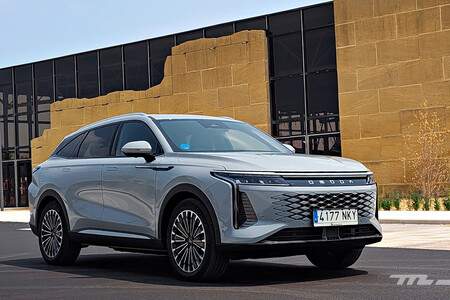
The Omoda 9 aims to be a premium car. There’s no doubt it could win sales from someone considering an Audi Q3 35 TFSI, for example, attracted by the 540 hp of the car, the look of a “luxury and cool” SUV, and the promise of low consumption.
However, in its price range, from 45,000 to 50,000 euros, its rivals are more mainstream or mainstream with premium aspirations, such as the Toyota RAV4, the Volkswagen Tiguan and T-Roc eTSI 4Motion, the Cupra Terramar, the Kia Sportage, or the Hyundai Tucson. And for those brands, Omoda can be a nightmare realized.
On the other hand, it isn’t going to steal sales from a BMW X3, for example, because “it offers more or the same as the Germans for less money,” as sometimes people say. The argument of price-to-equipment-to-performance is not decisive.
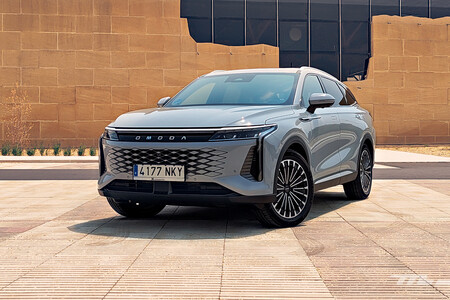
A Porsche or BMW X3 client buys more than a set of features, which work much better than in the Omoda, to be honest; they buy an intangible—a brand image—built on performance, comfort, and dynamic capability, not merely being somewhere in between.
And for now, Omoda doesn’t have that brand image. For now, it only offers an 8-year or 160,000 km warranty, or 7 years and 150,000 km, depending on the offer chosen by the buyer (as long as maintenance is done in its network).
Omoda 9 SHS: our assessment
7.5
7.5
8.0
7.5
7.0
7.0
7.5
7.5
6.0
7.5
9.0
Pros
- General consumption and range
- All-electric range
- Practicality
- Price and equipment
Cons
- Infotainment system and interface could be improved
- Clumsy dynamic behavior
- Driving aids too intrusive and tuning improvement possible
The Omoda 9 SHS is the brand’s first “premium” proposal for Europe and it is still a touch too Chinese in its setup (un-dynamic chassis, underwhelming infotainment and ADAS). Even so, it has found its audience by hitting several crucial elements, such as the price-to-equipment ratio, the range or consumption, and the look of a “high-end SUV.” The top-of-the-line Omoda is exactly the response to its quest.
|
|
|
|---|---|
|
Official price |
from 50,900 euros |
|
Engines |
Gasoline: 4‑cylinder turbo. 1.5 liters with 145 hp and 215 Nm. Three electric motors: 175 kW, 75 kW and 90 kW. |
|
Battery |
Lithium iron phosphate (LFP) of 34.4 kWh |
|
Maximum total power |
537 HP |
|
Maximum total torque |
650 Nm |
|
Transmission |
All-wheel drive. Automatic transmission with 3 gears |
|
Dimensions (L x W x H) |
4,775 x 1,920 x 1,671 mm |
|
Wheelbase |
2,800 mm |
|
Boot |
471 liters |
|
Weight |
2,270 kg |
|
80 to 120 km/h |
4.1 s |
|
0 to 100 km/h |
4.9 s |
|
Top speed |
180 km/h |
|
WLTP homologated average consumption |
1.7 l/100 km |
|
Tested consumption, battery charged |
3.5 l/100 km |
|
Tested consumption, battery at 0 |
7.8 l/100 km |
|
Maximum electric range (WLTP) |
145 km |
|
Electric range in testing |
88 km |
|
The car used for this test was loaned by Omoda. For more information see our corporate relationships guide. |