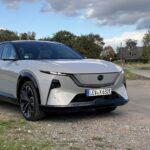
Smart has just unveiled more details concerning the future Smart #2. A compact city car that promises security never before seen in this segment. How can it offer such a promise to drivers? The manufacturer answers the questions!
Security concerns date back to 2009 for Smart
The Smart #2 sits in the sub-3-meter city-car segment. As a result, it’s hardly surprising to wonder about on-board safety. Yet Smart promises a level of protection unseen in its class. A question and a need to reassure that isn’t new for Smart. Indeed, with the Fortwo, there were numerous reservations about shielding occupants from much larger vehicles on the road.
An American organization, the IIHS, even conducted a frontal crash test between a Mercedes C-Class and a Fortwo at 64 km/h (about 40 mph). The result was unfavorable for the city car, with the survivable space collapsing and significant injury risks for occupants, notably the driver.
But over time, the maker improved the situation. By 2024, the model had earned 4 stars according to EuroNCAP. That’s why Smart intends to sustain this positive trajectory by stepping up another notch with the #2.
A pioneering system for a city car!
To achieve this feat, Smart relies on its Tridion Evo safety cell. The latter is built with more than 78% high-strength steel. Smart points to captivating figures, since the roof could support more than 4 tons. But that isn’t all. On board the #2, there are up to 7 airbags and front seatbelts designed to improve pelvic restraint. As for the battery, a new multiclayer structure has been installed. On paper, the promise is substantial. We’ll have to wait for independent results, including those from Euro NCAP, to see the real-world performance.
On other fronts, the Smart #2 will ride on the fully electric platform, ECA. This platform is intended to allow the drivetrain, the battery, and the occupants to fit within a compact footprint. Under the hood, there’s a 35.8 kWh battery and the use of CATL cells. That’s enough to target around 290 kilometers of range in the WLTP cycle. It’s important to note that this figure remains provisional since, at the time of writing, European homologation had not yet been completed. Smart also cites a 20-minute recharge time to move from 10% to 80%.
For more details, one will have to wait for the global unveiling in Paris at the Mondial de l’Auto, scheduled from October 12 to 18, 2026 at the Porte de Versailles.