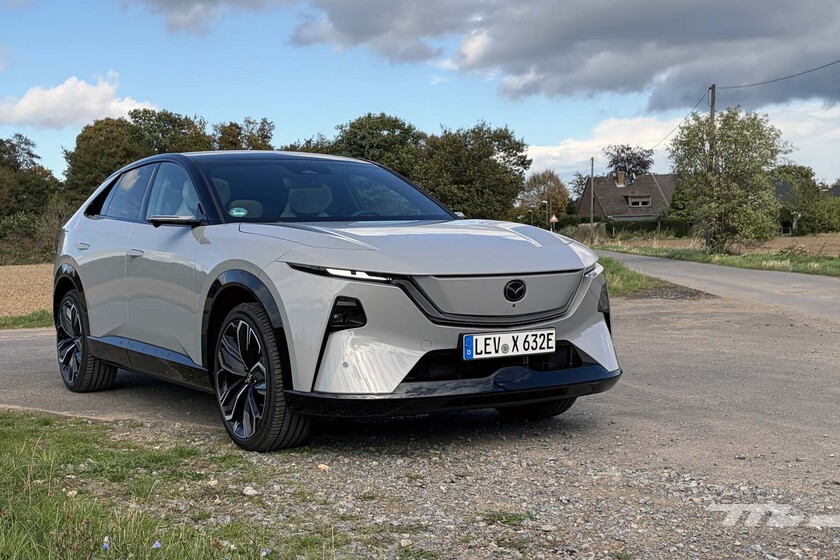
Mazda continues to bet on electric cars, this time with a mid-size SUV arriving with an unprecedented level of technology from the Japanese brand.
It is called Mazda CX-6e and is now available with a single electric motor of 258 hp, rear-wheel drive, and almost 500 km of range.
A Key Piece in Mazda’s Electrification Strategy
For some time now, Mazda has decided to bet on electric cars. It happened in 2020 and, as is typical of the Japanese brand, it did so in its own way and in an unusual manner, with the Mazda MX-30, an electric crossover featuring curious solutions, such as rear doors that open outwards (in the pure Mazda RX-8 style), and a high ride quality, but with very limited range, even for that era: barely 200 km.
The sales were not strong and in 2023 Mazda replaced that 100% electric version with a range-extended electric variant that could be bought until 2025, though its commercial results were also modest.

By then, Mazda was clear that it should continue betting on 100% electric mobility, but decided to do so with a strategy different from what it had with the MX-30, its first foray into the zero-emission universe. The people from Hiroshima chose to leverage Changan Mazda, the joint venture they have with the Chinese company Changan, with each company holding a 50% stake, to write the second chapter of their electric-age story.
This company launched the Mazda EZ-60 in China in 2025, an electric SUV that shares much of its technology with Changan’s Deepal S07. Well, what Mazda has done is bring that EZ-60 to Europe to have a more conventional electric vehicle than the MX-30, but adapting its setup to our market and changing its name to Mazda CX-6e.
The move isn’t new because the Mazda 6e sold here is essentially the EZ-6 that Changan Mazda sells in China; it’s Mazda’s way of having an interesting 100% electric lineup before developing its own EVs again without anyone’s help, which is something that should happen when Mazda focuses on the third phase of its electric plan.
Meanwhile, it is smart that a company like this leverages its synergies; it’s worth remembering that Mazda isn’t a giant manufacturer that can pour billions into electric cars overnight. To take such a big step, it must bet on solid ground.
That is why, as electric car adoption in Europe is taking off, it makes sense for Mazda to pursue this path, but it comes with a caveat, as we will see later. In any case, the Japanese firm believes this roadmap is the right one, and we already saw with the Mazda 6e that the strategy can be on the right track, as my colleague Jesús Martín told you after a thorough drive of this sedan.
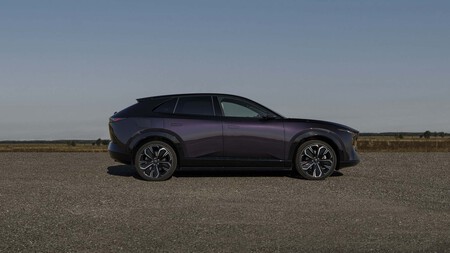
In a market where SUVs dominate, the 6e needed a true SUV sibling, and that is the Mazda CX-6e. At 4.85 meters in length, it is 7 cm shorter than the sedan, yet it remains in the D segment.
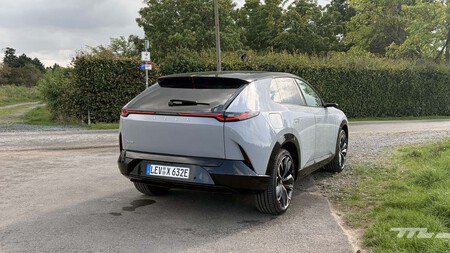
That said, its design does a good job of concealing its size and, at the same time, conceals its Chinese origins even more. Although it doesn’t share the same design language as the rest of the range and only shares this with the Mazda 6e, anyone who sees it for the first time will clearly recognize it as a Mazda.
Still, it uses unique touches, such as the front-end design that channels air through the leading edge of the hood, the air ducts from the C-pillar, or the digital mirrors (only available on the top-end Takumi Plus).
The move is to modernize Mazda’s distinctive style, though there are things no one asked for and no one needed, such as the aforementioned digital side mirrors. This technology has not convinced me in any car yet, and the CX-6e is no exception.
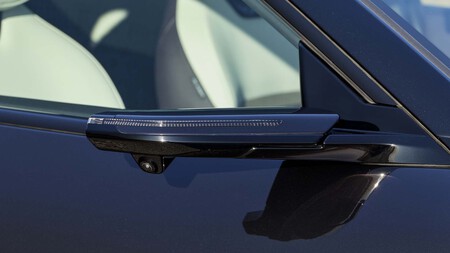
During my first contact drive, I tested a Takumi variant with traditional mirrors and a Takumi Plus with digital mirrors: the experience, at least for me, is much better with conventional mirrors, and even though the clarity of the digital mirrors projected on the interior screens is of very high quality, I can’t get used to their use and can’t trust the depth and distances, whereas with mirrors there is no error.
In my opinion, this technology is the best proof that not all changes are for the better. I also feel the same about the central digital rear-view mirror that this Mazda uses, although in this case it can be used as a normal mirror.
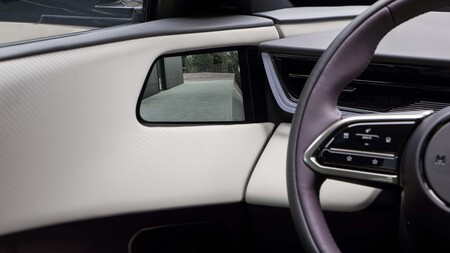
Además, se supone que mejoran la aerodinámica, pero el Takumi con espejos convencionales homologa 484 km y el Takumi Plus con retrovisores digitales se conforma con 468 km porque el primero utiliza llantas de 19” y el segundo unas de 21”. Al final, la supuesta ganancia en aerodinámica por los retrovisores se pierde por montar unas llantas enormes.
Mazda CX-6e: Inside Look
What is undeniable is that, tech-wise, it is the most complete Mazda. You only need to look at its interior, and you don’t even have to go to the Takumi Plus version with the digital mirrors and their respective screens.
And that the central touchscreen draws attention because it is 26”. Mazda has given this panel the spotlight, and it can virtually split into two so that the passenger has “their own screen”.
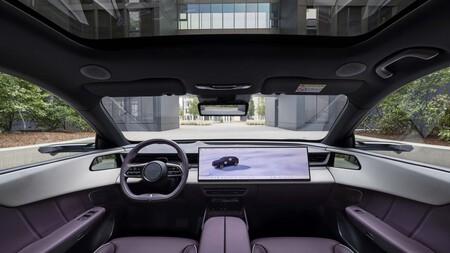
The good thing is that this giant screen has outstanding quality, both in image clarity and in how smoothly it enables multimedia usage, which is very fast. The bad thing is that almost everything has to be done through this screen, including adjusting the position of the mirrors (both digital and conventional).
Relying so heavily on a touchscreen isn’t ideal ergonomically or in terms of usability, even if the screen is excellent, as it is. At least there is a very complete Head-Up Display that serves as a perfect complement to the screen by projecting very useful information in front of the driver.
The point is that Mazda, with its habit of doing things its own way, has been the brand that has defended physical controls the most, and that is something many drivers have appreciated, but that philosophy is not present in the CX-6e (and not in the CX-5 either).
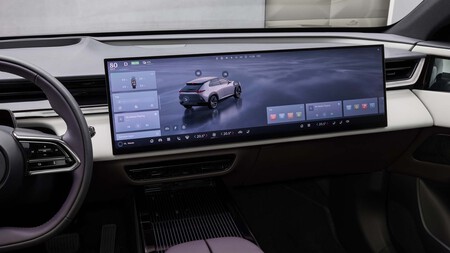
Somehow, betting almost everything on a single screen means losing part of its brand identity and, above all, losing personality compared to other manufacturers.
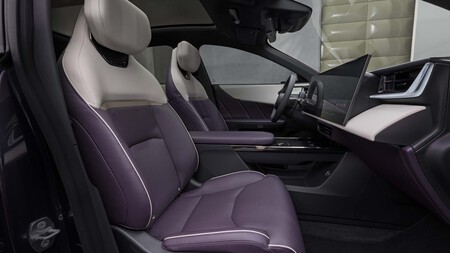
What remains in the CX-6e is Mazda’s hallmark attention to detail. The interior quality is very high, with premium materials and fit-and-finish that are flawless. All of that combines with a level of detail that isn’t even seen in many premium models in this segment, starting with the design of the front seats, continuing with the audio system featuring speakers in the front headrests, and finishing with the color combinations.
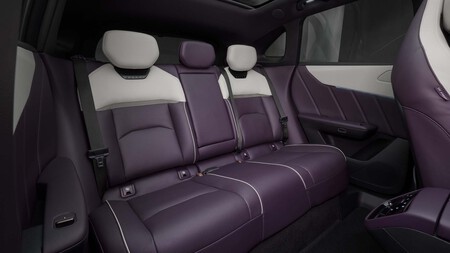
The habitability is another highlight: rear seats offer ample space, even for tall adults. As with most electric cars, the floor is quite high and requires knees to be flexed, but I don’t find it uncomfortable given the space on offer.
The boot isn’t overly spacious, but it doesn’t give the impression of the meager 363 liters Mazda quotes up to the loading tray. Up to the roof it is 468 liters, but neither figure seems right, as it looks larger.
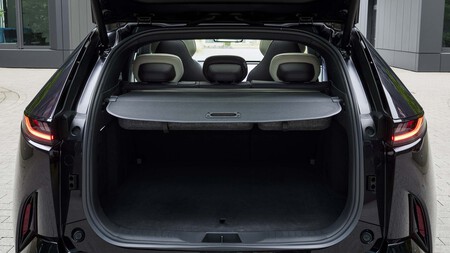
In any case, it sits below segment average, although the clean shapes and the wide loading mouth help maximize its use. Also, some of Mazda’s accessories, such as a handy box that sits under the tray with compartments to keep objects from rolling around in the boot.
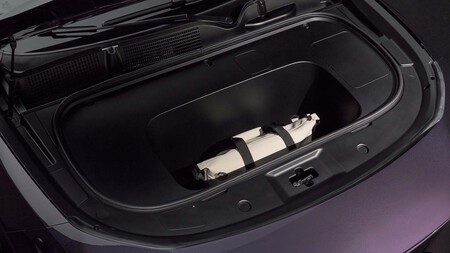
Under the hood there is another trunk that is not bad at all as it adds another 80 liters, more than enough to carry charging cables and a little more. There is also a very practical accessory for this space: a rigid basket that can be removed.
Mazda CX-6e: How It Drives
What isn’t visible is the motor. It develops 258 hp and 290 Nm of torque that go directly to the rear wheels. There are no all-wheel-drive versions. With that power, the Japanese SUV accelerates from 0 to 100 km/h in 7.9 seconds with the 19” wheels of the Takumi trim and in 8.1 seconds with the 21” wheels of the Takumi Plus (also optional on the Takumi).
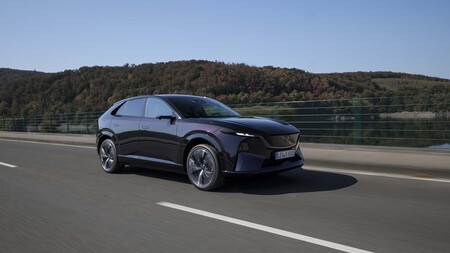
Powering the electric drive is a 78 kWh LFP battery. The official range is 484 km with 19” wheels and 468 km with 21” wheels.
Today, there are several models in this segment with larger batteries and more range, but they are also heavier. Mazda has opted for an intermediate solution to avoid pushing the car’s weight even higher, which stands at 2,130 kg curb weight without a driver.
Anyway, behind the wheel it doesn’t feel heavy, but beware, it also doesn’t give the impression of being as quick as some other EVs. The 258 hp allow it to move with adequate speed in any scenario, but the power delivery is very linear and doesn’t have the punch that some zero-emission cars exhibit. That’s good for comfort because it accelerates smoothly, without jerks, and very naturally.
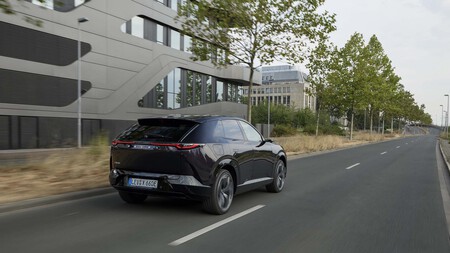
Overall, the mood is comfort. The suspension is firm but not harsh or uncomfortable, while the steering is pleasant and direct, though it could be more informative to give the feel of being “more Mazda.”
Just like the lack of physical buttons in the interior, dynamically it doesn’t have the distinctive personality of Mazda’s cars, although it is a comfortable, easy-to-drive, very proper car with a very European-tuned setup.
We need more kilometers to talk about real-world consumption and range because the test drive was brief, at low speed on roads that were very favorable for low consumption, with almost no incline and well suited for low energy use; in fact, the average consumption was around 16 kWh/100 km, a very good figure for a SUV of this size. With that average, achieving the homologated range seems plausible.
When it comes to charging, the maximum DC power is 200 kW, so it only takes 24 minutes to go from 10% to 80%. On AC, charging is up to 11 kW and it takes 8 hours to go from 0% to 100%.
Price of the Mazda CX-6e
And finally, price. The Takumi starts at €46,200 (MSRP) and the Takumi Plus starts from €49,200.
The former already includes a very well-equipped standard package that includes, among other things, a panoramic sunroof, electric tailgate, 360-degree camera, heat pump, heated steering wheel, heated and ventilated front seats, and seats made with Mazda’s so-called “synthetic leather.”
The Takumi Plus adds 21” wheels, digital mirrors, two-tone upholstery, ambient lighting in the dashboard, and heated and ventilated rear seats. Both are available with six-year or 150,000 km warranty.
Associated expenses for attending this presentation have been covered by the brand. For more information, consult our corporate relations guide.

Looking for your next electric car but overwhelmed by so many options? It’s normal.
More than 45,000 readers have already tried it. And you?
Advice offered by the brand