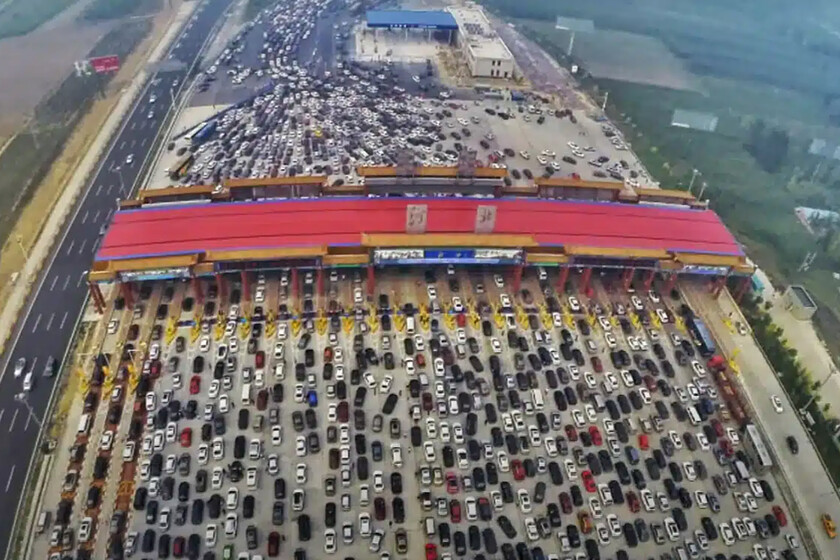
If you believed that the morning traffic jams on the M30 or the ring roads around Barcelona were a punishment, that pales in comparison to what the Chinese endured in a sweltering summer of 2010, with queues of 100 kilometers and up to 12 days trapped in their cars on the highway itself.
Those figures would unsettle even the most seasoned and patient driver.
12 Days in the Car Without Moving
The event regarded as the worst traffic jam in history occurred in China in 2010, and it was so extraordinary that it made headlines around the world. Being stuck in a traffic jam, one of those where you don’t move an inch, is among the most exasperating experiences imaginable.
You could take it with varying degrees of calm if it were the first day of your vacation, though you’d rather be on the beach, skiing, or in a village than on the highway. Yet there you are, boxed in between a refrigerated truck, a Dutch motorhome, and surrounded by cars with Swiss, German, and French plates. But at the end of the day there’s the promise of a vacation. Those who were stranded in Hebei, in China’s Inner Mongolia region, in August 2010 had no such incentive. They only wanted to get off the highway.
The story begins on August 14, 2010. Traffic was inching along on the G110 highway near Hebei, making slow progress at best. At times it seemed to be moving, and then suddenly there was no progress at all. For days on end.
The day was extraordinarily hot, which left drivers facing the unenviable choice of turning off the engine to save fuel or turning on the air conditioning. But what really worsened the traffic was the sheer volume of commercial trucks on the highway.
On top of that came an endless amount of construction that reduced the road’s capacity by about 50%. The result was a queue of between 97 and over 100 kilometers that took 12 days to unwind. In fact, many drivers recalled that they could barely move a kilometer per day.
UN VISTAZO A…
While the drivers endured hardship, the highway’s neighbors managed to see some upside to the jam; some spotted a business opportunity. Drivers ended up paying exorbitant prices for items like instant noodles and cigarettes. A bottle of water that would normally cost 1 yuan (about 15 cents) was being sold for 10 yuan (about $1.50).
What caused such chaos? It wasn’t a serious accident, nor a collapsed bridge or a landslide that cut the highway. No, what triggered it was simply the enormous number of cars and trucks entering the highway.
The trigger was roadworks on the G110 that cut the road’s capacity in half, just as a massive flow of freight trucks bound for Beijing passed through. It is estimated that traffic volume was about 60% higher than the highway’s designed capacity, and with works halving the number of lanes, a collapse was only a matter of time. But the real problem was that traffic on this highway had been growing at roughly 40% annually for years.
In the end, authorities asked transport companies to pause for a while or reroute, while at the same time allowing more trucks into Beijing at night (something that had been prohibited up to then).
Until that 2010 jam in China, the worst traffic jams in history were a European affair. In fact, the Guinness World Record for the worst jam occurred on April 12, 1990: 18 million cars advancing in a convoy along the border between the two Germanies. The Berlin Wall had fallen on November 9, 1989, and thousands of Germans hit the road to cross a border that had been closed for decades.
Before these two extreme cases, the worst jam in history had been the result of a France-bound winter getaway, either for skiing or for chasing the Mediterranean sun. The A6 motorway, linking Paris and Lyon, which at the time was the mandatory route for travel between northern and southern Europe, saw on February 16, 1980 a queue of cars stretching 175 km.
Images | CCCTV